Independent comparisons. We may earn from shop links. More info

Hand siren noise nuisance

Updated: 20.10.2026

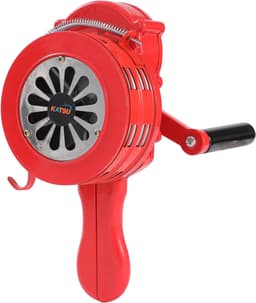
You are about to turn a hand siren in a garden or a small room, and the listing prints 110 dB or 120 dB as a selling point. Hand siren noise nuisance asks whether you, and the people next door, can live with a short burst. There is no automatic ban at a printed decibel, and no free pass because the tool has no battery. Your ear is the closest. A complaint is a statutory-nuisance question, not a fine on the box. Prices are on the [hand siren comparison](/hub/burglar-protection/hand-siren). Updated 19 October 2026. A qualifying purchase can earn us a commission at no extra cost to you.

You are about to turn a hand siren in a garden or a small room, and the listing prints 110 dB or 120 dB as a selling point.

Our top picks

On this page

What 110 dB means beside your ear

The Royal Free London NHS leaflet treats sound at or above 85 dB(A) as harmful, especially if it continues. You may have to raise your voice, feel pain, or hear ringing. A claim of 110 dB or 120 dB sits above that line. Where a distance is printed it is often 1 m, and you are closer than that. E2S reads a 1 m claim as about 6 dB less each time distance doubles. That is an open-air rule of thumb, not a test of these sirens. Stepping back helps a neighbour more than it helps you. Do not sound one against an ear or in a small room. How to crank is on the how to use a hand crank siren page.

Neighbours and statutory nuisance

In England a council asks whether the noise unreasonably and substantially interferes with a home, or injures health. Gardens count as premises. There is no decibel cap that makes you clear, and no line at 110 dB that makes a siren illegal by itself. If the council is satisfied the nuisance exists or is likely to recur, Shelter’s note on England says it must serve an abatement notice. GOV.UK describes warning notices from 11pm to 7am. Do not assume Scotland or Northern Ireland use the same steps. A street scare belongs on the hand siren vs personal alarm page. A garden rehearsal is what neighbours report.

This is not a house alarm with a 20-minute cut-off

GOV.UK’s intruder-alarm section is a different machine: keyholders, and a power to enter if an alarm runs 20 minutes continuously or an hour intermittently. Westmorland and Furness Council ties that idea to a property alarm and BS 4737. A hand crank has no timer and no BS 4737 label. Do not claim 20 minutes because an alarm leaflet said so. The nuisance test still applies in far less time: a terrace at 11.30pm, or a child cranking one each evening. Missing a cut-off is not permission for a long blast.

If this is work

At work the figures belong to the employer. The Control of Noise at Work Regulations 2005 set action values at 80 dB(A) and 85 dB(A), and a limit of 87 dB(A), with peaks at 135 dB(C), 137 dB(C) and 140 dB(C). A claimed 110 dB or 120 dB is already above the 85 dB(A) upper action value on the listing, before anyone measures the ear. A waist pack does not cover ears. Ask the employer for the assessment and for hearing protection. In your own garden, those work rules are not what binds you. The neighbour test is.

When to stop and who to call

Stop when your ears object. Pain, ringing, or a muffled feeling are the signs the Royal Free leaflet names. If you were indoors, stop, and next time go outside for a few seconds only. An abatement notice, as Shelter describes it for England, says what must stop or be limited, and ignoring it can be an offence. A short outdoor signal, stopped at the first ring, is the use that fits the claim. If you wanted indoor noise or a toy, do not buy it.

Common questions

Is 110 dB loud enough to damage hearing?
Treat 110 dB or 120 dB as above the Royal Free line of 85 dB(A). The person turning is closer than the 1 m some listings print. The figure is the seller’s claim, not a lab result. Do not hold the horn to an ear.
Can a neighbour report a garden practice?
Yes. In England, GOV.UK treats a garden as premises, and a council looks into a resident’s report. The test is whether the noise unreasonably and substantially interferes with a home, or injures health. One brief signal and a repeated evening practice are not the same case. No decibel on the listing makes a complaint invalid.
Is there a legal decibel limit for a hand siren?
There is no rule that a siren becomes illegal above 110 dB. England uses the statutory-nuisance test, not a number on the box. GOV.UK’s night warning notices run from 11pm to 7am for England. Scotland and Northern Ireland are not the same notice.
What is an abatement notice?
It is the notice an English council must serve when satisfied a statutory nuisance exists or is likely to recur. Shelter’s note on England says failing to comply can be an offence. The notice says what must stop or change. It is not a fine tied to a decibel. If one arrives, follow it, and do not answer with a 20-minute rule from an installed alarm.
Does the 20-minute alarm rule apply to a hand siren?
No. Twenty continuous minutes, or an hour intermittent, on GOV.UK’s alarm pages concern installed intruder alarms and keyholders. A hand crank has no cut-off. A short blast can still be a nuisance, and a long one is not allowed because a leaflet mentions 20 minutes.
What changes if this is used at work?
Employer duties sit at 80 dB(A) and 85 dB(A), with a limit of 87 dB(A). A 110 dB claim already sits above the upper action value as a listing figure. Ask for the assessment and for hearing protection. Another crank does not remove the duty.

Related pages

Sources

Public UK sources used for hearing, noise, and police attendance. Listing prices, stars, and review counts are the amazon.co.uk figures printed on the five listings, not a live check on 19 October 2026.

  1. Environmental Protection Act 1990, Part III — statutory nuisances (retrieved 19.10.2026)
  2. GOV.UK — noise nuisances: how councils deal with complaints (retrieved 19.10.2026)
  3. Control of Noise at Work Regulations 2005, regulation 4 (retrieved 19.10.2026)
  4. HSE — noise at work: what employers must do (retrieved 19.10.2026)
  5. Royal Free London NHS — protecting your hearing health (retrieved 19.10.2026)
  6. D G Controls — how hand cranked sirens work (retrieved 19.10.2026)
  7. Police.uk — keep burglars out of your property (retrieved 19.10.2026)
  8. ProtectUK — alarms and CCTV (retrieved 19.10.2026)
  9. ProtectUK — personal security (retrieved 19.10.2026)