Independent comparisons. We may earn from shop links. More info

Hand siren buying guide

Updated: 20.10.2026

You are looking at a portable crank siren on amazon.co.uk and the page offers three numbers at once: a decibel, a long range, and an attribute table that sometimes disagrees with the bullets. A hand siren buying guide has to decide which of those numbers you can use. The five kept listings sit at about £28 to £36. Prices stay on the [hand siren comparison](/hub/burglar-protection/hand-siren). This page is the order of the decision: distance on the decibel, a handle you can turn, and a star line with more than a single rating.

You are looking at a portable crank siren on amazon.co.uk and the page offers three numbers at once: a decibel, a long range, and an attribute table that sometimes disagrees with the bullets.

Our top picks

On this page

What you are actually buying

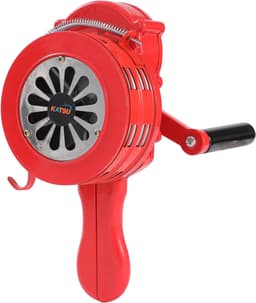
A hand siren in this set is a painted metal unit of about 1.0–1.6 kg with a rotor you drive by hand. D G Controls, a UK maker of sounders, describes that layout: one hand supports the body, the other turns the crank, and there is no supply. It is not a megaphone, not a pressed air horn, and not a 220 V wall siren, even when an attribute line prints a voltage. Stand-mounted sirens are a different layout and are not these ASINs. If the pictures show a cone or a canister of gas, you are in the wrong category.

Read the decibel only with a distance

KATSU 990630 and MYFULLY MY-0289 state about 110 ± 2 dB(A) at 1 m. That is the line you can compare. Estink states 120 dB with no distance. SUDEG and SENRISE state 110 dB with no distance. The higher price does not buy a proven extra 10 dB. A range of 400 m, 500 m, or 1,000 m is a different sentence. E2S uses a rule of thumb of about 6 dB less each time distance doubles. That is not a measurement of these cranks. SUDEG prints 220 V beside bullets that say there is no supply. SENRISE’s range attribute is 1,000 mm. If the listing must agree with itself, leave those two.

Handle, case, and weight

Printed weights run from SUDEG at 1.03 kg to KATSU at 1.6 kg. Reviewers say a proper wail means cranking hard, and that you tire within a few turns. A child is a poor fit. An adult who cannot grip and turn at the same time should not plan this as the signal under stress. A folding handle is not automatically a plus. Written reviews of the MYFULLY, from outside the UK, often describe a crank that shuts or gears that strip. A UK review of the KATSU, which does not advertise a fold, still calls the handle brittle. Aluminium alloy is a housing claim, not the internal gear. The waist pack carries the siren. It is not hearing protection. Who should skip each listing is on the best hand crank siren page.

What the star line cannot tell you

Estink is 5.0 from one rating and has no review text. SENRISE has no star line. One rating is not a verdict. A 5.0 does not make the 120 dB line true, and an 88 on the MYFULLY does not make overseas notes a UK survey. The KATSU’s 3.9 lines up with a UK complaint about the handle. Stars here measure whether a buyer was pleased with a short blast, not whether a meter read 110 dB(A). There is no Which? report on these five.

When this is the wrong product

Buy this only if someone can stand there and turn it: a drill, a yard, a power cut, a stage cue. Do not buy it for an empty house. Police.uk ties a typical response to a monitored alarm and a Unique Reference Number. ProtectUK says police will not attend an audible-only building alarm on sound alone. A crank has no monitoring path. Do not buy it as a street alarm either. That job needs one hand while you move. The split is on the hand siren versus personal alarm page. A claimed 110 dB or 120 dB sits above the Royal Free line of 85 dB(A), and the person turning is the closest.

Common questions

Does a hand siren need batteries or a 220 V socket?
The kept listings are crank sirens. KATSU, MYFULLY, Estink, and SENRISE say there is no battery or no power support. SUDEG’s bullets say the same, then an attribute prints 220 V. Treat that as a clash, not a mains spec. Do not plug any of these in on the strength of one attribute.
Is 110 dB the same as being heard for 500 metres?
No. A decibel at 1 m is a level next to the siren. A range of 400 m, 500 m, or 1,000 m is a separate claim, with no test method on these listings. E2S’s rule of thumb, about 6 dB less each time distance doubles, is not a test of these cranks. Do not convert the 1 m line into a radius.
Why does one listing say both no power and 220 V?
That is the SUDEG row. The bullets say there is no power supply. An attribute says 220 V, and another says a range of 1,000 cm. The Consumer Rights Act 2015 says goods must match their description, which is a reason to distrust a page that describes two machines. It is not a reason to assume the crank secretly needs mains. Prefer a listing whose bullets and attributes describe the same object.
Is a folding handle a plus?
Only if it stays open while you crank. MYFULLY and SENRISE advertise a fold. Reviews of the MYFULLY, from outside the UK, describe the handle folding shut and gears stripping. A fixed crank avoids that hinge and can still be a poor handle, as the UK KATSU review shows.
Is the £36 listing better because it says 120 dB?
Not on the evidence in the file. The Estink’s 120 dB has no distance, and 5.0 from one rating has no written review. The cheaper KATSU and MYFULLY both state about 110 dB(A) at 1 m and have more than one rating, with complaints attached. A single five-star click cannot outrank that.

Related pages

Sources

Public UK sources used for hearing, noise, and police attendance. Listing prices, stars, and review counts are the amazon.co.uk figures printed on the five listings, not a live check on 19 October 2026.

  1. Environmental Protection Act 1990, Part III — statutory nuisances (retrieved 19.10.2026)
  2. GOV.UK — noise nuisances: how councils deal with complaints (retrieved 19.10.2026)
  3. Control of Noise at Work Regulations 2005, regulation 4 (retrieved 19.10.2026)
  4. HSE — noise at work: what employers must do (retrieved 19.10.2026)
  5. Royal Free London NHS — protecting your hearing health (retrieved 19.10.2026)
  6. D G Controls — how hand cranked sirens work (retrieved 19.10.2026)
  7. Police.uk — keep burglars out of your property (retrieved 19.10.2026)
  8. ProtectUK — alarms and CCTV (retrieved 19.10.2026)
  9. ProtectUK — personal security (retrieved 19.10.2026)