Independent comparisons. We may earn from shop links. More info

What size bench vice

Updated: October 2026

A 50 mm jaw, a 4 inch jaw, and a 6 inch jaw are different tools, and the next number on the page is often a different measurement. What size bench vice you need depends on the piece you hold, not on the largest title in the search. This page keeps jaw width, opening, throat, and bench thickness apart, then maps the figures this amazon.co.uk set actually states. Prices are on the [bench vice comparison](/hub/workshop/vice). Products Compared used these files on 16 October 2026, with no lab measurement. A qualifying purchase can earn a commission at no extra cost to you.

A 50 mm jaw, a 4 inch jaw, and a 6 inch jaw are different tools, and the next number on the page is often a different measurement.

Our top picks

Stanley Stanley 1-83-069

Best overall

Stanley Stanley 1-83-069
9.2/10about £22.31
Stanley Stanley 1-83-065

Alternative

Stanley Stanley 1-83-065
8.6/10about £29.95
TEENO TEENO 70 mm

Best value

TEENO TEENO 70 mm
8.0/10about £18.99
On this page

Four measurements, not one

Jaw width is the length of the gripping face, the number people mean by a 4 inch vice. Opening is how far the faces move apart. Throat is how deep a piece can sit before it hits the body. Bench-clamp capacity is how thick a top a clamp-on will bite. Mixing two of those is how a 68 mm bullet becomes the size. Wonkee Donkee's UK notes put an engineer's jaw at about 75–200 mm, opening at about 60–300 mm, and throat at about 50–200 mm. Woodworking vices are often from about 150 mm, and a portable wood vice often clamps a bench only to about 55 mm. That 55 mm is a bench thickness, not a jaw. Excel's own table, not these listings, gives a 6 inch jaw a 150 mm opening and a 76 mm throat. Use that only as a scale. Do not paste it onto a BestEquip or a DAYUAN. A 40 mm tube needs an opening above 40 mm.

What 50 mm to 100 mm means in this set

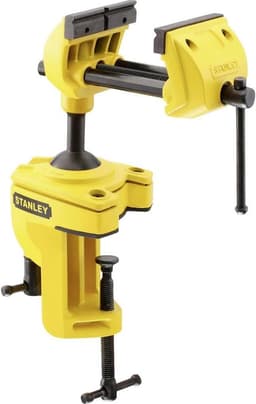
The DASBET states a 50 mm jaw and a 65 mm opening, at 1.47 kg and £14.59. The same bullet also prints 68 mm. Keep them apart: 50 mm is the width, 65 mm is the opening, and 68 mm is not a clear bench thickness. TEENO and Zazafolora both state 70 mm jaws, with openings of 77.5 mm and 0–77.5 mm. WinHub's bullets say 80 mm and a 74 mm opening, and one UK review says 70 mm. LDHHYH states 80 mm and a 62 mm bench limit that is not the jaw gap. The Stanley 1-83-069 puts 75 mm in the item name. Stanley UK's 71 mm opening is a conflict, not a replacement for that Amazon file. The Stanley 1-83-065 states 100 mm and no opening. The DAYUAN states 4 inches and no opening. The listing never prints a millimetre conversion, so do not label the DAYUAN as 100 mm. You will not know whether a 90 mm block fits until the vice arrives.
Stanley Stanley 1-83-069

Testsieger

Stanley Stanley 1-83-069
9.2/10about £22.31

Woodworking widths are mostly not in this basket

A bench-front woodworking vice is often 150–265 mm, with liners so the faces do not bruise timber. This set does not contain that vice. The widest ordinary jaws here are the Stanley at 100 mm, the DAYUAN at 4 inches, and a BestEquip title at 6 inches. A 70 mm TEENO will hold an offcut. It will not clamp a chair rail the way a woodworking vice does. Home metalwork often lives at 75–100 mm for fittings and short bar. The 50 mm DASBET sits below that start. Soft faces do not change the width.

A 6 inch title still needs an opening

The BestEquip is the 6 inch title: ductile iron, 19.1 kg, £89.90, grooved jaws claimed, and no stated opening or throat. The file has no United Kingdom review text. Excel's own 6 inch vice, a different product, prints a 150 mm opening, a 76 mm throat, and 14.5 kg. Grooved jaws help with pipe only if the opening accepts the pipe. Six inch is not automatically stronger than the Stanley 100 mm, which is 5.04 kg, bolt-down, called light-duty in UK reviews, and also missing an opening. For a short bar under 70 mm, a stated 77.5 mm opening is clearer than a blank 6 inch title. For wide timber, this set is the wrong size band.

Common questions

What does jaw width measure?
It is the length of the gripping face, not how far the jaws open and not how thick a bench the clamp accepts. The TEENO's 70 mm jaw is 70 mm of face. The opening on that file is 77.5 mm. A 4 inch vice means a face of about 4 inches. The DAYUAN listing says 4 inches and does not convert that to millimetres.
Is a 4 inch vice enough at home?
Often, for fittings, bike parts, and short bar. UK size notes start engineer's vices around 75–100 mm. The Stanley 1-83-065 is the 100 mm bolt-down, at 5.04 kg. The DAYUAN is the 4 inch, at 4.7 kg. Both omit the opening, so you still have to check your largest piece on arrival. Neither is a wide woodworking vice.
What is throat depth, and do these listings state it?
Throat is how far a workpiece sits down into the jaws before the body stops it. Wonkee Donkee's engineer's range is about 50–200 mm. Stanley UK quotes 39 mm jaw depth for the 1-83-069, and that figure is not in the amazon.co.uk file. None of the other ASINs here states a throat. Do not borrow Excel's 57 mm or 76 mm for them.
Why is bench thickness not the jaw opening?
One number is the top you clamp to. The other is the gap between the faces. LDHHYH and WinHub state a bench up to 62 mm. That is the edge, not the jaw. The DASBET's 65 mm opening, 50 mm width, and 68 mm clamping range are three claims. Using the largest as the size picks the wrong vice.
Is 6 inch always the stronger buy?
No. The BestEquip is 6 inch and 19.1 kg, with no stated opening or throat, no UK review text in this file, and a mounting line that conflicts. Excel's 6 inch vice states a 150 mm opening and weighs 14.5 kg, and it is a different product. A smaller vice with a stated opening can be the clearer buy when the piece is under 75 mm.

Related pages

Sources

Public UK sources for mounting, sizing, and consumer-rights context. Listings checked 16 October 2026. Prices on amazon.co.uk move.

  1. HSE, PUWER overview (retrieved 16 October 2026)
  2. HSE, HSG129 health and safety in engineering workshops (retrieved 16 October 2026)
  3. Consumer Rights Act 2015, section 22 (retrieved 16 October 2026)
  4. Wonkee Donkee, engineer's vice sizes (retrieved 16 October 2026)
  5. Wonkee Donkee, woodwork vice sizes (retrieved 16 October 2026)
  6. Toolstation, vices (retrieved 16 October 2026)
  7. Faithfull, mounting a bench vice (retrieved 16 October 2026)
  8. ITS, bench vice (retrieved 16 October 2026)