Independent comparisons. We may earn from shop links. More info

How to mount a bench vice

Updated: October 2026

The vice rocks, or the bench edge lifts, the first time you lean on a file. The top is carrying the load in the wrong place, or the clamp is biting a thickness the listing never states. This is how to mount a bench vice so the bench takes the force. Prices stay on the [bench vice comparison](/hub/workshop/vice). Products Compared used listing notes and UK fitting guidance on 16 October 2026, with no lab trial. A qualifying purchase can earn a commission at no extra cost to you.

The vice rocks, or the bench edge lifts, the first time you lean on a file. The top is carrying the load in the wrong place, or the clamp is biting a thickness the listing never states.

Our top picks

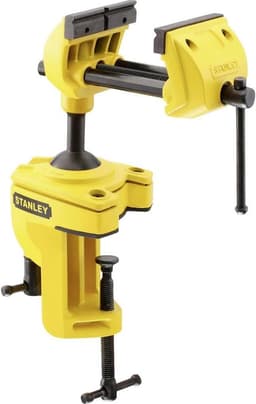
Stanley Stanley 1-83-069

Best overall

Stanley Stanley 1-83-069
9.2/10about £22.31
Stanley Stanley 1-83-065

Alternative

Stanley Stanley 1-83-065
8.6/10about £29.95
TEENO TEENO 70 mm

Best value

TEENO TEENO 70 mm
8.0/10about £18.99
On this page

Where the vice sits

Put the vice at the front corner, over a leg, when the bench has one. Right-handers often use the left of the front edge or the end, so the leg is under the load and long work hangs off the front. Set the fixed jaw just past the front edge so a long piece drops clear. Leave a full swing for the handle. A tube on that handle is how these screws get broken. A hollow door or a thin sheet will flex. Tooled-Up's rule of thumb, for the vices they sell, is solid timber at least about 40 mm, or a steel-framed bench. That 40 mm is their note, not a figure on these ASINs. A 20 mm kitchen top is the wrong place for coach screws. If you cannot see a leg or solid timber, stop before you drill.

If you are clamping to the edge

Use a clamp-on only for a thickness the listing states, and only while the clamp does not creep. BUYSK states 36 mm, and one UK review says sharp points marked the bench on both sides. LDHHYH and WinHub both state up to 62 mm. A WinHub review says that vice crumbled, which is a reason to stop, not to tighten harder. TEENO, Zazafolora, DASBET, and the Stanley 1-83-069 do not state a bench thickness in these amazon.co.uk files. The DASBET bullet's 68 mm sits beside a 65 mm opening and a 50 mm jaw, so do not treat 68 mm as a proven bench limit. RS aims the Stanley multi-angle clamp at about 60 mm. That is the RS note, not the Amazon specification. If your top is thicker than 62 mm, do not assume a silent listing will bite it. If the base walks under a hand push, the edge is too thin, too round, or too slippery.
Stanley Stanley 1-83-069

Testsieger

Stanley Stanley 1-83-069
9.2/10about £22.31

If you are bolting through

Bolt through a solid top when the vice will stay, and use every hole. A Pony Jorgensen manual, used here as a maker's limit rather than a UK price, says to use every hole, not to weld the vice, not to extend the handle, and to tighten swivel locks by hand. Faithfull allows coach screws from about 50 mm of solid timber, and through-bolts below that. Do not copy coach screws onto a 20 mm kitchen top. Put a washer under the nut, and a backing plate if the underside would crush. There is no single bolt size in this set. The Stanley 1-83-065 box lists the vice only. One UK reviewer used M5 bolts. The DAYUAN has lugs and no printed diameter. Drill only when the top is clear of cables and pipes. The fixed jaw should still overhang the front edge.

When to stop

Stop if the casting is cracked or arrived split. UK reviews include a Zazafolora that cracked after one use, a DASBET that cracked in half, and a WinHub that crumbled. More torque opens the crack. The Consumer Rights Act 2015 gives 30 days to reject goods that are not of satisfactory quality. Stop on a hollow door or a sheet you can flex by hand. Stop if the handle only swings with a tube on it. At home, stop if you need repeated hammering. A clamp-on under 2 kg does not become a blacksmith's vice because you used every hole. If the job is milling, HSE guidance expects a machine vice on the machine table. These bench vices are not that tool.

Common questions

Where should a vice sit on the bench?
At the front corner, over a leg when there is one. Right-handers often use the left of the front edge or the end. The fixed jaw should sit just past the edge so long work hangs clear, and the handle needs a full swing. A vice in the middle of the top makes every long piece hit the bench.
Bolts or coach screws?
Through-bolts with a washer under the nut are the safer default on a thin top. Faithfull's note allows coach screws from about 50 mm of solid timber. A 20 mm kitchen top is not that top. Use every hole. The Stanley 100 mm box lists no bolts, and one UK owner used M5s that matched the holes on that vice.
How thick a bench will these clamp-ons take?
Only where the file says so. BUYSK states 36 mm. LDHHYH and WinHub state up to 62 mm. TEENO, Zazafolora, DASBET, and the Stanley multi-angle do not state a bench thickness here. RS aims the Stanley clamp at about 60 mm on its own page, which is not the Amazon specification. A thicker top needs a different fixing.
Does the Stanley 100 mm include bolts?
No. The included list names the vice only. One UK reviewer bought M5 bolts. Match the holes you can see, with a washer under each nut. The DAYUAN file does not print a bolt diameter either, so do not copy the M5 across without looking at the lugs.
What must I not do with the handle?
Do not slide a tube over it. Maker notes forbid an extended handle because the screw or the casting fails next. Tighten a swivel lock by hand. If the work still moves, the vice is too small, the bench is flexing, or the casting is already damaged. A longer lever does not repair any of those.

Related pages

Sources

Public UK sources for mounting, sizing, and consumer-rights context. Listings checked 16 October 2026. Prices on amazon.co.uk move.

  1. HSE, PUWER overview (retrieved 16 October 2026)
  2. HSE, HSG129 health and safety in engineering workshops (retrieved 16 October 2026)
  3. Consumer Rights Act 2015, section 22 (retrieved 16 October 2026)
  4. Wonkee Donkee, engineer's vice sizes (retrieved 16 October 2026)
  5. Wonkee Donkee, woodwork vice sizes (retrieved 16 October 2026)
  6. Toolstation, vices (retrieved 16 October 2026)
  7. Faithfull, mounting a bench vice (retrieved 16 October 2026)
  8. ITS, bench vice (retrieved 16 October 2026)