Independent comparisons. We may earn from shop links. More info

Mains or rechargeable work light

Updated: 2026-10-21

The shed has no socket, and the brightest amazon.co.uk titles are all plugs. A mains or rechargeable work light here is a blunt split. Ten listings are corded floods claiming 11,000 to 30,000 lumens. Two are battery poles claiming about 3,000 lumens. None does both. If a sound 230 V socket is in the room, buy a mains flood and then check the plug. If it is not, buy the Saker or the SYLSTAR. The [LED work light with tripod comparison](/hub/workshop/led-work-light-with-tripod) holds every price. Products Compared used those listings and an HSE note on construction supplies on 19 October 2026, not in a lab. A qualifying purchase can earn a commission at no extra cost to you.

The shed has no socket, and the brightest amazon.co.uk titles are all plugs. A mains or rechargeable work light here is a blunt split. Ten listings are corded floods claiming 11,000 to 30,000 lumens.

Our top picks

On this page

When the socket is there

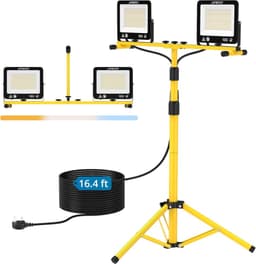
A mains flood wins on claimed output, which is why people tolerate the lead. The corded rows run from £47.49 to £79.99, with titles from 11,000 up to 30,000 lumens. Those figures are seller claims. They still sit far above the 3,000 lumen poles. The Yofuly 308605-EU at £79.99, 4.5 from 96, is the top pick among those floods: heads reviewers say come off the stand, a 5 m cable claimed, and no electrical failure in the ten UK reviews read. The AUTOUTLET at £60.99 adds 3000 K, 5000 K, and 6500 K, and its title and a bullet disagree on two heads or three. None of the mains files prints BS 1363. The BDDFOTO bullet says US standard plug. The unreviewed Yofuly prints 12 V AC against mains bullets. A socket in the room does not rescue the wrong plug sentence. Aiming that light at a car is the garage page.

When it is not

Without a socket, the choice is the Saker LD10 or the SYLSTAR. Both are rechargeable poles. Neither claims the five-figure lumen lines. The Saker is £54.98, with 4.5 from 87. It claims 3,200 lumens, a magnetic base, and a hook. The bullet says up to 20 hours on low and 12,000 mAh, and a specification line also says two batteries. Do not turn that milliamp figure into a second runtime. The SYLSTAR is £79.99, with 4.4 from 215. It claims 3,000 lumens and a 104 in stand. The title says 6,000 mAh and a specification line says one C battery. The listing does not print hours. One UK review says about 3 hours on full brightness. You pay more than the Saker for the taller stand, not for a brighter room.

Hybrids you will see elsewhere

Search results show hybrids that plug in and run on a battery. A NightSearcher around £70, a Draper around £82 with printed hours, and a Lighthouse Beacon listing are examples. None is in these twelve files, so none is a pick here. This set is a cord or a battery, not both. You cannot run the Yofuly from a USB pack at 21,000 lumens. You cannot plug the SYLSTAR in for a mains flood mode, because the file does not describe one. The Saker’s USB port, in the reviews, charges a phone. It does not turn the pole into a 200 W site light.

A site is a third answer

A domestic garage and a construction site are not the same socket. HSE’s construction guidance points to a reduced low-voltage system, commonly 110 V centre-tapped to earth, for temporary supplies. That is good practice on a site that asked for it. It does not make every 230 V lamp in a house illegal. Nothing here is a 110 V yellow site light. A rechargeable pole does not solve a site that asked for 110 V. It avoids the socket. It does not meet a temporary-supply specification. At home, refuse a buzzing plug and return a listing whose voltage lines fight.

Common questions

Which lights run without a socket?
Only the Saker LD10 and the SYLSTAR. The Saker is £54.98, 4.5 from 87, about 3,200 lumens claimed, with a magnet and a hook. The SYLSTAR is £79.99, 4.4 from 215, about 3,000 lumens claimed, with a remote and a 104 in stand. The other ten listings are mains floods. A USB socket on a page is not a second mains-free flood in this set.
How bright are they compared with the mains floods?
The battery poles claim about 3,000 to 3,200 lumens. The mains titles claim about 11,000 to 30,000. Both sets of numbers are claims, not a lab test. The gap is still large enough that a pole will not flood a garage the way a three-head mains light is sold to do. You trade that reach for the lack of a lead.
What runtime is actually printed?
The Saker bullet says up to 20 hours on low and a five-hour charge, beside 12,000 mAh and a two-battery line. The SYLSTAR listing prints no hours. One UK review says about 3 hours on full brightness and a long recharge. Others call the battery excellent or only adequate. Do not merge those into one official runtime. A Draper hybrid’s printed hours belong to a different product.
Is a hybrid in this set?
No. NightSearcher, Draper, and Lighthouse lights that run on mains and on a battery appear in search results and are not among the twelve listings. Here you get a corded flood or a battery pole. The Saker can charge a phone from USB in UK reviews. That does not make it a hybrid with a mains flood mode.
When is mains the better buy even though the lead is a nuisance?
When the socket is sound and you want the larger claimed beam for a garage or a job that outlasts a battery review. Open the Yofuly at £79.99 or the AUTOUTLET at £60.99, then check the plug. A lead along the wall is a smaller problem than a 3,000 lumen limit you cannot escape. If the plug sentence says US standard, mains is still the right type and that listing is the wrong one.

Related pages

Sources

Public UK sources and the amazon.co.uk listings compared on this page. Updated October 2026.

  1. Workplace (Health, Safety and Welfare) Regulations 1992, regulation 8 (retrieved October 2026)
  2. HSE L24: Workplace health, safety and welfare (retrieved October 2026)
  3. HSE: Lighting (retrieved October 2026)
  4. HSE HSG38: Lighting at work (retrieved October 2026)
  5. Electricity at Work Regulations 1989 (retrieved October 2026)
  6. HSE: Electrical systems (retrieved October 2026)
  7. HSE HSG107: Maintaining portable electrical equipment (retrieved October 2026)
  8. Plugs and Sockets etc. (Safety) Regulations 1994 (retrieved October 2026)