Independent comparisons. We may earn from shop links. More info

How to set up a tripod work light

Updated: 2026-10-21

The stand is open in a UK garage, one leg is still folded, and the beam hits you in the eyes. This is how to set up a tripod work light so the feet are planted, the column holds, and the heads sit below your eye line. If a knob spins or the plug buzzes, you stop. Which listing to buy stays on the [LED work light with tripod comparison](/hub/workshop/led-work-light-with-tripod). Products Compared followed HSE user checks for leads and plugs on 19 October 2026. A qualifying purchase can earn a commission at no extra cost to you.

The stand is open in a UK garage, one leg is still folded, and the beam hits you in the eyes. This is how to set up a tripod work light so the feet are planted, the column holds, and the heads sit below your eye line.

Our top picks

On this page

Feet and locks before the heads go on

Open the legs to their full stance before you raise the column. A tripod that is still half-folded walks when you nudge a head. The reviewed Yofuly weighs 5.54 kg on the listing. Plant all three feet, lock each joint while the column is still short, then extend one section at a time. The checks before you unpack it are on the buying guide. A UK review of the NATPOW describes a mounting screw that kept spinning, and glue that failed on a tube. A review of the £47.49 CORESLUX says the locking nut only just holds, and buyers were missing brackets. The Al waha reviews say the height does not lock. If the screw spins or the column sinks when you let go, stop.

Aim and height

Put the heads below your eyes, not at them. HSE’s lighting notes treat glare as a reason people twist away from the work. Lower the column, or tilt the heads down, until you see the work and not the LED face. This comparison did not measure lux at any height. Use one printed range. The wowspeed states 60–150 cm. The reviewed Yofuly states 97–191 cm and, in the same bullet, inches that do not match. For most car work, something near 1.5 m is enough if the heads tilt. A box size of 40 x 20 x 150 cm is not a working height. A NATPOW review says the leads between the heads are short, so independent aim is limited.

The lead and the plug

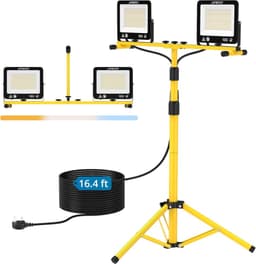
Run the lead along the wall, then across to the stand where nobody walks. Uncoil an extension reel fully if you must use one. Lengths include 3 m on the wowspeed, 5 m on several three-head files, and 5.5 m claimed on the EOTO. The cheap CORESLUX prints two lengths that do not match, so you measure the cord you unpack. HSE’s HSG107 treats a damaged sheath, a cracked plug, taped joints, and scorch marks as things a user can see. None of these twelve listings prints BS 1363. If the pins are flat US blades, as the BDDFOTO bullet states, do not force them into a UK socket with a loose adapter. The wowspeed listing says the cable switch is not waterproof even where the head claims IP66. If there is no socket within reach, that choice is on mains or rechargeable.

When to stop

Unplug at the first sign of arcing, a buzzing plug, a burning smell, or a scorch mark. One UK review of the wowspeed describes internal arcing within a month. Do not open the housing or tape a warm plug. The BDDFOTO bullet says the housing runs hot in long use. Hot plastic at the plug is a stop, not warm metal on an LED flood. A spinning screw, missing brackets, or a column that sinks means the lamp is not set up. Returning it is the remedy. A socket that trips at once needs a competent person. If the stand is stable, the beam is below your eyes, and the plug is quiet, you can work.

Common questions

What order do you open the stand in?
Spread the feet fully and lock them while the column is still down. Raise one section, lock it, then the next. Aim the heads only after a gentle push does not fold a leg or drop the pole. UK reviews in this set include locks that barely hold and brackets that were missing. If the stance is incomplete, more height makes a fall worse, not the light better.
How high should the heads sit relative to your eyes?
Below them. Tilt the heads down so you see the work and not the LED face. A claimed maximum of 150 cm or 191 cm is the listing’s upper figure, not a target for your eyes. In a single garage, chest height on the panel is usually enough. If you are squinting, lower the stand. This page does not quote a lux level at a given height.
What if the locking nut spins?
Stop. A NATPOW review describes a screw that spun and would not tighten. A cheap CORESLUX review says the nut only just holds, and the Al waha file says the poles are hard to lock. Do not add washers, glue, or extra force as a repair. If the column will not stay, the light is not ready to use. Pack it for return.
Where should the lead run?
Along the wall, then to the stand at a point you do not walk through. Uncoil an extension reel fully if you must use one. A 3 m lead often fails to reach a car from a socket on the back wall. A 5 m claim is the figure to plan with, and only when the listing states one length. Two conflicting lengths mean you measure the cord, not the title.
What do you do if the plug buzzes or the housing arcs?
Unplug at the wall and do not use the lamp again until it is replaced or properly repaired. UK reviews of the wowspeed describe arcing and a buzzing plug. HSE user checks treat scorch marks, a cracked plug, and a damaged sheath as stop signs. Do not open the driver or bypass the switch. A buzz is not a noise you wait out.

Related pages

Sources

Public UK sources and the amazon.co.uk listings compared on this page. Updated October 2026.

  1. Workplace (Health, Safety and Welfare) Regulations 1992, regulation 8 (retrieved October 2026)
  2. HSE L24: Workplace health, safety and welfare (retrieved October 2026)
  3. HSE: Lighting (retrieved October 2026)
  4. HSE HSG38: Lighting at work (retrieved October 2026)
  5. Electricity at Work Regulations 1989 (retrieved October 2026)
  6. HSE: Electrical systems (retrieved October 2026)
  7. HSE HSG107: Maintaining portable electrical equipment (retrieved October 2026)
  8. Plugs and Sockets etc. (Safety) Regulations 1994 (retrieved October 2026)