Independent comparisons. We may earn from shop links. More info

Boltless shelving or wire shelving

Updated: 2026-10-21

You have a board bay and a wire rack in the same amazon.co.uk basket, and both titles say heavy duty. Boltless shelving or wire shelving is a deck decision first and a brand decision second. The [heavy duty rack comparison](/hub/workshop/heavy-duty-rack) lists the ten captured products. This page says which deck holds boxes, which one drops screws, and when wheels cut the load you should plan for. Listings were read on 19 October 2026. Products Compared did not lab-test either type, and a qualifying purchase through our links can earn a commission at no extra cost to you.

You have a board bay and a wire rack in the same amazon.co.uk basket, and both titles say heavy duty. Boltless shelving or wire shelving is a deck decision first and a brand decision second.

Our top picks

On this page

What each type actually is in this set

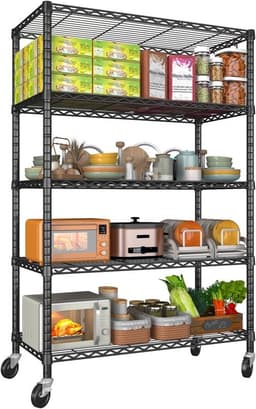
Boltless, in this folder, means a steel frame with a board you tap into place. DIVCHI at £21.29 is the 80 cm bay, and the deck is not named. REQUISITE NEEDS at £23.99 names MDF. Both SONGMICS pairs use yellow MDF. Harbour at £45.99 uses engineered wood on a galvanised frame. The repeated shelf line is 175 kg, written as evenly distributed on REQUISITE NEEDS, with 875 kg as five shelves on one bay. Wire is Mapleyard at £67.99 and three Forthcan racks at £93.99, £110.99, and £129.99: open mesh on posts and clips. Mapleyard states 114 kg per shelf. The wheeled Forthcan states pounds, not a matching kilogram. SUPEER at £89.99 is neither deck. It is a metal shelf, 183 × 90 × 40 cm, rubber feet, 200 kg per shelf in the bullets, and no MDF named. Who should skip a listing is on best heavy duty garage shelving.

Boxes, tins, and small parts

A board or a metal shelf is the simpler deck for mixed boxes, paint tins, and loose fixings. REQUISITE NEEDS, SONGMICS, and Harbour give you a continuous MDF or engineered-wood surface. SUPEER does that job in metal. DIVCHI may be the same kind of bay, but the page does not name the board, so you cannot assume MDF or metal from the title. Wire loses small parts. Screws, rawl plugs, and loose sockets fall through unless you add a bin or a tray. None of the Forthcan or Mapleyard listings tells you to lay a board on the mesh, and a board you add is your own load, not a higher kilogram. Wire is the better deck when the goods are already in crates, when you want dust to fall through, and when you will not balance loose envelopes on the mesh.

Air, water, and wheels

Open mesh moves air, which is why wire is often suggested for a clammy garage. A powder-coated wire rack is not automatically the damp-shed answer. Mapleyard’s special features include waterproof, with no test named, and the material field says wood while the bullets say alloy steel. The Forthcan finishes are paint or powder coat. They do not use the word galvanised. Harbour’s frame does. If moisture is the whole problem, use garage shelving for a damp shed rather than treating wire as a weather rating. Mapleyard states four wheels, two of them lockable, plus levelling feet. One review says only one wheel locks, so try the brakes first. The £93.99 Forthcan states 1,100 lb standing and 550 lb while moving. The 115 cm and 140 cm pages do not state wheels. SUPEER states rubber foot pads and does not state wheels.

Do not compare the kilograms raw

175 kg on a boltless board, 114 kg on Mapleyard, 200 kg on SUPEER, and 640 lb on the widest Forthcan are not one scale. The boltless 175 kg is a per-shelf claim, and 875 kg is that claim times five for one bay, not a pair. SUPEER’s bullets say 200 kg per shelf and 1,000 kg total, while another field says 600 kg, so the largest cell is not the winner. Mapleyard separates 114 kg per shelf from 567 kg standing. A higher number is not a reason to pick boltless if your goods fall through mesh, and a lower number is not a reason to reject wire if the crates are light and the rack must roll. Most boltless bays here are 40 cm deep. The Forthcan wire bays are about 45 cm. An overhang is a point load the evenly distributed line did not describe. Door and load order is the heavy duty rack buying guide.

Common questions

Should I buy boltless or wire?
Buy boltless, or the SUPEER metal shelf, when you want a continuous deck for boxes and tins. Buy wire when the goods are already in crates, you want air through the shelf, or you need wheels. In this set the boltless shelf line is usually 175 kg and the Mapleyard wire line is 114 kg per shelf. Those are printed claims, not a head-to-head test. Skip wire if loose screws are the thing you store.
Will screws and fixings fall through?
Yes, through the mesh on Mapleyard and the Forthcan racks, unless you put them in a bin or a tray. They will not fall through an MDF or engineered-wood deck on REQUISITE NEEDS, SONGMICS, or Harbour, or through SUPEER’s metal shelves. DIVCHI does not name its deck, so do not assume a solid board from the boltless label alone.
Are MDF shelves stronger than wire?
Not on the evidence in this folder. MDF is a flat deck that sellers say will bow before the frame does if the load sits in one spot. Wire is an open deck with its own stated loads, which are lower or written in pounds. Stronger would need one method applied to both. What you can say is that a board keeps small items put, and wire does not.
Do wheels make a rack less strong?
They change the load the listing tells you to use. The £93.99 Forthcan states 1,100 lb with the feet and 550 lb while moving. Mapleyard states 567 kg standing and does not print a moving limit, and one review says only one wheel locks. A boltless bay with plastic feet has no rolling figure because it is not meant to roll. Unload toward the moving number before you pull a wheeled rack out.
Where does the SUPEER metal shelf fit?
SUPEER is the third path: solid metal decks, no wheels stated, 200 kg per shelf in the bullets, £89.99, and 4.4 from 149 reviews. Choose it when you want a flat metal surface and a 90 cm door. Do not choose it as the wire one or the MDF one. A 600 kg field next to a 1,000 kg bullet means you still have two capacity lines, and reviews call the plastic feet brittle.
Can I put boards on a wire rack?
You can lay something flat across the mesh, and that is your own addition. These listings do not rate that board, and it does not turn 114 kg or a pound figure into the 175 kg boltless claim. If you need a solid deck, start with a board bay or the SUPEER rather than covering a wire shelf and hoping the clips were designed for the extra weight.

Related pages

Sources

Public UK sources and the amazon.co.uk listings compared on this page. Updated October 2026.

  1. HSE INDG412: workplace racking load and damage (retrieved October 2026)
  2. HSE INDG291: PUWER and domestic work (retrieved October 2026)
  3. HSE HSG76: warehousing guidance (retrieved October 2026)
  4. SEMA: Storage equipment guidance (retrieved October 2026)
  5. SEMA: Technical FAQ (retrieved October 2026)
  6. BSI BS EN 15512:2020 (retrieved October 2026)
  7. GOV.UK: General Product Safety Regulations 2005 (retrieved October 2026)
  8. Consumer Rights Act 2015 section 11 (retrieved October 2026)
  9. BiGDUG: MDF garage shelving (retrieved October 2026)