Independent comparisons. We may earn from shop links. More info

Fiddle leaf fig vs fig tree: species and product split

Updated: October 2026

You searched fig tree and amazon.co.uk offered a 180 cm artificial tree next to a £17.99 live Brown Turkey in a 9 cm pot. Fiddle leaf fig vs fig tree is not a taste test between two edible varieties; it is Ficus lyrata, faux décor, and Ficus carica solving different jobs. The [fig tree comparison](/hub/trees-and-palms/fig-tree) holds all seven listings side by side. This page stops the category mix-up. Cultivar ranking stays on [best fig tree for a UK patio](/hub/trees-and-palms/fig-tree/sub/fig-tree-best). Passport and pot-size checks sit on the [fig tree buying guide](/hub/trees-and-palms/fig-tree/sub/fig-tree-buying-guide). If you buy through our links, a qualifying purchase can earn us a commission at no extra cost to you.

You searched fig tree and amazon.co.uk offered a 180 cm artificial tree next to a £17.99 live Brown Turkey in a 9 cm pot.

Our top picks

On this page

Three products, one search

Retail search merges fruiting common figs, fiddle-leaf houseplants, and faux fiddle-leaf floor trees because shoppers reuse the word fig. Botanically they diverge. Ficus carica is deciduous, hardy to H4 for cultivars such as Brown Turkey, and grown for edible seedless fruit outdoors with restriction and sun. Ficus lyrata is evergreen, rated H1B, kept frost-free, with violin-shaped leaves up to about 45 cm; RHS notes flowers and fruits are not seen on container-grown plants indoors. A faux tree copies lyrata's silhouette in PE or polyester on wired stems, with no biology at all. In our set, two listings are live Ficus carica (Carbeth Brown Turkey pair and mixed pack). Five are faux lyrata lookalikes from Der Rose at 30 in (£23.99, 4.2 from 124 reviews) up to Keeplush at 180 cm (£99.99, 4.3 from 32 reviews). NEUWEABY at 160 cm (£89.99) shows no star line in the UK file. If you wanted jam, none of the five faux rows qualifies, regardless of stars.

A live fiddle-leaf fig

A live Ficus lyrata is a bright-indirect-light houseplant, not a UK wall fruit tree. BBC Gardeners' World places it indoors with stable warmth, warns that sap irritates skin, and lists toxicity to cats and dogs. Cats Protection includes ficus on indoor caution lists. The RHS ornamental fig guide keeps most ornamental ficus above about 10–13°C; lyrata's H1B rating means frost-free glasshouse or room, not a Scottish patio winter. It will not produce the brown dessert figs you eat with cheese, and container-grown lyrata does not offer the outdoor crop calendar of Ficus carica. Buying lyrata when you meant Brown Turkey is the common expensive mistake this category enables, especially when the listing photo shows a tall living room tree with no garden context.

A faux tree

Faux listings sell height, pot weight, and leaf count, not hardiness. Der Rose packs small at 940 g with a woven basin; Keeplush claims 180 cm, 106 leaves, and a cement pot with stone decor at 7.5 kg. Several dimension fields look like carton sizes. Fairblo lists 150 cm in the title beside a 70 cm dimension line, so measure your ceiling against both claims. Branches are often wired; reviewers spend ten minutes spreading stems after compression in the box. Keeplush reviews mention slot-together pieces despite a no-assembly bullet. Outdoor bullets on faux pages are not UK weather ratings. Without a stated hardiness or UV guarantee, treat balcony use as sheltered and occasional. None of these listings replaces pet safety research: live ficus sap is the documented risk; faux products do not automatically mean cat-safe unless the seller says so, and most pages here stay silent. If your room is dim or you travel often, faux solves the look without H1B heating or watering. If you wanted the scent of ripening fruit on a warm wall, exit this section and read the fruiting fig below.

The fruiting fig in this set

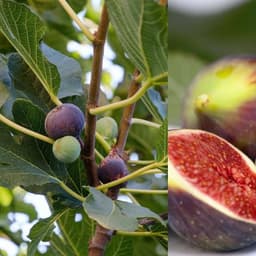
Edible figs require Ficus carica with a name you trust. The Brown Turkey pair at £17.99 names the cultivar on both 9 cm pots (3.4 from 30 reviews). The mixed pack at £19.99 names three cultivars in bullets but lists one piece in specs and draws label complaints in reviews. That is a poor fit when the decision is species-level clarity. Brown Turkey is H4 on the RHS profile; lyrata is H1B. Do not swap those ratings when planning winter. Fruiting figs need root restriction, full sun, and tip protection, covered on how to grow a fig tree. Once you know you want carica, the best fig tree page chooses between the two live rows.

Common questions

Will a fiddle-leaf fig produce edible figs indoors?
No useful outdoor-style crop. RHS notes fruits are not seen on container-grown lyrata; dessert figs come from Ficus carica in sun with restricted roots.
Can I leave a fiddle-leaf fig outside in a UK winter?
Not as a hardy wall plant. Lyrata is H1B frost-free territory. Brown Turkey carica is the H4 outdoor candidate.
Is a faux tree a substitute for fruit?
No. It is a décor shortcut. Five faux listings here occupy the fig tree search without fruit.
Are live ficus plants a problem for cats?
BBC Gardeners' World and Cats Protection treat ficus as a risk for pets. Sap can irritate human skin too. Faux is not automatically safe unless the listing says so.
Why do faux listings say outdoor?
Marketing for patios and balconies. Without UV or frost data, assume sheltered use only.
Which listing is the edible one?
Carbeth Brown Turkey B07NYN8X2Z and the mixed live pack B085RNR7W9. Every other row in this comparison is faux lyrata.
Do faux branches need shaping?
Usually yes. Bullets promise adjustable wire stems; reviewers report spreading branches after compressed shipping.
Does fig tree on the packet mean Ficus carica?
Only if the species line says common fig or a cultivar such as Brown Turkey. Fiddle leaf or artificial means lyrata or faux, not dessert fruit.

Related pages

Sources

Public UK sources from the research digest, used for this page in October 2026. Prices, stars and review counts are from the amazon.co.uk listings checked on 19 October 2026. This is not a taste test or a hardiness trial.

  1. RHS, How to grow figs (retrieved October 2026)
  2. RHS, Ficus carica ‘Brown Turkey’ (retrieved October 2026)
  3. RHS AGM fruit list (retrieved October 2026)
  4. RHS, Ficus lyrata (retrieved October 2026)
  5. GOV.UK, Issuing plant passports to trade plants in Great Britain (retrieved October 2026)
  6. DEFRA, Xylella host risk levels (retrieved October 2026)
  7. Forest Research, Xylella fastidiosa (retrieved October 2026)
  8. BBC Gardeners’ World, Fiddle-leaf fig (retrieved October 2026)