Independent comparisons. We may earn from shop links. More info

How to set a mouse trap without losing the bait or a finger

Updated: 21 October 2026

The usual failure is a trap still set in the morning with the bait gone, or a bar that fires while you are holding it. How to set a mouse trap is a sequence: a pea of sticky bait, the trap on the run, the bar pressed in place, and a check at least every 12 hours. The room map is [mouse traps indoors](/hub/traps/mouse-trap-snap-trap/sub/mouse-trap-snap-trap-indoors). When a spring is the wrong method, see [mouse traps versus poison](/hub/traps/mouse-trap-snap-trap/sub/mouse-trap-snap-trap-vs-poison). The nine listings are the [mouse trap snap trap comparison](/hub/traps/mouse-trap-snap-trap). Peter F. used BPCA, UFAW, the Pest Management Alliance code and the Fort Products leaflet. A purchase through our links can earn a commission at no extra cost to you.

The usual failure is a trap still set in the morning with the bait gone, or a bar that fires while you are holding it.

Our top picks

On this page

Bait it before it is set

Put the bait on while the bar is unset. Reviewers on the RnCop and MSR packs report the trap firing while they were still placing it, which is what happens when that order is reversed. A pea of sticky bait is the amount. The Fort Products leaflet names chocolate spread or crunchy peanut butter and treats cheese as a weak default. BPCA’s examples are nutty chocolate or raisins. If the bait keeps vanishing, the Fort leaflet says to put it under the paddle rather than on the rim. That is a placement fix, not proof the spring is dead. Pre-baiting an unset trap is in that leaflet, and it matters more for rats than for one kitchen mouse.

Put it on the run, then arm it

BPCA’s placement is at right angles to the wall, trigger towards the skirting, out of reach of children and pets. Set several traps on the same run and leave them. The mouse is using a route, not a tile you move every night. Arm the trap where it will stay. Do not set it on the worktop and carry it. Press the bar only after the trap is against the wall and your hands are off the pedal. If a child or a pet can reach that spot, the trap goes in a station or it does not go down. Roshield is the listing in this set that states a fit in that brand’s stations.
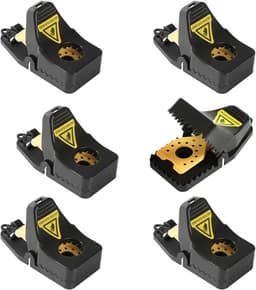
RnCop RnCop 6-pack snap trap

Testsieger

RnCop RnCop 6-pack snap trap
8.8/10about £9.49

When the bait is gone

Three misses look the same in the morning. Too much bait lets the mouse feed from the rim. Bait on the rim does the same. A stiff pedal, or a mouse too light for that setting, can lick a pea and leave the bar up. A stolen bait is not proof the spring is dead. Reduce the bait to a pea, move it under the paddle if the listing allows, and keep the trap on the same run. Do not add a second blob. More bait is how the first blob failed. If the latch is broken after a catch, that unit is finished. Bin it. Do not drown an animal the next jaw only injured.

Check, empty, and stop

UFAW’s line for the public is to check a rodent trap at least every 12 hours, and to be ready to deal with a wounded animal. The Pest Management Alliance code says there is no statutory interval written only for break-back traps, and that you still inspect them under the Animal Welfare Act 2006 once the animal is under your control. The Alliance code rejects drowning. If the mouse is still alive, do not leave it until the weekend and do not put the trap in a bucket. If you will not dispatch a wounded mouse, do not arm the trap.

Common questions

How much peanut butter?
A pea. Sticky, on the pedal or under it if the bait is being stolen. A larger blob lets the mouse feed without tripping the trap. MSR’s bullets say the same limit in their own words: too much bait lets a mouse feed without firing the trap. Peanut butter, chocolate spread, nutty chocolate or raisins are the baits named in the UK sources used here.
Cheese or not?
Cheese is a weak default. The Fort Products leaflet discourages it, and a slice on the pedal is easy for a mouse to carry off without pressing the bar. Peanut butter, chocolate spread, nutty chocolate or raisins are the baits named in the listings and in BPCA’s mouse examples. Use a pea, not a chunk.
Do I set the trap and then carry it?
No. Bait it unset, put it on the run, then press the bar in place. Reviewers on the RnCop and MSR packs report fires while the trap is being placed. That walk from the worktop to the skirting is when the bar meets a finger. Your hands stay off the pedal once the trap is against the wall.
The bait vanished and nothing fired. Is it broken?
Often it is too much bait, bait on the rim, or a pedal the mouse did not depress. A stolen bait is not proof the spring is dead. Reduce it to a pea and move it under the paddle if the listing allows. A latch that has already snapped off is a dead unit. Bin that jaw. Do not drown an animal the next jaw only injured.
How often do I have to look?
At least every 12 hours, which is UFAW’s guidance for the public. The Pest Management Alliance code ties the duty to the Animal Welfare Act 2006 once the animal is under your control. It is not a line in the Pests Act, and there is no statutory interval written only for break-back traps. Morning and evening on the same route is the practical version.
What if the mouse is still alive?
You have to deal with it. Do not drown it, and do not leave it until the weekend. The Alliance code rejects drowning. Dispatch is your responsibility because you set the trap. If you will not do that, do not arm the trap. A void you cannot see, or chewed wiring, is when GOV.UK and BPCA point to a controller.

Related pages

Sources

Public UK sources from the research digest, plus amazon.co.uk listings for the nine packs. Shelf date 19 October 2026.

  1. Pests Act 1954, section 8 (retrieved 19.10.2026)
  2. Small Ground Vermin Traps Order 1958 (retrieved 19.10.2026)
  3. Glue Traps (Offences) Act 2022, section 1 (retrieved 19.10.2026)
  4. GOV.UK, pest control on your property (retrieved 19.10.2026)
  5. BPCA, mouse control (retrieved 19.10.2026)
  6. UFAW, rodent control (retrieved 19.10.2026)
  7. Baker and colleagues, PLOS ONE, 2012 (retrieved 19.10.2026)
  8. Which?, how to get rid of mice (retrieved 19.10.2026)