Independent comparisons. We may earn from shop links. More info

Needle scaler vs angle grinder: rust, pits and dust

Updated: 17 October 2026

The needle scaler vs angle grinder choice becomes clear when you name the surface rather than the tool. Needles suit loose rust in pits, corners and around welds. An abrasive disc is faster across broad flat steel, and it can remove sound parent metal as well. This comparison draws on UK guidance and saved amazon.co.uk reviews, not a laboratory trial. See the [needle scaler comparison](/hub/tools/needle-scaler) for the products and prices. A qualifying purchase can earn a commission at no extra cost to you.

The needle scaler vs angle grinder choice becomes clear when you name the surface rather than the tool. Needles suit loose rust in pits, corners and around welds.

Our top picks

On this page

What each tool actually removes

A needle scaler uses independently moving steel needles. Their tips follow an irregular surface and strike brittle rust, mill scale, paint and weld slag, including pits and raised welds a flat abrasive misses. The finish is peened rather than polished. Repeated impacts can still damage thin material. An angle grinder changes with the accessory. A flap disc cuts coating and parent metal. A wire wheel brushes and polishes. On broad flat plate a suitable disc is faster than a small needle head. In a deep pit it may only touch the high spots. One WorkPad reviewer used a wire wheel until the steel looked shiny, then found rust beneath when the needles were applied at roughly 30–45 degrees. That is one observation, not a material-loss test. A wire wheel can burnish flaky corrosion. Body and head choices are in the needle scaler buying guide.

Dust, noise and access are not simple wins

Needles often throw larger flakes than a grinder’s abrasive stream. A POWER AERO NOVIA reviewer reported very little dust on a garden-seat frame compared with a flap disc. There is no measured dust comparison for these tools, and old paint can still produce respirable particles. HSE surface-preparation guidance calls for respiratory protection of at least APF 20 in the task guidance researched here. EH44 uses 10 mg/m³ inhalable and 4 mg/m³ respirable as general hazardous-dust thresholds. Do not clear residue with compressed air or dry brushing. Reviewers call needle scalers extremely loud. HSE action values begin at 80 and 85 dB(A), with a limit of 87 dB(A) after hearing protection. Most saved listings publish no noise figure, so a low-noise bullet does not establish low exposure. An angle grinder is also noisy. Access often decides first: needles reach welds and corners, while a grinder covers flat panel and needs no compressor. A listing that says sandblasting hammer does not include grit or containment.
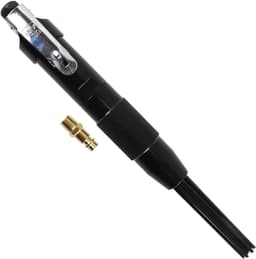
Enwye Enwye mini 12-needle

Testsieger

Enwye Enwye mini 12-needle
9.8/10about £29.99

Choose the disc, the needles or neither

Choose needles when corrosion is thick and flaky, the surface is irregular, and preserving sound metal matters more than a smooth finish. Welded frames, cast iron and heavy brackets fit, provided the section is sound. Use light pressure and keep moving. The finish still needs preparation before paint. Choose a disc when broad, flat, sound steel needs fast coating removal and you can accept some parent metal going with it. Use the guard and a speed-rated accessory. A wire wheel may only polish scale. A coarse flap disc can cut aggressively. For flaky scale on a solid non-structural frame, needles are the more conservative start. For uniform coating on sound plate, the disc is faster. Neither finish proves thickness.

When neither tool should finish the job

Choose neither for thin decorative tube, body skin or metal of unknown thickness. A needle-made hole is not a test you should pursue. Impact can dent thin steel, and an abrasive can thin it further without a dramatic flake. Structural corrosion, unknown coatings and enclosed sections are the handoff. A fabricator assesses the remaining section. A blasting specialist chooses media and containment. If steering, braking or load-bearing mountings are involved, cleaning cannot show that the vehicle is safe. The vehicle-specific boundary is in the needle scaler chassis rust guide.

Common questions

Will a needle scaler remove less parent metal than a flap disc?
It can be less cutting because the needles chip brittle surface material rather than abrading a flat path, and a saved reviewer observed that difference after a wire wheel had left a shiny surface. It is not harmless. Repeated impacts can peen, dent or perforate thin steel. Treat reduced cutting as a job-dependent characteristic, not a guarantee that sound metal will remain untouched.
Can a wire wheel hide rust?
Yes. A wire wheel can polish or burnish scaly corrosion so that the surface looks bright while rust remains in pits or beneath flattened scale. That behaviour appears in the saved WorkPad review, where needles later found rust under the shine. Inspect the surface closely. Do not accept shine as evidence of clean steel.
Is a needle scaler less dusty than an angle grinder?
Some reviewers report larger flakes and less visible dust than with a flap disc, including one POWER AERO NOVIA report on a garden-seat frame. There is no measured comparison for these products. Needle scaling can still release hazardous fine particles from rust and old coatings. Use extraction and respiratory protection for the identified material. Needles are not a substitute for dust control.
Which tool is faster on a flat panel?
An angle grinder with a suitable disc is usually faster across broad, flat, sound steel because it removes material continuously over a larger path. A needle scaler earns its slower pace in pits, corners and around welds. Speed is the wrong criterion if the abrasive would remove too much parent metal or if a wire wheel would only polish the scale.
When should the work be blasted professionally?
Consider professional blasting when the component has complex geometry, extensive coating, uncertain hazardous paint or a need for consistent preparation that handheld tools cannot provide safely. Structural or thin sections also need competent assessment before aggressive cleaning. Blasting is a controlled process with selected media, extraction and containment, not a mode hidden inside an air-hammer listing.

Related pages

Sources

Public UK sources for vibration, noise, compressor margin, and the 30-day right to reject. Listings are the amazon.co.uk captures for these nine ASINs on 16 October 2026, not a live reload. Prices on amazon.co.uk move.

  1. HSE, hand-arm vibration regulations (retrieved 17 October 2026)
  2. Control of Vibration at Work Regulations 2005, regulation 4 (retrieved 17 October 2026)
  3. HSE, assessing hand-arm vibration risks (retrieved 17 October 2026)
  4. HSE, noise at work for employers (retrieved 17 October 2026)
  5. Sealey compressor buying guide (retrieved 17 October 2026)
  6. Sealey SA51 instructions (retrieved 17 October 2026)
  7. Consumer Rights Act 2015, section 22 (retrieved 17 October 2026)
  8. Draper 84131 on amazon.co.uk (retrieved 17 October 2026)