Independent comparisons. We may earn from shop links. More info

How to use a needle scaler: pressure, oil and stop

Updated: 17 October 2026

Knowing how to use a needle scaler starts before the needles touch rusty steel. A dry inlet, a narrow hose or excessive pressure can make a sound air tool behave as if it is faulty, and long trigger time can expose your hands to serious vibration. This guide follows named UK manufacturer guidance and HSE information. It is not a laboratory test of the products in our [needle scaler comparison](/hub/tools/needle-scaler). Check your own manual first. Most saved amazon.co.uk listings here omit at least one important figure. A qualifying purchase can earn a commission at no extra cost to you.

Knowing how to use a needle scaler starts before the needles touch rusty steel.

Our top picks

On this page

Set the pressure, oil and hose before connecting

Inspect the tool while it is disconnected. Look for cracked housings, loose needle retainers, bent needles and a trigger that does not return freely. WorkPad reviews mention swivel fittings unscrewing and leaking. Do not improvise a retainer. Drain water from the receiver. Sealey’s SA51 instructions specify clean, dry air and a few drops of suitable air-tool oil each day when no automatic lubricator is fitted. That manual is for the named Sealey model, not every gun here. Follow your tool’s oil specification. Oil belongs in the air path, not on a surface that must later accept paint. Set regulated pressure with air flowing and stay at or below the manual. The researched Sealey and Trelawny guidance uses 90 psi, about 0.62 MPa. More pressure does not compensate for a restrictive hose. Use at least a 10 mm internal bore. Enwye states 4.0 cfm at 90 psi. Most other saved files omit cfm, so match demand in the needle scaler buying guide. Keep the trigger released. Sealey says not to free-run the scaler.

Hold the tool lightly and limit trigger time

Start on a small, non-critical patch. Present several needle tips to the surface and use only light pressure. Forcing the body into the work can bend needles without a cleaner result. Keep the head moving. Disconnect the air before clearing a jam or changing needles, and never point the head at a person. A small receiver may empty quickly. Release the trigger and let pressure recover rather than raising the regulator. Stop if the sound changes sharply, the trigger sticks or the casing heats abnormally. HSE uses an initial magnitude of 19 m/s² for a conventional needle scaler and 7 m/s² for a vibration-reduced type. On the generic 19 m/s² figure, the arithmetic reaches the 2.5 m/s² A(8) action value after about eight minutes of trigger time and the 5 m/s² A(8) limit after about 33 minutes. These are not measured times for your Amazon tool and not targets to work up to. For paid work, record actual trigger time and use the manufacturer magnitude where it exists. Stop for numbness, tingling or loss of grip.
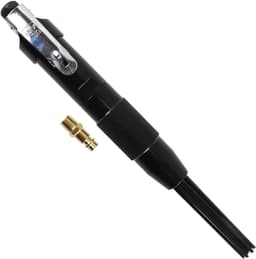
Enwye Enwye mini 12-needle

Testsieger

Enwye Enwye mini 12-needle
9.8/10about £29.99

Control noise and dust

Needle scalers are loud even when a listing says low noise. POWER AERO NOVIA reviewers call hearing protection necessary, and most saved listings print no decibel value. HSE’s workplace action values are 80 and 85 dB(A), with an exposure limit of 87 dB(A) after hearing protection is taken into account. Fitted hearing and eye protection are the DIY minimum. HSE treats dust at 10 mg/m³ inhalable or 4 mg/m³ respirable as hazardous under COSHH. Heavy flakes do not prove there is no fine dust. Identify old paint where you can, use suitable extraction and respiratory protection, and do not clear hazardous dust with compressed air or dry brushing.

Know when to stop and how to shut down

Stop when you cannot identify the coating, when adequate extraction is unavailable, or when the work is structural and you cannot assess what metal remains. A scaler removes loose material. It does not measure wall thickness or certify a repair. Thin body panels and tubes can dent or perforate, and a heavily corroded chassis member may need a fabricator. That boundary is set out in the chassis rust guide. At the end, release the trigger, isolate the air supply and bleed the line before disconnecting the tool as its manual directs. Clean debris without blowing it into the air, inspect the needles and retainer, and wipe down the body. Apply storage lubrication only as the manufacturer specifies. Coil the hose without kinks and leave the compressor drained. Water, leakage and dry storage can turn the next session into a fault that should have been maintenance.

Common questions

What pressure should I use for a needle scaler?
Use the pressure stated for your exact tool and do not exceed it. The named guidance researched here commonly uses 90 psi, equivalent to about 0.62 MPa, but that is not a substitute for a missing manual. Set regulated pressure while air is flowing. Fix hose restrictions or inadequate cfm rather than increasing pressure to make a weak gun feel stronger.
How often should I oil an air needle scaler?
Follow the exact manufacturer instruction. Sealey’s researched guidance calls for a few drops of suitable air-tool oil each day when no automatic lubricator is fitted. Disconnect the air first and avoid excessive oil, which can reach a surface you later need to paint. If your model has a different lubrication system, its manual takes priority over this general procedure.
Why must the trigger be off before I connect the hose?
An engaged trigger can make the needle head start as soon as pressure reaches the tool. That creates an uncontrolled impact and projectile risk before you have a stable grip or the work is positioned. Check that the trigger returns freely, point the head away from people and connect only with the control released. Sealey also says not to free-run the scaler in the air.
How long can I run a needle scaler?
There is no universal safe time. HSE’s generic 19 m/s² conventional-scaler magnitude reaches the workplace action value in roughly eight minutes of trigger time and the exposure limit in about 33 minutes by calculation. Those numbers are warnings, not allowances for your tool. Use its declared vibration magnitude, where one exists, and a proper exposure assessment for paid work.
When should I call a professional?
Stop when the coating may be hazardous and you cannot provide suitable extraction and respiratory control, or when corrosion affects a structural section whose remaining thickness you cannot assess. Also stop for numbness, abnormal tool behaviour or repeated air-system faults. Cleaning harder is not a substitute for exposure control or structural judgement.

Related pages

Sources

Public UK sources for vibration, noise, compressor margin, and the 30-day right to reject. Listings are the amazon.co.uk captures for these nine ASINs on 16 October 2026, not a live reload. Prices on amazon.co.uk move.

  1. HSE, hand-arm vibration regulations (retrieved 17 October 2026)
  2. Control of Vibration at Work Regulations 2005, regulation 4 (retrieved 17 October 2026)
  3. HSE, assessing hand-arm vibration risks (retrieved 17 October 2026)
  4. HSE, noise at work for employers (retrieved 17 October 2026)
  5. Sealey compressor buying guide (retrieved 17 October 2026)
  6. Sealey SA51 instructions (retrieved 17 October 2026)
  7. Consumer Rights Act 2015, section 22 (retrieved 17 October 2026)
  8. Draper 84131 on amazon.co.uk (retrieved 17 October 2026)