Independent comparisons. We may earn from shop links. More info

How to use a belt sander without digging one hollow

Updated: 17 October 2026

Learning how to use a belt sander starts before the abrasive touches the work. The belt cuts continuously, so a tilted nose, a pause in one place or a machine started on the timber can leave a hollow within moments. Set the direction and tracking with the tool clear, hold it with both hands, then lower it while already moving. Our [Makita belt sander comparison](/hub/tools/makita-belt-sander) shows wide and narrow machines, but the same control principle applies to both. This guide covers setup, the pass, grit progression and the faults that mean you should stop rather than forcing the job. A qualifying purchase can earn a commission at no extra cost to you.

Learning how to use a belt sander starts before the abrasive touches the work. The belt cuts continuously, so a tilted nose, a pause in one place or a machine started on the timber can leave a hollow within moments.

Our top picks

Bosch Bosch PBS 75 A

Best overall

Bosch Bosch PBS 75 A
9.4/10about £79.98
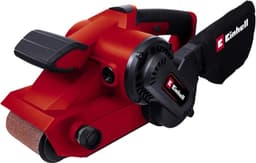
Einhell Einhell TC-BS 8038

Best value

Einhell Einhell TC-BS 8038
8.6/10about £48.94
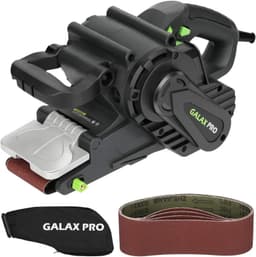
GALAX PRO GALAX PRO 1010 W

Rank 3

GALAX PRO GALAX PRO 1010 W
8.2/10about £50.99
On this page

Before the belt touches the work

Disconnect a corded machine or remove its battery before your fingers go near the belt. Fit the exact width and loop length, and follow the direction arrow. A 76 x 457 mm loop does not fit a 76 x 533 mm machine. The Makita belt sander buying guide lists the common sizes if the listing is unclear. Check tracking with the tool held clear of the bench and your body. Use the tracking control in small steps until the belt runs centrally. Do not do this on the workpiece. GALAX PRO owners report belts walking off until tension and tracking are set. Confirm that the trigger releases and the lock-on disengages while the belt is in the air. One Roadtime reviewer said a release button broke and the tool stopped only when the battery was removed. Clamp the work, keep the cable behind you, and treat a dust bag as the minimum. For wood dust, follow the belt sander dust extraction guide.

Make the pass with the belt flat and moving

Start with the belt clear, let it reach speed, then bring the rear of the platen onto the timber while you are already moving. Settle the sole flat. Do not drop the front roller on first. That cuts a trench at the nose. Move with the grain in overlapping passes and let the machine’s weight do the cutting. Extra pressure adds heat and makes a pull harder to recover. Reviews of the Bosch PBS 75 A and the Einhell say both run away if the grip is light, so keep two hands on the tool. Lift clear while still moving if you need to look, then switch off and wait. Do not park a running sander on one spot. At an edge, keep as much of the platen supported as you can. On veneer, practise on scrap first.
Bosch Bosch PBS 75 A

Testsieger

Bosch Bosch PBS 75 A
9.4/10about £79.98

Choose grit, then hand over to another sander

Start with the least aggressive grit that still removes the coating. P40 is coarse removal, P80 is a common cutting grit, and P120 begins finer preparation. Many machines here include P80, so the belt in the box is not a finishing belt. Clear the surface between grits so loose coarse grit does not score the next pass. Once the surface is flat and the heavy coating is gone, switch to an orbital or finishing sander. If the timber darkens, the belt smells burnt or removal slows, stop. Replace a clogged belt rather than pressing harder.

Stop when the machine or material changes the risk

Stop immediately if the belt will not track, contacts the housing or repeatedly walks off. Disconnect power before investigating tension, roller condition or an incorrectly sized loop. A torn belt, unusual vibration or a burning electrical smell also takes the machine out of service until it has been checked. A failed switch needs the same response. Do not continue with a battery tool on the assumption that pulling the pack is an acceptable routine stop. Suspected lead paint requires a different assessment and containment plan. Do not attack it with a belt sander and a fabric bag. A whole-room floor creates sustained dust and control demands beyond a quick board repair. Get competent advice when the material is uncertain or the project exceeds the extraction you can provide. Stop when fatigue affects your grip. Wide corded machines in this set weigh roughly 3.4 to 4.6 kg, and repeated passes make tipping more likely. Short sessions with inspection between them produce a flatter result than one long push after your hands are tired.

Common questions

Which way should the belt arrow point?
Match the arrow on the inside of the abrasive to the machine’s stated travel direction. If the belt has no arrow, follow its manufacturer’s instructions. Always disconnect power before fitting it, and confirm tracking with the tool held clear before touching the work.
Should I track the belt on the wood?
No. Run and adjust it while the sander is lifted clear, making small changes until it stays central. Tracking on the work can score the surface or pull the belt into the housing before you can stop.
How hard should I press?
Use the machine’s weight and maintain guidance rather than adding heavy downward force. Keep the platen flat, move steadily with the grain and hold both handles. Excess pressure adds heat and makes gouging more likely without guaranteeing faster, cleaner removal.
What grit should I use for paint?
Use the least coarse grit that removes the known coating effectively. P80 is a common cutting starting point, while P40 is more aggressive. Test an inconspicuous area and identify old coatings first. Suspected lead paint is not a routine belt-sander task.
When should I switch to an orbital sander?
Switch once the heavy material is removed and the surface is broadly flat. An orbital gives more control for finer scratch removal and preparation for finish. Continuing with a belt sander late in the job increases the risk of hollows.
What must I do before changing a belt?
Unplug a corded tool or remove the battery, then wait until every moving part has stopped. Release tension, fit the exact belt size and direction, restore tension and track it in the air. Never rely only on the trigger being released.

Related pages

Sources

Public UK sources for the Makita corded range, wood-dust limits, and BS 1363 plugs. Listings are the amazon.co.uk captures for these eleven ASINs, saved on 15 October 2026, not a live reload on 17 October 2026. Prices on amazon.co.uk move.

  1. Makita UK belt sanders (retrieved 15 October 2026)
  2. Makita 9903 (retrieved 15 October 2026)
  3. Makita 9031 product sheet (retrieved 15 October 2026)
  4. Makita DBO180 (retrieved 15 October 2026)
  5. HSE wood dust (retrieved 15 October 2026)
  6. HSE WD7, hand-held sanders (retrieved 15 October 2026)
  7. HSE cutting and sanding wood (retrieved 15 October 2026)
  8. Electrical Safety First, plugs and fuses (retrieved 15 October 2026)