Independent comparisons. We may earn from shop links. More info

Belt sander dust extraction: a bag is only a start

Updated: 17 October 2026

Belt sander dust extraction matters before the first indoor pass, because a wide abrasive can produce heavy visible debris and finer airborne wood dust at the same time. Every wide machine in our [Makita belt sander comparison](/hub/tools/makita-belt-sander) has a bag, box or stated port, yet that accessory alone is not the control described by the Health and Safety Executive. HSE names belt sanding as a potentially very high-dust task and recommends on-tool extraction to a suitable M- or H-class unit, alongside suitable respiratory protective equipment for most sanding. A householder does not inherit every employer inspection duty, but the dust in a bedroom is the same material. A qualifying purchase can earn a commission at no extra cost to you.

Belt sander dust extraction matters before the first indoor pass, because a wide abrasive can produce heavy visible debris and finer airborne wood dust at the same time.

Our top picks

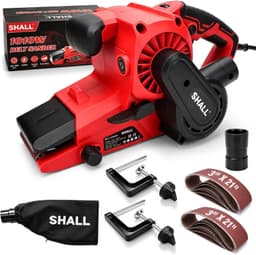
Shall SHALL 1010 W

Best overall

Shall SHALL 1010 W
10.0/10about £63.99
Bosch Bosch PBS 75 A

Rank 2

Bosch Bosch PBS 75 A
9.4/10about £79.98
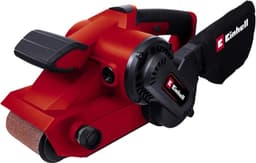
Einhell Einhell TC-BS 8038

Best value

Einhell Einhell TC-BS 8038
8.6/10about £48.94
On this page

What the dust is

Wood dust is not just the pile left under the bench. Belt sanding breaks hardwood, softwood and sheet material into particles that can remain airborne and enter the lungs. MDF also contains resin binders, so sanding it indoors deserves capture at the source rather than an open window after the work. HSE’s current wood-dust page states workplace exposure limits, averaged over eight hours, of 3 mg/m³ for hardwood dust and 5 mg/m³ for softwood dust. Where hardwood and softwood dust are mixed, the 3 mg/m³ limit applies to all wood dust in the mixture. These are workplace limits, not targets that make an unmeasured home job safe. Without exposure measurement, you cannot infer compliance from how clean the room looks. A fabric bag can catch larger chips while finer particles escape around the port, through the material or during emptying. Paint, preservative or an unknown old finish can add hazards that a wood-dust bag does not address. Suspected lead paint should stop routine belt sanding until the material and the control method have been assessed. The guide to using a belt sander covers tracking and grit. It does not turn hazardous-coating removal into a DIY task.

What HSE expects on a belt sander

HSE describes on-tool extraction as a complete system: the tool and its capturing hood, a hose, and the extraction unit. For cutting and sanding wood, its guidance calls for an M- or H-class unit and an antistatic hose. A correctly fitting manufactured adaptor is preferable to a loose joint improvised with tape, because air lost at the connection reduces capture where the belt meets the work. HSE also gives respiratory protective equipment with an assigned protection factor of 20 for most sanding, particularly in enclosed spaces, and names FFP3 as an example. The mask must fit the wearer. Tight-fitting RPE needs face-fit testing in a workplace, and facial hair can prevent the seal. A mask is not permission to fill a room with dust, and an extractor does not make respiratory protection irrelevant for a high-dust task. A domestic vacuum is not automatically a suitable substitute. HSE’s CIS69 guidance distinguishes the extraction class and the complete unit. Putting a nominal HEPA filter into a general household vacuum does not turn it into an M-class extractor. For employers, COSHH duties include maintenance and formal examination of local exhaust controls. HSE’s WD7 sheet refers to a thorough examination at least every 14 months. A private householder is not being told to commission that statutory test, but extraction still needs airflow, sound hoses, a sealed connection and maintained filters.
Shall SHALL 1010 W

Testsieger

Shall SHALL 1010 W
10.0/10about £63.99

What the saved sanders include

The Bosch PBS 75 A includes a microfilter dust box. Owners say it catches some debris, but several prefer a vacuum connection and describe the box as only adequate. That makes the box useful for brief collection, not evidence of a measured capture rate. The Bosch Professional GBS 750 includes a bag. One UK reviewer said dust stopped reaching it after sanding a floor, while another connected a Bosch vacuum. The GALAX PRO includes a dust bag, but reviewers describe a small barred port that clogs. Clear a blockage only with the tool unplugged and the belt stopped. Einhell supplies a container and states a 35 mm extraction connection on its UK page. Reviewers still call the onboard collection weak, and one owner could not fit a normal vacuum hose. The SHALL includes both a bag and a hose adaptor, which is a more complete starting kit, although its 5.0 rating is based on only seven reviews. The Makita 9031 listing states connection to a Makita vacuum, while several low-cost cordless files give little useful dust information. A small belt does not mean harmless dust. No product here has a verified capture percentage. Do not turn “comes with a bag” into a claim such as 90 or 99 per cent collection. For size and power source, use the Makita belt sander buying guide, then price the extractor and adaptor as part of the system.

When the bag is the wrong plan

A whole floor, prolonged MDF work or sanding in a furnished room exceeds what an onboard bag should be expected to control. Move the work outside where practical, isolate the area, connect appropriate on-tool extraction and use suitable RPE. Keep other people out, especially anyone not wearing the same protection. If lead is suspected, stop and seek competent advice on testing and controlled removal. A dust bag cannot make unknown hazardous paint safe, and an ordinary vacuum can spread contamination. In a workplace, use the employer’s COSHH assessment, maintained extraction and RPE programme rather than improvising with the accessory supplied by a retail tool. Hearing also belongs in the setup. Makita’s published data for wide sanders is around 83 to 85 dB(A) sound pressure at the operator position, so wear appropriate hearing protection and limit exposure. Choosing a different machine does not remove the need for dust and noise controls.

Common questions

Is a belt sander dust bag enough indoors?
Not as the only control for sustained wood sanding. A bag can catch larger debris, but HSE guidance for belt sanding describes on-tool extraction to an M- or H-class unit plus suitable RPE for most sanding. Isolate the area and connect a properly fitting extraction system.
What does HSE say about belt sanders?
HSE names belt sanding as work that can produce very high wood-dust levels. Its construction guidance recommends on-tool extraction with an M- or H-class unit, an antistatic hose and RPE with an assigned protection factor of 20 for most sanding, especially in enclosed spaces.
What is the UK hardwood dust limit?
HSE states a workplace exposure limit of 3 mg/m³ over eight hours for hardwood dust. Softwood is 5 mg/m³, but a hardwood and softwood mixture uses 3 mg/m³ for all the wood dust. These figures are workplace limits, not a DIY target.
Do I need FFP3 as well as extraction?
HSE gives FFP3 as an example of RPE providing APF 20 for most sanding. It must fit correctly, and extraction remains necessary because RPE does not control dust released into the room. Workplace users should follow their COSHH assessment and face-fit arrangements.
Can I use a household vacuum?
A household vacuum is not automatically an M-class extractor, even if a HEPA filter can be fitted. The complete unit, sealing, filtration class, hose and safe emptying matter. Use equipment rated for the dust and connect it with the correct adaptor.
Does this guidance matter at home?
Employer inspection duties do not simply transfer to a private householder, but the health hazard does not change at the front door. The sensible home approach is still source extraction, suitable RPE, isolation and controlled cleaning. Get professional help when the coating or scale is uncertain.

Related pages

Sources

Public UK sources for the Makita corded range, wood-dust limits, and BS 1363 plugs. Listings are the amazon.co.uk captures for these eleven ASINs, saved on 15 October 2026, not a live reload on 17 October 2026. Prices on amazon.co.uk move.

  1. Makita UK belt sanders (retrieved 15 October 2026)
  2. Makita 9903 (retrieved 15 October 2026)
  3. Makita 9031 product sheet (retrieved 15 October 2026)
  4. Makita DBO180 (retrieved 15 October 2026)
  5. HSE wood dust (retrieved 15 October 2026)
  6. HSE WD7, hand-held sanders (retrieved 15 October 2026)
  7. HSE cutting and sanding wood (retrieved 15 October 2026)
  8. Electrical Safety First, plugs and fuses (retrieved 15 October 2026)