Independent comparisons. We may earn from shop links. More info

DeWalt impact driver for decking

Updated: 22 October 2026

A deck is the same screw until cam-out chews a recess or a head holds water. A DeWalt impact driver for decking is the right driver for those screws when you use an impact-rated Torx bit, a pilot at the ends, and you stop at flush. It is the wrong tool for the pilot holes. The bit and mode sequence is on the [how to use a DeWalt impact driver](/hub/tools/de-walt-cordless-impact-driver/sub/de-walt-cordless-impact-driver-how-to-use) page. The four bodies are on the [DeWalt cordless impact driver comparison](/hub/tools/de-walt-cordless-impact-driver). Listings were saved on 20 October 2026, with Timber Decking and Cladding Association guidance. This is not a lab test. A qualifying purchase can earn a commission at no extra cost to you.

A deck is the same screw until cam-out chews a recess or a head holds water.

Our top picks

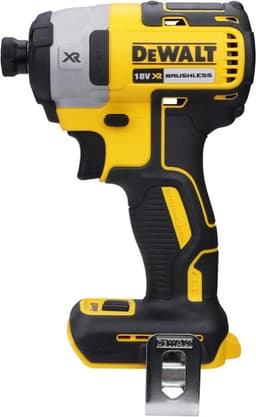
DeWalt DeWalt DCF887N

Best overall

DeWalt DeWalt DCF887N
9.2/10about £59.95
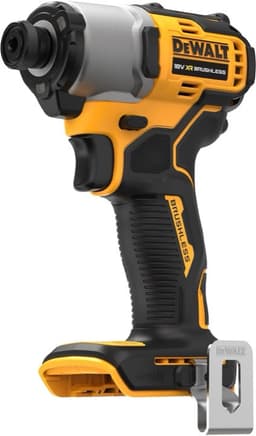
DeWalt DeWalt DCF850N

Best value

DeWalt DeWalt DCF850N
8.0/10about £98.43
DeWalt DeWalt DCF840N

Alternative

DeWalt DeWalt DCF840N
6.1/10about £78.00
On this page

The driver is for the screws, not for the holes

UK reviewers put a conventional DeWalt impact driver on decking because the anvil takes the twist a combi puts through the wrist. For a long run of boards, the DCF887N, DCF850N, or DCF840N is the mechanical class, at about £59.95, about £98.43, and about £78.00, all bare. Clip on the DCF887N if you own 18 V XR packs and the longer body reaches the joist. The DCF850N, about 101 mm, is the one when the nose has to sit between joists. The DCF840N is single-speed, 4.5 from 38 ratings. The DCF870N at about £184.99 and 56 Nm can fasten timber. Buy it when noise is the reason, and treat 56 Nm as its own figure. Keep the combi for the pilots. That split is the versus page.

Screw, coating, and a Torx bit

Outdoor screws need a coating meant for treated timber and weather. Pozidriv recesses are tapered, and they cam out once the torque arrives in blows. Torx spreads the load onto six lobes. One UK DCF887 reviewer switched to Torx and to impact-rated bits about 57 mm long. That length is one person's choice. Copy the type: a 6.35 mm hex, impact-rated, matching the screw you bought. A worn bit will still cam out, and a cheap bit on mode 3 will snap. Seat the shank fully, with the battery off or the direction locked in the centre, before the first board. Composite boards usually want the maker's own screw, and often a pilot at every point.
DeWalt DeWalt DCF887N

Testsieger

DeWalt DeWalt DCF887N
9.2/10about £59.95

Where to pre-drill

Timber Decking and Cladding Association guidance says screws should be at least 2.5 times the board thickness, at the quarter points, and no closer than 25 mm to the end. Pre-drill the ends. For hardwood, pre-drill every point about 2 mm over the shank. A head below the surface leaves a cup that holds water. A 28 mm board, multiplied by 2.5, wants a screw of at least 70 mm. That is their minimum, not a claim that every UK deck is 28 mm. Softwood in the middle of a board often goes in without a pilot if you stay 25 mm off the end. Use the combi for the end and for hardwood.

Mode, pressure, and the flush head

On a DCF887 or DCF850, mode 1 may stall on a long deck screw. That pause is Precision Drive, and the manual's answer is mode 2. Mode 3 sinks the head. Feather mode 2 and ease off as the head meets the surface. The DCF840 gives you only the trigger, so a short pull is the control. About 205 Nm, or 192 Nm on the DCF840, is a maximum, not the torque in each screw. Specified bolts want a torque wrench. Declared sound pressure runs from 88 dB(A) to 96 dB(A). Ear protection is the practical response. The 80 dB(A) action value is an employer duty if this deck is paid work.

Common questions

Is an impact driver the right tool for deck screws?
Yes for the screws, once you have an impact-rated bit and you stop at a flush head. The combi, or a drill, still cuts the pilot holes. A bare DCF887N at about £59.95 is the usual starting body if you already own 18 V XR batteries and the longer nose fits.
Do I pre-drill?
Pre-drill board ends, and pre-drill hardwood at every screw, about 2 mm over the shank so the board can move. That is Timber Decking and Cladding Association guidance. A softwood screw in the middle of a board, at least 25 mm from the end, often goes in without a pilot. Use the combi for the hole.
Torx or Pozidriv?
Torx holds up better once the driver starts impacting, because the force sits on the six lobes. Pozidriv cams out of a tapered recess, and the chewed head is then stuck in the board. Match the bit to the screw you bought, and replace it when it shines or slips. Impact-rated 6.35 mm hex is the shank these tools accept.
Which mode, so the head sits flush?
On the DCF887 or DCF850, mode 1 can stall on a long deck screw. Move to mode 2 and feather the trigger, then ease off as the head meets the board. Mode 3 sinks the head and leaves a cup for water. The DCF840 has no dial, so a short trigger pull is the control. A head below the surface is too far.
Will it split the end of the board?
It will if you drive close to the end without a pilot. Keep screws at least 25 mm from the end, on the association's guidance, and pre-drill those holes with the combi. Hardwood wants a pilot at every point, about 2 mm over the shank. Mode 1 does not repair a split after the fact.
What about composite decking?
Follow the board maker's screw and their pilot instruction. A composite screw is not a timber screw. Many boards want a pilot at each point so the board can move. The impact driver can drive the screw they specify if you stop at the depth they set.

Related pages

Sources

Public UK sources from the research digest, used for this page in October 2026. Prices, stars and review counts are from the four amazon.co.uk listings captured on 20 October 2026. Noise and vibration action values apply at work. They are not a certificate that a domestic driver is silent or safe for all-day use.

  1. DCF887 instruction manual (retrieved 20 October 2026)
  2. DCF850 instruction manual (retrieved 20 October 2026)
  3. DeWalt UK, DCF840N-XJ bare unit (retrieved 20 October 2026)
  4. DeWalt UK, DCF850 compact kit (retrieved 20 October 2026)
  5. HSE, hand-arm vibration calculator (retrieved 20 October 2026)
  6. HSE, noise for employers (retrieved 20 October 2026)
  7. GOV.UK, Supply of Machinery (Safety) Regulations 2008 (retrieved 20 October 2026)
  8. Consumer Rights Act 2015, section 23 (retrieved 20 October 2026)