Independent comparisons. We may earn from shop links. More info

How to use a bar clamp without marking the work

Updated: 17 October 2026

Knowing how to use a bar clamp starts before you squeeze the trigger. Seat both contact faces, keep your fingers outside the closing gap and check that every pad is present before pressure reaches the work. This matters in the current amazon.co.uk set because reviews mention loose pads, jammed releases and bars rusting after damp storage. The steps below apply to ordinary one-handed trigger clamps, with product-specific limits where spreader conversion is stated. Compare your exact model on the [main clamps page](/hub/tools/clamps) rather than assuming that every removable jaw works in the same way. A qualifying purchase can earn a commission at no extra cost to you.

Knowing how to use a bar clamp starts before you squeeze the trigger. Seat both contact faces, keep your fingers outside the closing gap and check that every pad is present before pressure reaches the work.

Our top picks

IRWIN Irwin Quick-Grip 300 mm pair

Best overall

IRWIN Irwin Quick-Grip 300 mm pair
9.4/10about £14.90
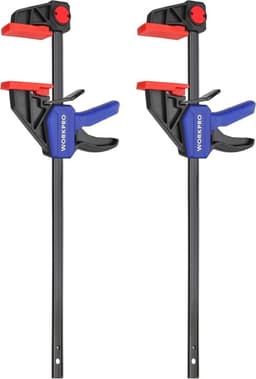
WORKPRO WORKPRO 150 mm pair

Best value

WORKPRO WORKPRO 150 mm pair
9.2/10about £12.99
WORKPRO WORKPRO 305 mm pair

Rank 3

WORKPRO WORKPRO 305 mm pair
9.2/10about £16.99
On this page

Set the jaw before you squeeze

Place the fixed jaw against one side and move the sliding jaw until both faces are square. The release lets the moving jaw travel; the handle then tightens it. Do not put a fingertip between a pad and the surface. A clamp can close quickly even when the holding force is described as light-duty. Check capacity first. Irwin states a 150–300 mm jaw and a 62 mm throat. The long WORKPRO pair states 305 mm and 60 mm. The short pair states 150 mm. A 300 mm opening does not mean the pad can reach more than 62 mm in from an edge. If the jaw barely fits, add no force until both faces sit flat. Take up pressure gradually and alternate when a joint uses a pair. Stop if a thin board bows, a pad walks off or the body twists. Catalogue values of 23 kg, 63 kg or 68 kg were not measured together, so they do not tell you how many squeezes a joint needs. For adhesive timing, move to clamps for wood glue. A spring’s force is fixed. Reviews call the LOLYSIC springs hard to open, so stop if opening one hurts.

Check the pads and use clean scrap

Inspect both faces before every hold. A half-detached pad can tilt and leave the hard jaw against paint or soft timber. Orange LOLYSIC tips fall off, WORKPRO pads work loose, and the small G-clamp pads are described as discs on tape. One Amazon Basics buyer says the non-marring pads feel like hard plastic. If a pad is missing, seat clean flat scrap before you load the clamp. It should be large enough not to split, and free of grit or dried glue. Release and reset if it moves. Do not treat gluing a pad back on as a universal repair. If the face cannot be made stable, use another clamp. swihorab says its faces pivot up to 45 degrees, but one review says they are no softer than the body. The clamp buying guide separates pad wording from jaw and throat.

Convert to a spreader only when specified

Use spreader mode only when the listing describes a reversible jaw. The WORKPRO 305 mm pair says you loosen the wingnut and move the fixed jaw, for a stated 440 mm spread. Check the fastening is secure before you apply pressure. The WORKPRO 150 mm pair and the 120/150 mm set describe a red quick-change button. Stated spreads are 285 mm for the short pair and 200 mm or 270 mm for the set. Keep your hand off the face that will move. LJHOME states that its 4-inch bars convert but gives no length. Irwin and the Amazon Basics bullets do not state reverse-jaw use. If your ASIN has no spreader statement, do not force the fixed end off. Spring clamp or bar clamp explains where spreading belongs.

Release, clean and store after the job

Support the work before you release, especially if it is vertical. On a trigger bar, use the release so the jaw slides back rather than snapping. On a spring, open both handles under control. If a release jams, do not add load. One review of the mixed WORKPRO set reports a clamp that would not release. Remove glue as the adhesive instructions say, and check that tips are still fitted. Store steel bars dry, indoors rather than on a damp shed floor. Shared WORKPRO reviews mention rust after damp or coastal storage, and one LOLYSIC outdoor review reports rust despite a rust-proof claim. No temperature rating is printed for the springs. Keep photography clips away from hot lamps unless the instructions confirm it. Retire a clamp that is cracked, badly rusted, unable to release or missing a secure face.

Common questions

How do I avoid trapping a finger?
Move the sliding jaw close while the clamp is unloaded, place both pads squarely, and keep your supporting fingers beside rather than between the contact faces. Take up the last gap with the trigger. If the work can fall when released, support it independently before touching the release lever.
What can I use when a pad has fallen off?
Clean, flat scrap wood can isolate a bare jaw and spread its contact for a temporary hold. Place it before loading the clamp and release immediately if it slips. Do not assume a particular glue will permanently repair every plastic pad. Replacement pads, manufacturer advice or another sound clamp are better for valuable finished work.
Why is my spring clamp so hard to open?
Its force is fixed by the spring, and reviews describe the LOLYSIC pack as especially strong in the hand. No measured opening force is provided. Use two hands only if that keeps the tool controlled, and stop if the action causes pain or snaps shut unpredictably. A trigger bar may suit a weaker grip better.
Can every quick clamp become a spreader?
No. The WORKPRO models described above state reversible-jaw functions, and LJHOME states conversion without a length. The Irwin and Amazon Basics bullets used here do not state that mode. Follow the instructions for your exact model and do not remove a fixed jaw simply because another brand uses a similar shape.
Can I leave clamps in a damp shed?
Dry storage is preferable for any clamp with a steel bar, spring or fastener. Reviews in this set mention rust after damp or coastal storage, including on a product marketed as rust proof. Wipe bars dry, remove wet glue and keep them away from a damp floor. Inspect corrosion before applying load again.
When should I stop using a clamp?
Stop if the body is cracked, the bar is badly corroded, a loaded release will not operate, or a contact pad cannot be secured. Also stop if the work bows or the clamp twists as pressure rises. Release safely and choose a sound tool with the correct jaw and throat rather than applying more force.

Related pages

Sources

Public UK sources for satisfactory quality, workplace equipment, and woodworking-machine standards. Clamp sizes and forces are the amazon.co.uk captures for these eleven ASINs on 16 October 2026, plus the Irwin page for T54122EL7. Prices on amazon.co.uk move.

  1. Consumer Rights Act 2015, section 9 (retrieved 16 October 2026)
  2. HSE, PUWER overview (retrieved 16 October 2026)
  3. HSE, woodworking standards (retrieved 16 October 2026)
  4. IRWIN, mini one-handed bar clamp (retrieved 16 October 2026)
  5. Thomas Graham, clamp size and force (retrieved 16 October 2026)
  6. Lee Valley, working with PVA glues (retrieved 16 October 2026)
  7. Mark Haley, glue-ups with clamps and cauls (retrieved 16 October 2026)
  8. amazon.co.uk listings, 16 October 2026 (retrieved 16 October 2026)