Independent comparisons. We may earn from shop links. More info

Straight vs angle die grinder

Updated: 22 October 2026

You are choosing geometry before brand: whether the accessory spins in line with your arm or bends ninety degrees to the body. That choice decides which amazon.co.uk listings belong in the basket. A 90 degree kit with 2 inch discs is a rust-and-paint tool. A 25,000 rpm straight body is a burr-and-port tool. The [air die grinder comparison](/hub/tools/air-die-grinder) keeps seven straight-class, three ninety-degree, and one extended straight row. This page compares those shapes for UK jobs. Prices and stars stay on the main table. Peter F. updated it on 22 October 2026 from the 20 October capture. A qualifying purchase can earn a commission at no extra cost to you.

You are choosing geometry before brand: whether the accessory spins in line with your arm or bends ninety degrees to the body. That choice decides which amazon.co.uk listings belong in the basket.

Our top picks

On this page

Straight for in-line work

A straight die grinder carries the shank along the same axis as the body. You look down the line of cut, which suits carbide burrs, mounted points, and small stones on weld seams, cast flash, and port openings. Most straight rows in the set list 20,000–25,000 rpm free speed, with the Chicago Pneumatic CP876 at 30,000 rpm for shop deburring. Collets on straight bodies commonly cover 6 mm and 3 mm metric shanks, or 1/4 inch and 6 mm on pro compact tools. Straight kits such as the Orazio/Katsu, Yosoo, and Stanley pencil bundle stones for learning. They do not replace burrs on hard steel if air delivery cannot hold rpm. UK praise for the Sealey SA671, the WORKPRO WG803, and the Draper 65130 sits in this straight band, with the usual caveats about compressor fade and checking the collet. Pencil-style straight kits trade diameter for reach into tubes. They are still straight geometry, not an angle head. If the task is inside a bore, looking along the shank, straight wins. If the task is a disc flat on a wing, read the next section before you buy a straight body and bend your wrist. Mini straight bodies such as the Draper Storm Force sit in the same in-line family. The grip is shorter, but the burr still projects ahead of your knuckles. That matters in an engine bay where a disc could strike a hose you cannot see behind the spinning plane.

Ninety degrees for face work

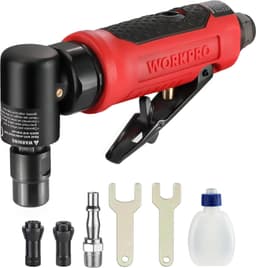
A 90 degree head puts the accessory axis sideways to the grip. That is the natural layout for 2 inch sanding discs, flap wheels, and surface rust where the abrasive must lie flat on the panel. The Anesty GL558-7 kit includes twenty quick-change discs. The WORKPRO angle shares 85.5 L/min at 90 psi with its straight sibling but runs a 20,000 rpm angle head. Do not assume an angle head equals more power. Face work can feel easier because you push along the disc face, but air use follows the listing, not the head angle. UK buyers like angle tools for wheel lips and tight corners where a straight disc would gouge. Failure modes differ. WORKPRO angle reviews mention trigger roll pins and spindle sparks. The QWORK’s 12,000 rpm body targets sanding discs, not carbide burr speeds. Treating it as a porting grinder is a category error. An angle pneumatic die grinder does not replace a mains angle grinder on large cuts. It replaces awkward finger work with discs in spaces where a big guard will not fit, provided the compressor keeps rpm. When amazon titles blur angle grinder and die grinder, read the rpm and what is in the box. A kit with only sanding discs at 20,000 rpm expects face work, not a 30,000 rpm carbide port. Model names for disc work versus burr work are on best air die grinder UK.

Extended reach

An extended straight body, the LithiCraft BF007 in the comparison, adds shaft length ahead of the collet for tyre shoulders, deep pockets, and spots where even a compact angle head is too wide. It still runs burrs in line with the extended shaft, not a disc face parallel to the panel, unless you mount a very small radial accessory meant for that rpm. UK reviews on the LithiCraft praise reach on car work but note loud running, high air use, and weak speed control, with only six ratings on amazon.co.uk at capture. Reach is described in the text more clearly than long-term durability. Choose extended when a standard straight cannot physically enter. Choose angle when the job is face sanding. Choose a standard straight for everyday burrs and welds. Air sizing is the same in principle for every shape. Free air delivery with a margin matters more than head angle. Worked examples are on what size compressor for a die grinder. Default to straight for burrs and weld dressing. Default to 90 degrees for disc kits and flat rust. Consider an extended straight only when neither standard shape fits, and size the air before you buy on reach alone.

Which shape, on one condition

If you are looking along a shank into a port or along a weld, buy straight. If the abrasive has to lie on a panel, a wheel lip, or a patch of rust, buy 90 degrees and match the disc to the stated rpm. If the path is a narrow recess or a tyre shoulder that a short body cannot enter, an extended straight is the third shape, and six reviews are not a life test. Head angle does not change the collet rule: 6 mm is not 1/4 inch.

Common questions

Which shape for carbide burrs in a port?
Straight, with a collet matched to the shank, usually 6 mm or 3 mm in the UK. An angle head is awkward when you need to look along a deep port. Most straight rows in this set sit around 20,000–25,000 rpm, which is the band those burrs are bought for.
Which shape for 2 inch sanding discs?
A 90 degree kit designed for discs at about 20,000 rpm, such as the Anesty or the WORKPRO angle. Verify the collets and the rpm on delivery. A straight 25,000 rpm burr body is the wrong geometry for a disc that must lie flat.
Can I use an angle head for deburring inside a bore?
Sometimes, if the bore diameter clears the head width and you accept awkward sight lines. A straight pencil or a standard straight body is usually the safer choice for in-bore work, because you can look along the shank.
When is extended straight worth it over an angle head?
When you need length along a narrow path, such as tyre buffing or a deep recess, rather than a flat disc on a panel. An extended shaft does not replace a disc kit for a large flat rust patch. It still spins the burr in line with the shaft.
Does an angle head use more air?
Consumption follows the listing in cfm or L/min, not the geometry. The WORKPRO straight and the WORKPRO angle share 85.5 L/min in this set. Add a free-air-delivery margin either way. A 90 degree head is not automatically thirstier.
Will a 90 degree kit replace an angle grinder?
No for large cuts and for the guard coverage of a mains angle grinder. Yes for small disc work in tight automotive corners, if the air supply keeps speed and you use discs rated for that rpm. Read the box, not only the title.

Related pages

Sources

Public UK sources from the research digest, used for this page in October 2026. Prices, stars and review counts are from the twelve amazon.co.uk listings captured on 20 October 2026. Trade airflow is labelled separately from gaps on those listings. Noise, vibration, PUWER and pressure-systems rules apply at work. They are not a certificate for a hobby garage.

  1. Sealey, SA671 instructions (retrieved 20 October 2026)
  2. Sealey, Guide to compressors (retrieved 20 October 2026)
  3. legislation.gov.uk, Control of Noise at Work Regulations 2005 (retrieved 20 October 2026)
  4. legislation.gov.uk, vibration regulation 4 (retrieved 20 October 2026)
  5. HSE, PUWER overview (retrieved 20 October 2026)
  6. legislation.gov.uk, PSSR Schedule 1 (retrieved 20 October 2026)
  7. Heamar, Ingersoll Rand 308B-M (retrieved 20 October 2026)
  8. Power Tool Sales, CP876 (retrieved 20 October 2026)