Independent comparisons. We may earn from shop links. More info

How to wear a tool belt

Updated: 17 October 2026

Learning how to wear a tool belt starts before you put a hammer in it. Measure over the clothes you work in, settle the belt around your hips, and arrange tools so you can reach them without twisting or letting a hammer strike your knee. This guide is about fit and use rather than product ranking. If you have not chosen a layout yet, start with our [tool belt comparison](/hub/tool-accessories/tool-belt) and the separate [tool belt buying guide](/hub/tool-accessories/tool-belt/sub/tool-belt-buying-guide). A qualifying purchase can earn a commission at no extra cost to you.

Learning how to wear a tool belt starts before you put a hammer in it.

Our top picks

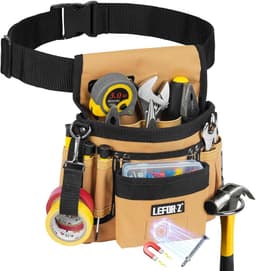
LEFOR·Z LEFOR·Z 14-pocket pouch

Best overall

LEFOR·Z LEFOR·Z 14-pocket pouch
8.2/10about £14.99
Stanley Stanley Essential apron

Best value

Stanley Stanley Essential apron
8.8/10about £14.38
On this page

Measure where you will wear it

Do not start from the waist printed in your jeans. Measure around the hips where the pouches will hang, over the trousers and any layer that will sit under the belt. Compare that number with the maker's range. A TF Tools example pairs 33-inch jeans with a 37-inch measurement over work clothes. Occidental Leather says its own sizing may sit roughly 3–7 inches above trouser waist. That guide is for its belts, not for every Amazon listing. Leave room either side of your measurement. A Stanley leather owner with a roughly 32-inch waist reported a long spare strap. Secure it in the keeper. The HAUTMEC HT0400 claimed about 46 inches, but one review described wearing it at around 36 inches. Test it indoors while you can still return it.

Put the hammer on the working side

Place the hammer where the hand that uses it can draw it without crossing the body, often just behind that hip, with fixings for the other hand. Writing hand is not always hammering hand, so try the motion. The handle should clear your knee when you walk and kneel. If it strikes your leg, move the loop or carry the hammer elsewhere. None of these ten products is a dedicated left-handed model. Removable pouches are easier to swap than one stitched right-side slot. Do not reverse a shaped belt if that turns the buckle and the pocket openings the wrong way. A carpentry carry is on the carpenter tool belt page.
LEFOR·Z LEFOR·Z 14-pocket pouch

Testsieger

LEFOR·Z LEFOR·Z 14-pocket pouch
8.2/10about £14.99

Recognise when the belt is at fault

A long spare tail is an adjustment problem if no keeper controls it. A pouch that slides around the waist may need a stop or a different attachment. A thin strap that twists into a rope, as one Copechilla review described, is not fixed by pulling it tighter. Load the empty belt in steps: tape and pencil, then the hammer, then a few fixings. After each step, see whether the buckle slips or one side drops. A heavy cluster on one hip should not pull you sideways. If the belt is stable empty and distorts with one bulky tool, take that tool off. Walk, kneel and bend indoors with that test load. A low belt can hit the thigh. A high belt can press the waist when you bend. In the first week, a sliding buckle, a tearing stitch or an enlarged eyelet is a defect or a capacity warning, not a reason to punch another hole. Reported faults are on the best tool belt page.

Manage load, braces and discomfort

The Health and Safety Executive does not set one kilogram figure that makes a belt safe below it and unsafe above it. A listing's 10 kg line does not mean that load belongs on your hips. Carry this task's tools and refill from a box. Braces can spread pressure. They do not fix a poor pocket map. Stop if you get numbness, a changed walk or pain that outlasts the shift, and speak to your GP or occupational health service as appropriate. An ordinary tool belt is not fall-arrest equipment. Never clip yourself to an anchor with it.

Common questions

Do I use my jeans size?
No. Measure around the hips where the tool belt will sit, over the work clothes you normally wear. Trouser labels can differ from your actual clothed measurement, and thicker winter layers add more. Choose a belt whose adjustment range leaves room on either side rather than placing you at the final hole.
Where should a tool belt sit?
Most tool belts should sit securely around the hips, close enough to the body that pouches do not swing but not so tight that breathing or bending is restricted. The exact height depends on your shape and pocket drop. Test walking, kneeling and reaching with a light real-world load before keeping it.
Which side should hold the hammer?
Usually, put the hammer just behind the hip on the side of the hand that actually uses it, leaving the other hand to take fixings. Test the draw because your hammering hand may differ from your writing hand. The handle should clear your knee and should not force you to twist.
What should a left-handed user check?
Check whether the hammer loop and pouches are removable or symmetrical. A fixed right-side loop cannot always be made left-handed by reversing the belt, because pocket openings and buckle orientation may then be wrong. None of the ten belts in our comparison was presented as a dedicated left-handed model.
Why does my pouch slide around?
The belt may be too narrow for the attachment, the pouch may lack a stop, or the whole belt may be too loose. Confirm compatibility before improvising a fix. If a loaded pouch still travels or flips after correct adjustment, replace the attachment or layout rather than tightening the belt until it hurts.
When should I stop wearing the belt?
Stop if you experience numbness, persistent pain, broken hardware, altered balance or a strap that cannot hold its adjustment. Remove unnecessary tools and inspect the belt. Seek medical or occupational-health advice when symptoms outlast the job, and never use an ordinary tool belt as safety or fall-arrest equipment.

Related pages

Sources

Public UK sources for manual handling, work equipment, PPE, sizing, and consumer-rights context. Amazon prices, stars, and review counts are the stored amazon.co.uk pages for these ten ASINs. Listings checked 17 October 2026. Prices move.

  1. HSE, manual handling (retrieved 17 October 2026)
  2. Manual Handling Operations Regulations 1992 (retrieved 17 October 2026)
  3. HSE, manual handling risk filters (retrieved 17 October 2026)
  4. HSE, PUWER overview (retrieved 17 October 2026)
  5. PPE at Work Regulations 1992, regulation 2 (retrieved 17 October 2026)
  6. Consumer Rights Act 2015 (retrieved 17 October 2026)
  7. TF Tools, Badger tool belt sizing (retrieved 17 October 2026)
  8. KITD, tool belts, pouches and rigs (retrieved 17 October 2026)