Independent comparisons. We may earn from shop links. More info

Tool belt buying guide

Updated: 17 October 2026

If you are choosing a belt for jobs around a UK home or site, the largest pocket count is rarely the best starting point. This tool belt buying guide puts the decisions in a more useful order: decide what you need to carry, choose the type of belt, measure where it will sit, and inspect the hardware that supports the load. Our [tool belt comparison](/hub/tool-accessories/tool-belt) covers the individual products. This guide helps you decide which sort belongs on your shortlist before price or branding distracts you. A qualifying purchase can earn a commission at no extra cost to you.

If you are choosing a belt for jobs around a UK home or site, the largest pocket count is rarely the best starting point.

Our top picks

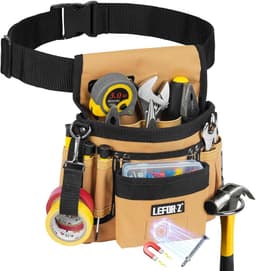
LEFOR·Z LEFOR·Z 14-pocket pouch

Best overall

LEFOR·Z LEFOR·Z 14-pocket pouch
8.2/10about £14.99
Stanley Stanley Essential apron

Best value

Stanley Stanley Essential apron
8.8/10about £14.38
On this page

What you are actually buying

Tool belt can mean four different products. An apron spreads pockets around the waist for mixed hand tools and fixings. A single clip-on pouch holds a small set without wrapping the whole waist. A rig combines a belt with larger pouches, sometimes with braces. A belt-only product is the platform you add storage to. The HAUTMEC HT0141-TB was listed at £71.99 but is a padded belt without the pouches most shoppers expect. The £7.99 WORKPRO is a small garden belt, not a building-site rig. Write down what must stay on your body, such as a tape, pencil, knife, hammer and a handful of fixings. A full apron suits both hands needing quick access. A small pouch is often better for occasional DIY. Pocket count cannot compensate for weak eyelets, a twisting strap or a buckle that slips.

Match the pockets to the working hour

Count tasks, not pockets. A carpenter may need a deep pocket for nails or screws, a hammer holder and a place for a tape. An electrician is more likely to want narrow sleeves that keep drivers, pliers and a tester upright. Twenty-seven undivided spaces do not automatically serve either trade. Think through an ordinary hour. Put lighter items you use often in the easiest positions, and leave a drill off the belt unless there is a supported holster. A drill pushed into a fixing pocket can pull the belt out of shape and move weight away from your body. Household work may need only a tape, pencil, screwdriver, knife and a few fixings. A gardener may need secateurs and no hammer loop. Carpentry layout is on the carpenter tool belt page.
LEFOR·Z LEFOR·Z 14-pocket pouch

Testsieger

LEFOR·Z LEFOR·Z 14-pocket pouch
8.2/10about £14.99

Check waist, hardware and loaded comfort

Do not order from your jeans size alone. Measure around the hips where the belt will sit, over the clothes you work in, and compare that with the stated range. A TF Tools note pairs 33-inch jeans with a 37-inch measurement over work clothes. The trouser label is not enough. The HAUTMEC HT0400 was advertised to about 46 inches, yet one review described wearing it at roughly 36 inches. Want spare adjustment, and an easy return, if you are near either end. Denier is yarn mass. 1680D does not prove the eyelets or the buckle. The Copechilla 10 kg line is not a recommended safe load. The Health and Safety Executive sets no universal kilogram limit. If the belt sags or twists, reduce the load before you add braces.

Make the final trade-offs

Material comes after layout and fit. Leather can hold its shape around sharp hand tools but needs drying. Synthetic fabric is lighter and often easier when it gets damp. A fibre name should not overrule poor stitching or the wrong pockets. That choice is on the leather or nylon tool belt page. When the belt arrives, load only the hourly kit and wear it indoors over your work clothes. Check the buckle, whether a hammer clears your knee, and whether spare strap can be secured. Inspect seams again while returns are still practical. Placement is on the how to wear a tool belt page.

Common questions

How many pockets do I need?
You need enough separate spaces for the tools and fixings you use repeatedly, not every item you own. List one normal hour's carry and assign each item a sensible place. Five useful pockets can outperform twelve shallow or duplicated ones, particularly if the smaller layout stays close to your body and leaves room to bend.
Should I buy the belt with the highest pocket number?
No. Pocket shape, position and attachment matter more than the headline total. A carpenter needs a deep fixing pocket and a hammer holder, while an electrician benefits from narrow organised sleeves. Compare the actual layout with your tools, then examine waist range, buckle, eyelets and stitching before using pocket count as a tie-breaker.
Do I order using my jeans size?
Measure over the clothes you will work in, around the hips where the belt will sit. Jeans sizing can differ from that measurement by several inches, especially over winter layers. If your result is near the stated maximum or minimum, choose a model with more adjustment or confirm that returns will be straightforward.
When are suspenders worth having?
Suspenders can help distribute the pressure of a loaded rig during longer jobs, but there is no universal weight at which they become compulsory. First remove tools that do not need to be carried. If the belt still sags or concentrates pressure, braces may improve comfort, provided they fit securely and do not restrict movement.
Is a padded belt without pouches still a tool belt?
It can be a tool-belt platform, but it is not a complete storage rig. Check whether pouches are included, pictured only for context, or sold separately, and whether the attachment system accepts products you can readily buy in the UK. Add the full cost of belt, pouches and braces before comparing it with an apron.
Is a tool belt personal protective equipment?
An ordinary tool belt organises tools. It is not fall-arrest equipment or a substitute for task-specific personal protective equipment. Do not attach yourself to an anchor with it, and do not assume that its load claim is a safety certification. Employers should assess manual-handling and site risks for the actual task.

Related pages

Sources

Public UK sources for manual handling, work equipment, PPE, sizing, and consumer-rights context. Amazon prices, stars, and review counts are the stored amazon.co.uk pages for these ten ASINs. Listings checked 17 October 2026. Prices move.

  1. HSE, manual handling (retrieved 17 October 2026)
  2. Manual Handling Operations Regulations 1992 (retrieved 17 October 2026)
  3. HSE, manual handling risk filters (retrieved 17 October 2026)
  4. HSE, PUWER overview (retrieved 17 October 2026)
  5. PPE at Work Regulations 1992, regulation 2 (retrieved 17 October 2026)
  6. Consumer Rights Act 2015 (retrieved 17 October 2026)
  7. TF Tools, Badger tool belt sizing (retrieved 17 October 2026)
  8. KITD, tool belts, pouches and rigs (retrieved 17 October 2026)