Independent comparisons. We may earn from shop links. More info

Tool bag vs toolbox

Updated: October 2026

The tool bag vs toolbox decision depends on what moves with you and what needs protecting. A fabric bag is usually better for a limited set of hand tools carried into a room or across a site. A rigid box suits equipment that stays in a van, needs a structured lid, or has become too heavy for one-shoulder carrying. Current bag formats are in the [tool bag comparison](/hub/tool-accessories/tool-bag). Neither type is automatically safer. The answer comes from the kit, the weather, the route, and whether you need quick retrieval, physical protection, wheels or some resistance to unauthorised access. A qualifying purchase can earn a commission at no extra cost to you.

The tool bag vs toolbox decision depends on what moves with you and what needs protecting. A fabric bag is usually better for a limited set of hand tools carried into a room or across a site.

Our top picks

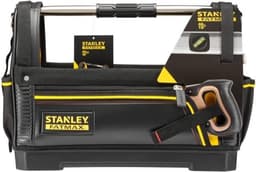
Stanley Stanley FatMax open tote

Best overall

Stanley Stanley FatMax open tote
9.4/10about £39
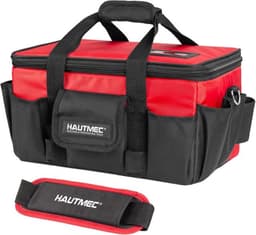
HAUTMEC HAUTMEC HT0401

Alternative

HAUTMEC HAUTMEC HT0401
8.6/10about £39.99
On this page

What each storage type is for

A tool bag bends around awkward hand tools and is lighter than many rigid systems. A framed mouth lets you see into the centre. An open tote keeps frequent tools immediately available. A toolbox puts a hard structure around the contents. It is the stronger start for power tools that need protection, accessories that belong in trays, or kit that stays in a vehicle. A lid may take a lock. The security still depends on the product and how you secure it. A fabric zip is not secure van storage. The line is not absolute. The HAUTMEC HT0401 sits between a soft bag and a box. A hard-base bag protects the bottom without enclosing the sides. If the question is bases, openings and sizes, start with the tool bag buying guide.

Why some buyers leave the box behind

Review signals describe buyers moving from a rigid box to a tote or a technician bag because the tools were easier to see indoors. One anecdote mentions avoiding the clips on a DeWalt box. Those accounts are a use case, not a controlled comparison. The advantage is a selected day kit, such as a drill, bits, tape, a level and a few hand tools, without the full workshop. An open tote removes the zip step. A wide-mouth holdall protects the contents better on the walk. That advantage goes if the bag becomes a general store. Wall pockets push into the centre, the zip strains, and the stairs get awkward. A bigger bag postpones the decision. How to organise a tool bag keeps the day kit selective.

When a bag is the wrong object

Choose a box when protection, structure or security matters more than flexible access. Valuable tools in a van need more than fabric. An open tote is a poor choice in rain or when it is left unattended. A bag described as waterproof may only have a waterproof base. The zip, seams and pockets can carry narrower claims. A seller’s 18 kg or 30 kg figure does not belong on one shoulder as a target. HSE guidance considers the whole handling task and gives no universal legal safe kilogram limit. If the load is repeatedly heavy, a rolling box can turn a carry into a push. Kerbs, stairs and the lift into a van still count. A loose bag on a ladder occupies a hand and can let tools fall. A longer strap is not the fix. A box is clearer when stock needs rigid divisions, because screws, plugs and blades migrate through a soft compartment.

Keep both, with one condition

For many mobile users the practical answer is a box plus a bag. Keep the broader kit and stock in a secured van box or a workshop system. Load only the next task into a day bag. The condition is that the bag is reset. If tools move into the bag and never return, you carry duplicates and both systems drift. At the end of the job, remove waste and damp items, return specialist tools, and restock only what you expect to use. A household can do the same thing smaller. A rigid box holds rarely used tools in a cupboard. A compact bag carries what you need upstairs or into the garden. If the kit is modest and it lives indoors, one zipped bag may be enough.

Common questions

Is a tool bag better than a toolbox?
A bag is better for a limited kit that you carry between rooms or from a vehicle to the job, especially when quick access matters. A box is better for rigid protection, structured storage or a load that should roll. The kit and route decide, not the label.
Are power tools safer in a box?
A fitted hard case generally protects a power tool better from impact and loose sharp objects than an unstructured compartment. A carefully packed hard-base bag can still carry a compact cordless kit. Protect batteries and accessories, and do not assume fabric provides security in a vehicle.
Why do trades use open totes?
An open tote keeps frequently used hand tools visible and removes the need to operate a zip repeatedly. That speed is useful during indoor fitting or maintenance. The trade-off is exposure to rain, dust, falling items and unauthorised access, so it is not the best format for every site.
When do I need wheels?
Consider wheels when the kit is repeatedly too heavy or bulky for a controlled carry, or when the distance from vehicle to work area is long and reasonably level. Wheels change the handling task rather than removing risk. Steps, kerbs, slopes and lifting into a van still matter.
Can a fabric tool bag be locked?
Some zips may accept a small lock, but fabric and ordinary zip construction do not provide the protection of a secured rigid system. Do not rely on a soft bag for valuable tools left unattended. Follow your workplace and insurer’s storage requirements where they apply.
Does a lighter bag mean a safer lift?
Lower empty weight leaves more of the total load for tools, but it does not make the finished carry automatically safe. Balance, grip, distance, frequency and posture still matter. Pack for the actual route and split or wheel the load when it is no longer manageable.

Related pages

Sources

Public UK sources for manual handling, product safety, and how a tool bag is built. Listings checked 17 October 2026. Prices on amazon.co.uk move.

  1. HSE, manual handling (retrieved 17 October 2026)
  2. HSE, manual handling risk filters (retrieved 17 October 2026)
  3. Manual Handling Operations Regulations 1992 (retrieved 17 October 2026)
  4. Consumer Rights Act 2015 (retrieved 17 October 2026)
  5. General Product Safety Regulations 2005, Great Britain (retrieved 17 October 2026)
  6. Screwfix, tool storage buying guide (retrieved 17 October 2026)
  7. Expert Reviews, best tool bag (retrieved 17 October 2026)
  8. RS, tool bags guide (retrieved 17 October 2026)