Independent comparisons. We may earn from shop links. More info

Electrician tool kit for home DIY

Updated: October 2026

An electrician tool kit for DIY can support a small job after the circuit has been isolated and proved dead. It cannot decide whether the work is within your competence, remove a Part P requirement or make consumer-unit work safe. Before buying anything from our [electrician tool kit comparison](/hub/tool-accessories/electrician-tool-kit), define the job's stopping point. A householder replacing a damaged faceplate like for like has a different need from someone planning a new circuit or bathroom installation. For the narrow job, a correctly marked driver set may be enough. For the larger one, the right purchase is professional help. A qualifying purchase can earn a commission at no extra cost to you.

An electrician tool kit for DIY can support a small job after the circuit has been isolated and proved dead.

Our top picks

On this page

The job decides, not the case

Start with scope. Electrical Safety First advises DIYers to switch off the power and not to undertake electrical work if they are unsure. Installing a new circuit, and work in a bathroom, involve Part P requirements, notification and certification by a registered competent person. A red case labelled 1,000 V does not change that boundary. A small like-for-like accessory task may need only the correct screwdriver profile, provided you can isolate, secure and prove the circuit dead. Unexpected cable colours, damaged insulation, overheating, multiple supplies or a circuit that will not stay off are reasons to stop. Do not open a consumer unit because you own insulated tools. Live parts may remain when an outgoing circuit is switched off, and a plan that depends on working live is not suitable for DIY. The how to use electrician tools safely guide explains the isolation sequence. A tester pen in the case does not replace two-pole indication and a proving unit.

What a small home set actually needs

For UK accessories, check the screw heads first. Pozidriv is common, and PZ1 or PZ2 is not the same profile as Phillips PH1 or PH2. A mismatched cross-head can slip and mark the screw. Slotted terminal drivers need the correct width and thickness so the blade sits in the slot. IEC 60900 is the relevant hand-tool standard. VDE is a third-party certification route often seen on insulated tools. The bare word insulated, or a red or yellow handle, gives you less than a named standard. The VDE or IEC 60900 guide explains why a 1,000 V title is not enough on its own. Pliers are optional only if the job does not need them. Side cutters, combination pliers, long-nose pliers and wire strippers do different work. Buying fewer correct tools is better than crushing a conductor or cutting insulation with the wrong edge. Keep test equipment separate. A neon screwdriver is not a way to prove a circuit dead. GS38 addresses guarded tips and limited exposed metal on proper indicators. A two-pole voltage indicator and proving unit are safety equipment, not bonus pieces hidden in a hand-tool case.
ArmaKit ArmaKit AKVDE-14t

Testsieger

ArmaKit ArmaKit AKVDE-14t
9.6/10about £37.95

How the cheaper sets fit home DIY

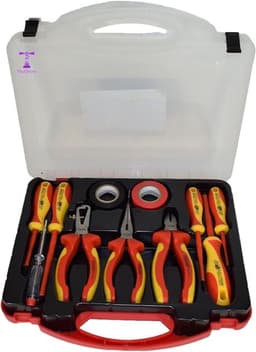
Tolsen is the clearest low-cost match for a narrow screwdriving job. It costs £19.95, lists Pozi, Phillips, slotted and Torx, claims VDE insulation up to 1,000 V, and has 4.6 stars from 2,020 reviews. There are no pliers, cutters, stripper or tester in the contents. PaulStore at £25.99 adds long-nose pliers, side cutters, an adjustable stripper, two tapes and a bulb tester. The bullets say insulated without naming IEC 60900 or VDE. A reviewer reported that photographed 1,000 V marks were missing from the delivered tools, and reviews criticise the case. The drivers are flats and two PH1s, with no Pozidriv. More pieces do not repair a missing Pozidriv or an unnamed standard. The electrician tool kit buying guide is the checklist.

Jobs that are not a screwdriver purchase

A bathroom installation and a new circuit are the examples Electrical Safety First highlights for DIYers. Those jobs involve Part P and should go through a registered competent person, with notification and certification. The same stop applies if you are changing circuit protection or working inside a consumer unit you do not understand. Fault finding is another boundary. If a breaker trips again, a circuit will not stay isolated, or a fitting still shows as live, do not keep swapping tools. A set of insulated drivers cannot identify an earth fault, confirm protective measures or certify the work. If you still buy a set for permitted, dead, like-for-like work, keep the choice conditional. Tolsen is the low-cost driver option where Pozidriv is needed. ArmaKit at £37.95 names IEC 60900 and is the more complete mixed set, yet no Pozidriv driver is listed. Compare the job against those omissions before choosing.

Common questions

Do I need a full electrician kit to change a faceplate?
Not necessarily. A straightforward like-for-like replacement may need only the correct drivers, provided you are competent, have isolated and secured the correct circuit, and can prove it dead with suitable equipment. Stop if the wiring, accessory or supply is not as expected.
Is the cheapest set enough?
Tolsen's £19.95 set may be enough for narrow screwdriving because it lists Pozidriv and claims VDE insulation. It is not enough where you require cutters, pliers, a stripper or equipment to prove dead. Judge sufficiency against the task, not price alone.
Why is no Pozidriv a problem?
Many UK electrical accessories use Pozidriv screws. A Phillips tip is shaped differently even if it appears to enter the recess, so it can slip or damage the screw. Check the fitting and choose the exact PZ size rather than treating all cross-head drivers as equivalent.
Can I open a consumer unit with 1,000 V tools?
A 1,000 V tool rating does not make consumer-unit work suitable for DIY. Parts may remain live despite switching off an outgoing circuit, and the risks require competence, safe isolation and appropriate equipment. If you are asking whether the tool rating makes it safe, stop and call a professional.
What if the circuit will not stay off?
Do not continue. Prevent access to the work area if necessary and obtain competent help. A circuit that re-energises, an isolator you cannot control or a confusing supply arrangement means the planned dead-working conditions have not been achieved. Do not improvise.
When is a competent person the answer?
Use a registered competent person for a new circuit, relevant bathroom work and other notifiable work, as well as any task beyond your knowledge. They are also the right answer when damage, repeated tripping, uncertain isolation or unexpected wiring turns a simple replacement into diagnosis.

Related pages

Sources

Public UK sources for live working, proving dead and isolation. Prices are the figures stored with these listings, not a live amazon.co.uk page.

  1. Electricity at Work Regulations 1989, regulation 14 (retrieved 17 October 2026)
  2. HSE GS38, electrical test equipment for use by electricians (retrieved 17 October 2026)
  3. HSE HSG85, electricity at work: safe working practices (retrieved 17 October 2026)
  4. BSI, BS EN IEC 60900:2018 (retrieved 17 October 2026)
  5. Electrical Safety First, Best Practice Guide 2 (retrieved 17 October 2026)
  6. Electrical Safety First, DIY advice (retrieved 17 October 2026)
  7. SELECT, steps to safe isolation (retrieved 17 October 2026)
  8. Maun Industries, is VDE a legal requirement? (retrieved 17 October 2026)