Independent comparisons. We may earn from shop links. More info

How to use a pool thermometer

Updated: October 2026

You already have a float or a scoop, or you are about to drop one into a garden pool, and the number moves every time you look. How to use a pool thermometer comes down to place, angle and waiting time. A reading taken in the sun on the surface, or in the stream from the return, is a real temperature of that spot and a poor guide to the water you swim in. This page is the routine, not a shortlist. Models and prices stay on the [pool thermometer comparison](/hub/swimming-pools/pool-thermometer). If the screen is blank because the link died, that is a fault, not a placement trick, and the [solar or wireless pool thermometer](/hub/swimming-pools/pool-thermometer/sub/pool-thermometer-solar-or-wireless) page is where those failure patterns sit.

You already have a float or a scoop, or you are about to drop one into a garden pool, and the number moves every time you look. How to use a pool thermometer comes down to place, angle and waiting time.

Our top picks

AQUAVERITY AQUAVERITY IN-327

Best overall

AQUAVERITY AQUAVERITY IN-327
9.2/10about £8.95
PoolPrime PoolPrime dual screen

Alternative

PoolPrime PoolPrime dual screen
8.0/10about £25.99
On this page

Put it where the water is ordinary

Choose a patch that is neither the skimmer nor the return. The skimmer pulls the surface film, and a loose float ends up against the weir. The return is the jet from the pump, often the first place a heater or a solar loop dumps warmer or cooler water. A reading there tells you what the pipe just delivered. Nothing in this set’s listings measures a set distance from that jet, so do not invent a gap in feet. Surface water in sun can sit warmer than the water a hand’s depth down. UK reviews of the analogue float say the number at the surface is not the swim. A solar float’s sensor is still near the top, under the body of the float. That layer is usable if you always read it. It is misleading if you compare yesterday’s dipped scoop with today’s sunlit skin. Same place and a similar time of day is the comparison that means anything. A thermometer left on top of a cover is reading air and plastic.

Tether it, and expect the cord to age

Tie the float so it cannot travel into the skimmer, and not to the return fitting. The tether is wear, not a lifetime part. On the PoolPrime dual-screen float the bullet includes a nylon cord, and one UK review said that cord perished within six to eight weeks of strong sun. That is one review, not a rate for every nylon line. Look at the cord when the float goes missing before you assume the thermometer has failed. The Thermometer World included-components line lists the thermometer only. UK reviews mention a rope that failed. If your box had no cord, add your own and check the knot after hot days. A string does not waterproof the case. These listings do not give a UK freeze temperature for winter storage, so this page will not invent one. Bring a battery unit indoors if the care text says to remove the cells, which is what the Aottom care line says.
AQUAVERITY AQUAVERITY IN-327

Testsieger

AQUAVERITY AQUAVERITY IN-327
9.2/10about £8.95

How you read a scoop or an analogue tube

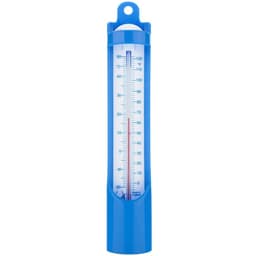
A scoop is not a leave-in. The AQUAVERITY IN-327 is the scoop in this set: submerge it for about 30 seconds and read the display at eye level. Pulling it out early, or reading it from a low angle, manufactures a number you then argue with. One UK review said that, left in a below-ground pool, it only sampled just under the surface. Use the half minute, then take it out. An analogue tube cares about angle. UK reviews of the Thermometer World float say it can sit upright or on its side unless you weight it or hold it, and that a sideways position changes the reading. Lift it and hold it as the scale expects. If condensation hides the column, orientation will not save the reading. The liquid is not named, so do not shake it like a fever thermometer.

Caps, covers and a blank screen

A wireless float has a cap. The Aottom bullet says the unit is IP68 with a sealed rubber ring and tells you to tighten the cap before you immerse it. A loose cap is a placement error you can still fix. A link that never returns, or a solar screen that stays blank after daylight, is past placement. Point a solar panel at sky rather than leaving it under a dark cover and then calling the pool cold. You will not reseal a leaked case with a better knot. Hot-tub water has its own ceiling, on the hot tub thermometer page. Do not store a wet electronic float in a sealed bag and expect the seal to improve.

Common questions

Where should the float sit?
Put it in ordinary pool water, away from the skimmer mouth and away from the return jet. Those two spots move or heat a thin layer and then pretend it is the whole pool. Use the same area each time, at a similar time of day. A float on top of a cover is reading the cover, not the swim. Nothing in these listings gives you a measured distance from the jet, so clear of it is the instruction.
Why tether it?
So it does not end in the skimmer, where you lose it and where the reading is surface water on the move. A tether still ages. One UK review of a nylon cord said it perished in six to eight weeks of strong sun, and reviews of the analogue float mention a rope that failed. Check the line when the number or the float goes missing. The cord is not a waterproof seal.
How long does the scoop need in the water?
The AQUAVERITY listing prints about 30 seconds. Submerge it, wait that long, and read at eye level. A shorter dip is a different measurement. This scoop is a tool you hold, not a gauge you leave overnight in a below-ground pool. A UK review said a leave-in attempt only sampled just under the surface. Take the reading, then take the scoop out.
Why does the analogue tube read oddly on its side?
Because the column is meant to be read in a set orientation, and UK reviews say this float sits upright or sideways unless you weight it or hold it. A sideways tube changes the number. Lift it and hold it level rather than trusting the deck view of a floating stick. If condensation hides the column, orientation will not give you a clear figure either.
Is the surface the same as the water I swim in?
Often it is warmer, especially in sun. UK reviews of the analogue float make that distinction: surface versus deeper water. A solar float also senses near the top, under its own body. That layer is usable if you always measure it. It is a poor match for a scooped reading taken lower down, or for how the pool feels at chest depth on a hot afternoon.
What do I tighten on a wireless float before it goes in?
On the Aottom, tighten the cap. The bullet says IP68 with a sealed rubber ring and tells you to do that before immersion. Other wireless units in this set are not all written the same way, so read the cap note on the model you hold. A tight cap does not repair a link that has already died, and it does not add the batteries the technical block forgot to count.
When is a blank screen a fault rather than a placement error?
After you have moved it out of the skimmer, given a scoop its 30 seconds, held an analogue tube level, and given a solar panel some daylight off the cover. If the screen is still blank, or the indoor receiver never finds the float, treat it as a failed unit. UK reviews across the solar and wireless rows describe dead displays and dead links within weeks or months. That is not fixed by a better knot. Do not open a sealed cell hoping to dry it on the kitchen radiator.

Related pages

Sources

Public UK sources for managed-pool temperature context, the hot-tub ceiling, cold-water shock, and mercury controls. Listings are the amazon.co.uk captures for these eleven ASINs, not a live reload on 17 October 2026. Prices on amazon.co.uk move.

  1. HSE, swimming pool safety (retrieved 17 October 2026)
  2. Hastings FOI on pool temperature (retrieved 17 October 2026)
  3. Wokingham FOI, swimming pool temperature (retrieved 17 October 2026)
  4. PWTAG, temperature cuts (retrieved 17 October 2026)
  5. GOV.UK, controls on mercury (retrieved 17 October 2026)
  6. GOV.UK, General Product Safety Regulations 2005 (retrieved 17 October 2026)
  7. RNLI, cold water shock (retrieved 17 October 2026)
  8. BISHTA, hot tub temperature and HSG 282 (retrieved 17 October 2026)