Independent comparisons. We may earn from shop links. More info

Hot tub thermometer

Updated: October 2026

You are about to get into a hot tub, the panel on the cabinet shows a comfortable number, and you are not sure the water agrees. A hot tub thermometer is the second instrument you use to check that panel. It is not a gadget for running the tub hotter, and it is not a substitute for the tub’s own high-limit kit. The ceiling you are checking is 40°C. Prices for the pool floats that can display that band stay on the [pool thermometer comparison](/hub/swimming-pools/pool-thermometer). Where you tie the float is on the [how to use a pool thermometer](/hub/swimming-pools/pool-thermometer/sub/pool-thermometer-how-to-use) page. This page is the temperature and the scale, not a chemical procedure and not a repair of the heater.

You are about to get into a hot tub, the panel on the cabinet shows a comfortable number, and you are not sure the water agrees. A hot tub thermometer is the second instrument you use to check that panel.

Our top picks

AQUAVERITY AQUAVERITY IN-327

Best overall

AQUAVERITY AQUAVERITY IN-327
9.2/10about £8.95
Inkbird Inkbird IBS-P01R

Alternative

Inkbird Inkbird IBS-P01R
7.2/10about £29.59
On this page

The temperature you are checking

The British and Irish Spa and Hot Tub Association says you should never run a hot tub above 40°C. BISHTA’s factsheet on using a hot tub safely puts a typical adult soak at about 37°C, and about 36°C for children under 12. Children under four stay out, on the medical advice BISHTA cites. About 37°C is a soaking temperature, not a target to beat and not a licence to edge upward because the water feels mild in a cold garden. The ceiling is 40°C. Past that, you get out and you let the tub cool. BISHTA also says to keep a separate thermometer so you can check the number the tub is showing you. A GOV.UK product safety alert for certain Sundance and Jacuzzi hot tubs, recall 2301-0007, described a faulty temperature sensor that could display the wrong temperature. The alert’s wording includes a risk of the water being hotter than shown, with burns as the harm, and it told owners to confirm the water with an external thermometer until the sensor was replaced. Those tubs are not the ASINs in this pool comparison. The alert is why a second thermometer exists at all. BISHTA says reputable brands are factory-set so they cannot be run above 40°C. That is BISHTA’s statement about those brands, not a test we ran on your tub. A commercial operator note from Argyll and Bute Council, written for Scandinavian spas in January 2024, says the same ceiling: never exceed 40°C, with about 36°C to 38°C for a healthy adult, and provide a thermometer. It points at HSE’s HSG282 and at BS EN 17125:2018. HSG282 is about spa-pool systems, and it records that prolonged immersion above body temperature can lead to delayed shock. That book is for operators, not a float review. If you are pregnant, or you have a heart or blood-pressure condition, BISHTA and that operator note both send you to a GP or the manufacturer’s medical warnings. This page will not add bathing-time prescriptions of its own. BISHTA’s factsheet includes a break of about 15 minutes as its recommendation. Treat that as BISHTA’s line, not as personal medical advice from a product comparison.

Which scales in this set can show that

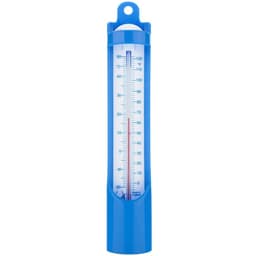
A pool thermometer can check a tub kept within that ceiling if its scale clearly includes about 36°C to 40°C and still has a little headroom so 40°C is not the last unreadable mark. An upper rating of 50°C does that. It does not invite you to heat toward 50°C. The AQUAVERITY scoop prints −20°C to +50°C on the bullet, and the technical upper rating is also 50°C. One UK reviewer was disappointed it stopped at 50. For a tub that must not pass 40°C, the stop is not the problem. The problem would be trusting a panel that reads 39 while the water is already over the ceiling and the scoop is still in a drawer. The Thermometer World analogue float has an upper rating of 50°C and no battery. It can show the same band if you hold it so the column is readable. The liquid is not named. The Mupkvy solar float’s technical upper rating is 50°C as well, with only three reviews, one of them a rusted, capsized unit after seven days. A scale that reaches 50°C is not a reason to buy a three-review float. Inkbird’s sensor lines print up to 70°C, on both the IBS-P01R and the IBS-P05R. That extra room can show an overheating tub that a 50°C scale would clip. It is still not a suggestion to use the extra room. The awkward listing is the Baldr dual-screen solar float. The bullet says −9°C to 80°C. The technical block says an upper rating of 50°C. Both are printed. You can see 40°C on either figure. You cannot be sure the product is the 80°C instrument the bullet describes. The PoolPrime dual screen is cleaner on this one point: bullet and technical line both go to 80°C. Do not heat toward the top of any of these scales. A thermometer that can display 70°C is how you notice a fault. It is not a control knob.
AQUAVERITY AQUAVERITY IN-327

Testsieger

AQUAVERITY AQUAVERITY IN-327
9.2/10about £8.95

Float on the water or a monitor indoors

A covered tub hides the float’s own screen, which is the practical case for a receiver. UK reviews do put the Inkbird IBS-P01R, the Longzhuo and the Aottom on hot tubs. The same files describe early failures: transmitters that stop, links that drop, seals that let water in, often within weeks or a few months. That is a pattern in the stored reviews, not a failure rate you can quote as a percentage. A monitor is useful while it lives. It is a bad single source if you have no second way to check the water on the day the receiver goes quiet. If you will lift the cover and look, a solar float or the analogue float is the simpler check, with the life limits already on those listings. The scoop is the one you hold in the water for about 30 seconds when you do not trust a leave-in unit in hot, chemically treated water. None of these products adjusts the heater. If the external thermometer and the panel disagree, or the water feels wrong, stop using the tub and follow the manufacturer’s high-limit and sensor procedure, or a competent service visit. HSG282-level water treatment and legionella control for a commercial spa are not something a float write-up can finish for you. The solar or wireless pool thermometer page is where you choose deck screen versus indoor receiver once you know 40°C is the number that matters. Before you order, read the upper line twice on the main comparison, and do not pay extra for a scale you intend to use past the ceiling.

When a new float will not fix it

A new thermometer is the wrong next step when a simple recheck, cover open, probe actually in the water, still disagrees with the panel. It is the wrong step when the water is above 40°C and will not come down, and when a high-limit or a sensor has already been recalled or has failed. A replacement LCD will not repair a heater that overshoots. Commercial chemistry and legionella control belong with a competent person and HSG282. If you have not chosen a type yet, the pool thermometer buying guide is the criteria page, not a repair guide.

Common questions

What is the hottest a hot tub should be?
40°C, as a ceiling, not as a goal. BISHTA’s guidance is never above 40°C. A council note for commercial Scandinavian spas says the same and cites BS EN 17125:2018. If your external thermometer shows over 40°C, do not get in while it cools. A pool float that can display 50°C or 70°C is there to reveal that overshoot. It is not there to encourage it.
Is 37°C a target or a ceiling?
About 37°C is BISHTA’s adult soaking figure. The ceiling is 40°C. About 36°C is the figure BISHTA gives for children under 12, and children under four stay out on the medical advice it cites. You are not trying to creep from 37 toward 40 because the evening is cold. If the panel and a separate thermometer disagree, believe the need for a check, not the more flattering number.
Can a pool thermometer that stops at 50°C still check a tub?
Yes. 40°C sits inside a scale that ends at 50°C, which is the AQUAVERITY bullet, the analogue float’s upper rating, and the technical line on several solar units. What a 50°C stop cannot do is show you 55°C as a number rather than as at the end of the scale. One UK reviewer wanted more than 50 on the scoop. For a tub run within BISHTA’s ceiling, that extra scale is optional, not required.
Should I trust the tub’s own panel alone?
No. BISHTA tells you to keep a separate thermometer for that check. GOV.UK alert 2301-0007 is a case where a faulty spa sensor could show the wrong temperature and create a burn risk, and owners were told to use an external thermometer until it was replaced. Your tub may not be in that recall. The habit is still the right one: panel plus a second reading, especially after a repair or when the water feels hotter than the display.
Do children use the same temperature?
BISHTA does not use one figure for every age. About 36°C is the line it gives for children under 12, against about 37°C for adults, with the same 40°C ceiling. Children under four should not use the tub, following the medical advice BISHTA cites. Supervision and the manufacturer’s age rules still apply. A thermometer does not make a too-young child into a safe bather.
Is a wireless monitor useful on a covered tub?
It can be, because the float’s screen is under the cover and the receiver is indoors. UK reviews do mention these wireless units on hot tubs, and the same reviews include links and transmitters that died within months. Use the monitor as a convenience while it works, and keep a way to check the water directly when it does not. A 300 metre claim on a bullet is not what makes the covered-tub case valid. The cover does.

Related pages

Sources

Public UK sources for managed-pool temperature context, the hot-tub ceiling, cold-water shock, and mercury controls. Listings are the amazon.co.uk captures for these eleven ASINs, not a live reload on 17 October 2026. Prices on amazon.co.uk move.

  1. HSE, swimming pool safety (retrieved 17 October 2026)
  2. Hastings FOI on pool temperature (retrieved 17 October 2026)
  3. Wokingham FOI, swimming pool temperature (retrieved 17 October 2026)
  4. PWTAG, temperature cuts (retrieved 17 October 2026)
  5. GOV.UK, controls on mercury (retrieved 17 October 2026)
  6. GOV.UK, General Product Safety Regulations 2005 (retrieved 17 October 2026)
  7. RNLI, cold water shock (retrieved 17 October 2026)
  8. BISHTA, hot tub temperature and HSG 282 (retrieved 17 October 2026)