Store inflatable hot tub for winter: powered or dry

Leave a Lay-Z-Spa up in a frost only when Freeze Shield is real and the pump stays powered. Otherwise drain, dry, and store the tub well above about 4°C.
On this page

A hard frost is on the forecast and the spa is still full on the patio, cover on, pump plugged into the summer socket. You looked up how to store inflatable hot tub for winter because leaving it there feels like a gamble. It is a choice with two paths. A Lay-Z-Spa with a real Freeze Shield can stay set up, and only while that pump stays powered. Any other inflatable, and any tub you plan to unplug, comes down. Drain it, dry it, deflate it, and store it well above about 4°C.
This page is from Peter F., editor for DIY & tools at productscompared.co.uk. Freeze behaviour here is Lay-Z-Spa's Freeze Shield, winterise, pack-away, and winter-ready pages, set against the listing fields in our comparison. There is no laboratory frost test. A qualifying purchase through our links can earn a commission at no extra cost to you.
In short
Leave the spa standing only when the anti-freeze feature is printed for your model and the pump stays powered. Lay-Z-Spa's Freeze Shield, on their page, circulates and heats towards 10°C once the air is below 6°C. If that feature is missing, or the plug will come out, drain and dry the liner and store it well above about 4°C.
Leave it up only if the feature is real and powered
The leave-it-up path is open when two facts are true together. Your tub's own instructions describe an anti-freeze feature, and the pump that runs it keeps a live supply. Lay-Z-Spa's winterise article treats packing away as the later option. Their default is the lid, the filter, and fresh water before next season, with the spa left standing. A listing that never mentions a freeze mode stays on the dry path.
Power is the half that fails quietly. A holiday switch-off, a tripped RCD, or a socket you isolate at the consumer unit stops the circulation. The outdoor supply has to stay available while the tub stays full, which is why the socket sits in our outdoor socket for a hot tub article. If the plug comes out in November, use the dry pack-away.
Heating the water to 40°C all winter is a larger bill. Freeze Shield, as the brand describes it, aims the water towards about 10°C in cold air. A 40°C set-point is the summer soak. What that soak costs to hold is on the running costs page. Freeze Shield is the narrower job: keep the set-up above freezing while the pump has power.
What Freeze Shield claims
Lay-Z-Spa's Freeze Shield page states a narrow behaviour. When the air drops below 6°C, the pump circulates the water and heats it towards 10°C, provided the pump is powered. The claim comes from the brand, not from a frost trial on a British patio. Check whether a listing repeats it in the inflatable hot tub comparison.
The Lay-Z-Spa Aruba AirJet is the listing that does state Freeze Shield. The amazon.co.uk file, ASIN B095PK7W5D, shows £394.74, 4.4 from 30 ratings, a cover and a type VI filter cartridge in the box, a claim of up to three adults, and a 40°C maximum. The same file's power attribute says Battery Powered, while the bullets describe a heater and Freeze Shield. Treat that clash as a plug-in tub. A battery line does not carry a heater through a January night.
Ten degrees Celsius keeps water above freezing. It is a poor temperature for a soak. The 40°C line is the bathing ceiling, separate from the Freeze Shield target. You still fit the cover and leave the pump connected. After a storm, check the plug and the RCD. A timer that kills the socket until morning leaves the feature idle in the coldest hours. If you cannot check the supply, pack the tub away dry.
Cover, filter, and a deep clean
If the spa stays up, Lay-Z-Spa's winterise notes point at the lid, the filter, and fresh water before the season. On the Aruba listing a cover is in the box. It keeps leaves and rain out and holds some heat in. It does not move water. Their winter-ready article's thermal-cover claim is theirs.
A cartridge that limped out of September meets a pump that may have to run in a cold snap. Follow the rinse or replace interval your manual prints. A blocked cartridge is a weak partner for a pump you are trusting with a frost.
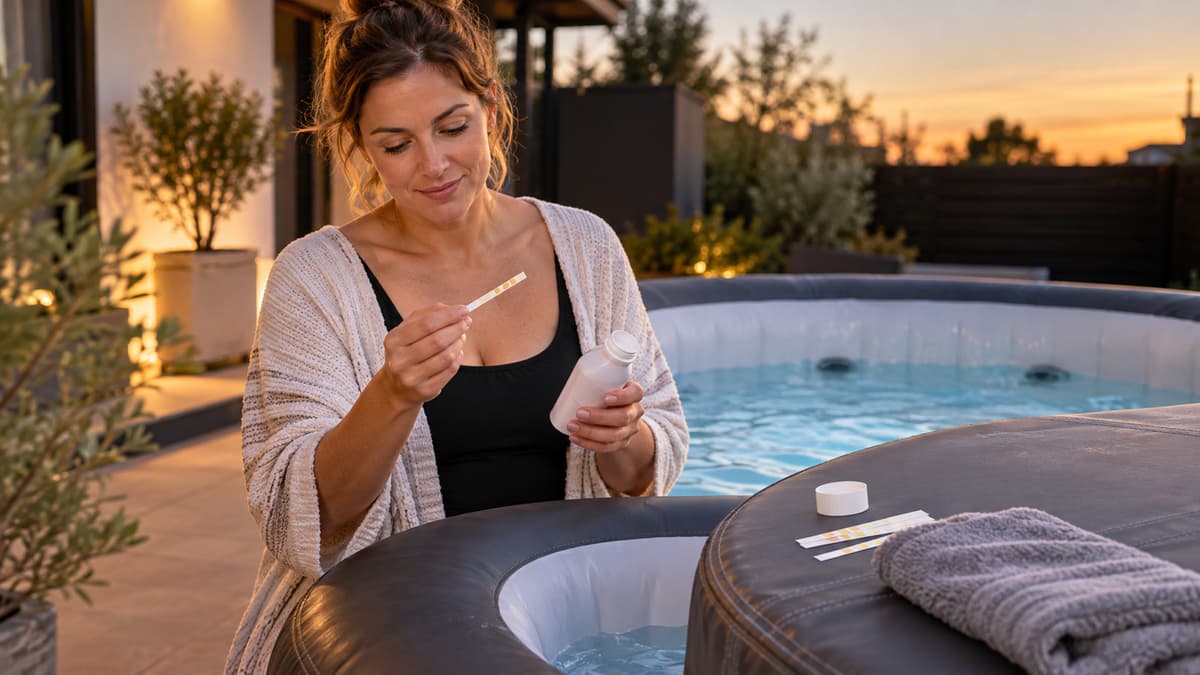
Fresh water before the season means you fill again before the first soak of the new year. Sanitiser and pH carry on while the tub stays full, in the same order as our hot tub chlorine and pH article. If the waterline is slimy now, drain, wipe it, and refill with water you are willing to keep. Folding a filthy liner into a bag still starts with that drain.
Pack it away dry if the pump will be off
Pack the tub away when it has no documented freeze mode, when the pump will be off, or when you want the patio clear. Lay-Z-Spa's pack-away notes are short: drain, dry thoroughly, deflate, and store above about 4°C. Carry the liner. They say dragging it damages the material. The same maker says mould follows damp storage. You need time, and a room warmer than a shed that tracks the night air.
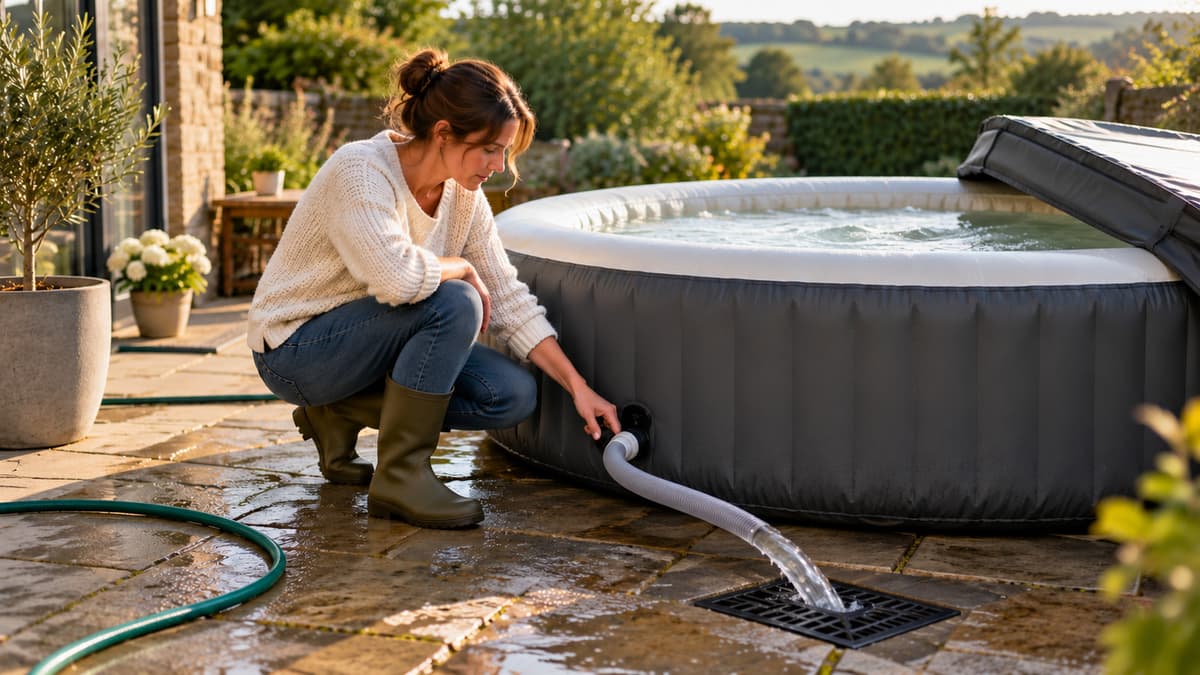
- Drain the tub, including the low ring and the pump if your model has a drain for it. Check where treated water may go before the hose runs onto the garden.
- Dry the liner before you let the air out. Wipe standing water and leave seams and folds until they are dry. A crease that feels cool and damp is still wet.
- Dry the pump housing and any filter cartridge you are keeping. A wet cartridge in a closed bag grows mould in a small space.
- Deflate once the material is dry, and carry the liner.
- Fold it and store it well above about 4°C. The Aruba listing's dry weight is 26.3 kg, and the inflated size is 170 × 66 × 170 cm. Empty, it is a two-person lift, which is a reason to lift it clear of the paving.
If the only dry air is indoors, take the open shell there before you fold it. When it comes out again, fresh water comes before the first soak. Inflation, a flat base, and the plug are on the set-up page.
Tubs that do not document a freeze mode
Freeze Shield is a Lay-Z-Spa name for their own system. In this comparison the generic amazon.co.uk listings do not state it. A full, unplugged tub of that kind sits outside the behaviour their page describes.
The MSpa Tekapo 6P, ASIN B0C6GK647K, is the contrast in the same file. The listing claims a square six-seat tub, 132 jets, 230 V, and £399, with 3.0 from 25 ratings. The shut-off or freeze field is empty. Nothing on that row says the pump will wake below 6°C and heat towards 10°C. If your tub reads like that, pack it dry. Freeze damage is the risk a full, unplugged shell carries into a frost.
A thermal cover on another brand stays a cover. Lay-Z-Spa's thermal-cover claim lives on their winter-ready page. Where your manual never describes a powered freeze mode, drain, dry, deflate, and store the bundle well above about 4°C. If a winter on the patio is part of the purchase, read the freeze line in the inflatable hot tub comparison. The Aruba AirJet is the top pick there, and the Freeze Shield claim still needs the pump powered. The buying guide covers seats and what the box includes. Winter storage adds one question: will you leave this pump powered through the coldest weeks you actually get?
Common questions
Do I have to pack an inflatable hot tub away for winter?
What does Freeze Shield actually do?
Does the pump have to stay plugged in?
How do I dry an inflatable hot tub so it does not go mouldy?
Where should treated hot tub water go?
What if my inflatable hot tub is not a Lay-Z-Spa?
Will a thermal cover replace Freeze Shield?
What temperature should I store an inflatable hot tub at?

Peter F. is the editor for DIY & tools at productscompared.co.uk. Comparisons in this category are checked against amazon.co.uk listings, review evidence and public UK sources.
Related articles
How often to change hot tub water: a UK drain window
A tub left full through winter is still on a water-change decision. Dull water is a reason to drain before you trust it.

Hot tub RCD outdoor socket: rules before you plug in
Freeze Shield runs only while the pump has power, so the outdoor socket has to stay available through a cold snap.
Hot tub chlorine and pH: the home bands to test
Water that stays in the tub still needs sanitiser and a pH check. A winter cover does not pause that job.