Vertical awning vs parasol
The balcony fits a chair, the sun comes in low across the railing in the afternoon, and at noon it drops straight onto the seat. You cannot put a roof and a side wall in the same square metre without blocking the door. Vertical awning vs parasol is that choice. A vertical screen closes the side and needs a floor and a soffit, or a fixing you are allowed to use. A parasol covers you from above and needs a base. The clamp screens are on the [vertical awning comparison](/hub/sun-shades/vertical-awning). The Products Compared editorial team used those amazon.co.uk extracts and published UK shade notes. Parasol base weights below are sellers’ rules of thumb, not a test of these screens. A qualifying purchase can earn us a commission at no extra cost to you.
The balcony fits a chair, the sun comes in low across the railing in the afternoon, and at noon it drops straight onto the seat. You cannot put a roof and a side wall in the same square metre without blocking the door.
The balcony fits a chair, the sun comes in low across the railing in the afternoon, and at noon it drops straight onto the seat. You cannot put a roof and a side wall in the same square metre without blocking the door. Vertical awning vs parasol is that choice. A vertical screen closes the side and needs a floor and a soffit, or a fixing you are allowed to use. A parasol covers you from above and needs a base. The clamp screens are on the vertical awning comparison. The Products Compared editorial team used those amazon.co.uk extracts and published UK shade notes. Parasol base weights below are sellers’ rules of thumb, not a test of these screens. A qualifying purchase can earn us a commission at no extra cost to you.
Our top picks
| Badge | Product | Width | Mount | Cloth | Note | Price | Offer |
|---|---|---|---|---|---|---|---|
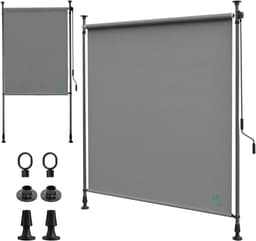
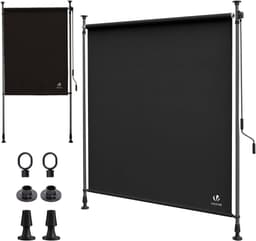
| Best overall |  VOUNOT VOUNOT 150 × 310 cm vertical awning | 150 cm | No-drill clamp | 180 gsm polyester, PU coating | 7.8 | about £54.05 | View offer |
| Preis-Tipp |  VOUNOT VOUNOT 200 × 310 cm vertical awning | 200 cm | No-drill clamp | 180 gsm polyester, PU coating | 7.4 | about £54.92 | View offer |
| Alternative |  YEAUPE PRO YEAUPE PRO 200 × 270 cm vertical awning | 200 cm | No-drill clamp | 180 gsm polyester, PU coating | 5.8 | about £70.18 | View offer |

On this page
What each one actually shades
When the vertical awning is the one
When the parasol is the one
One recommendation
Common questions
I have side sun and neighbours. Which one?
I need shade on a chair at noon. Which one?
There is no room for a base. Then what?
There is no ceiling to clamp to. Then what?
Which is worse in wind?
Will a vertical screen replace a parasol?
Related pages
Sources
Public UK sources used for this comparison. Listing prices, stars, and review counts are the saved amazon.co.uk lines. A spot check on 16 October 2026 is noted in the guide where the shelf had moved.
- BSI, BS EN 13561:2015 — external blinds and awnings (retrieved 16.10.2026)
- BSI, BS EN 1932:2013 — resistance to wind loads (retrieved 16.10.2026)
- GOV.UK — permitted development rights for householders (retrieved 16.10.2026)
- Consumer Rights Act 2015 (retrieved 16.10.2026)
- GOV.UK — General Product Safety Regulations 2005 (retrieved 16.10.2026)
- Greater Cambridge — external shading (retrieved 16.10.2026)
- Red Kite — balconies (retrieved 16.10.2026)
- Managed Partnerships — balcony limitations (retrieved 16.10.2026)