Independent comparisons. We may earn from shop links. More info

Balcony vertical awning with no drilling

Updated: 16.10.2026

You rent the flat, or you own the lease, and a listing says no drilling and even mentions rented properties. A balcony vertical awning with no drilling can be a pressure-fit screen rather than a row of plugs, and it can still be something your landlord, freeholder, or block rules will not allow. This page is the ask. The fitting sequence, after a written yes, is [how to fit a vertical awning](/hub/sun-shades/vertical-awning/sub/vertical-awning-how-to-fit). The products are on the [vertical awning comparison](/hub/sun-shades/vertical-awning). The Products Compared editorial team used those amazon.co.uk extracts and public UK housing notes. There was no survey of your lease. A qualifying purchase can earn us a commission at no extra cost to you.

You rent the flat, or you own the lease, and a listing says no drilling and even mentions rented properties.

Our top picks

On this page

What no-drill does and does not mean

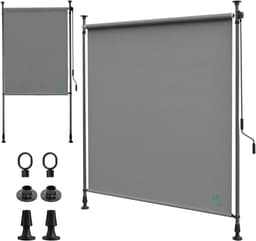
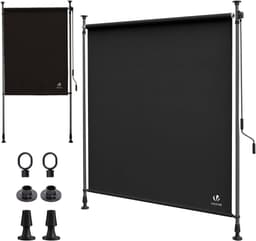
On the VOUNOT bullets, no drilling means a telescopic pressure fit, poles stated from 220 cm to 310 cm, and up to 3 cm at the foot. The same bullets name balconies, patios, and rented properties. YEAUPE’s title also says no drilling, and it does not use the word renter. Both claims describe the hardware. Neither is a term in your tenancy or your lease. The poles still push. A clamp loads the floor and the overhead. If the soffit is a thin panel or a glass edge, no holes can still be damage. A tie-on cover lashed to the railing is a different product. Switching from plugs to cable ties does not take you out of a rule that bans screens. The chain roller at about £149.99 and 160 × 160 cm is not this case. Its bullets say wall or ceiling fitting. The listing at about £43.99 does not state a mount at all, because the bullets are kitchenware. Do not read a missing fixing method as a no-drill promise.

Landlord, freeholder, council

Three people can say no, and they are not the same person. The landlord controls the tenancy. The freeholder, often through a managing agent, controls the block. The council controls planning. A yes from one is not a yes from the others. Red Kite Community Housing tells residents to get approval in advance for screens, blinds, or external lighting, and it separates that permission from planning. Managed Partnerships tells leaseholders not to fix any screen, for instance hessian or bamboo, to the balcony. Bromford lists a balcony privacy screen among alterations that need a request. Those are three landlords or agents, not a national statute. If the lease requires written consent, you need it for work that touches what the landlord retains. A clamp that bears on the slab and the soffit is that kind of question. Ask in writing, name the product, and say it is tensioned rather than plugged. Keep the reply. Ask the planning authority for your postcode if the freeholder’s yes still leaves a planning question.

Flat or house

Householder permitted development, in the GOV.UK technical guidance, is for houses. It does not apply to flats. Greater Cambridge’s note on external shading says a flat can need freeholder consent and planning to change the exterior. Scotland, Wales, and Northern Ireland have their own planning systems. These sources do not contain a UK-wide rule that renters may clamp. A house whose owner controls the wall and the soffit is the simpler case, though a listed building or a conservation area can still sit outside ordinary householder rights. If the handbook says no screens, the sales bullet does not overrule it.

If you are allowed to fit one

After a written yes, match the mechanism to the yes. A clamp is the VOUNOT or YEAUPE pattern: floor, soffit, crank, no plugs. A yes that allows drilling is what the chain roller would need. A yes that allows nothing fixed or tensioned rules out both. A freestanding parasol, if a base will fit, is the safer ask, and vertical awning or parasol is that fork. If the yes is for a clamp, then measure. The VOUNOT claim is 220–310 cm. Do not order the 150 cm file because it is the top pick if the opening is 190 cm, and do not order either file because a bullet mentioned renters. About £54.05 and about £54.92 do not buy consent. If the answer is no, do not order.

Common questions

Who do I ask, the landlord or the council?
Ask the landlord or the managing agent about the tenancy or the lease. Ask the council if the exterior change needs planning. Red Kite says its approval is not planning permission. A reply from one does not answer the other. Name the screen, say it is a pressure fit, and keep the email.
Do flats have the same permitted development rights as houses?
No. GOV.UK’s householder guidance is for houses. Flats sit outside it. Greater Cambridge says a flat can need freeholder consent and planning to change the exterior. Your council may see a small clamp differently. You still ask, rather than copying a householder right onto a block.
Is a clamp the same as tying a screen to the railing?
No. A clamp bears on the floor and the overhead. A tie-on screen pulls on the railing. Managed Partnerships’ example bans fixing hessian or bamboo to the balcony. Either can be refused. Describe the product you mean, so a yes is not read as permission for the railing.
The listing says rented properties. Is that enough?
It is not consent. It shows the seller markets the clamp at renters. Your tenancy, lease, and block handbook are the documents that count. If they are silent, ask in writing anyway. Order after the reply, not after the bullet.
What if I only need it for the summer?
Say so, and say you will take it down. A seasonal screen can be easier to allow, and it can still be refused where the handbook bans screens. The cloth is visible the day it goes up. Do not fit it in June and apologise in July.

Related pages

Sources

Public UK sources used for this comparison. Listing prices, stars, and review counts are the saved amazon.co.uk lines. A spot check on 16 October 2026 is noted in the guide where the shelf had moved.

  1. BSI, BS EN 13561:2015 — external blinds and awnings (retrieved 16.10.2026)
  2. BSI, BS EN 1932:2013 — resistance to wind loads (retrieved 16.10.2026)
  3. GOV.UK — permitted development rights for householders (retrieved 16.10.2026)
  4. Consumer Rights Act 2015 (retrieved 16.10.2026)
  5. GOV.UK — General Product Safety Regulations 2005 (retrieved 16.10.2026)
  6. Greater Cambridge — external shading (retrieved 16.10.2026)
  7. Red Kite — balconies (retrieved 16.10.2026)
  8. Managed Partnerships — balcony limitations (retrieved 16.10.2026)