How to choose a parasol base with wheels
You already own the parasol, and the patio is slabs or deck boards. A parasol base with wheels is the shell you fill and then roll, or tip onto wheels, so you can move the shade without lifting the ballast. Wheels do not add stability. Prices and pole lines are on the [parasol base with wheels comparison](/hub/sun-shades/parasol-base-with-wheels). We read eight amazon.co.uk listings on 21 October 2026 and did not fill a base or run a wind test. If yours is an offset or banana parasol, use the [cantilever parasol base with wheels](/hub/sun-shades/parasol-base-with-wheels/sub/parasol-base-with-wheels-cantilever) page first, because a centre socket stays the wrong foot.
You already own the parasol, and the patio is slabs or deck boards. A parasol base with wheels is the shell you fill and then roll, or tip onto wheels, so you can move the shade without lifting the ballast.
You already own the parasol, and the patio is slabs or deck boards. A parasol base with wheels is the shell you fill and then roll, or tip onto wheels, so you can move the shade without lifting the ballast. Wheels do not add stability. Prices and pole lines are on the parasol base with wheels comparison. We read eight amazon.co.uk listings on 21 October 2026 and did not fill a base or run a wind test. If yours is an offset or banana parasol, use the cantilever parasol base with wheels page first, because a centre socket stays the wrong foot.
Our top picks
| Badge | Product | Wheel type | Pole fit | Cantilever | Note | Price | Offer |
|---|---|---|---|---|---|---|---|
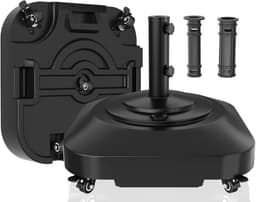
| Best overall |  Digury Digury fillable wheeled base | Wheels in the title; count not printed | Not stated | Not stated | 9.0 | about £113.66 | View offer |
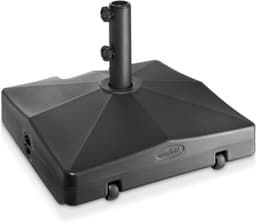
| Preis-Tipp |  AOSTD AOSTD five-wheel parasol base | Five wheels, centre swivel | 1.26–1.97 in | Not stated | 8.8 | about £55.02 | View offer |
| Alternative |  Casafield Casafield two-wheel parasol base | Two caster wheels and a handle | 1–2 in | Not for offset or cantilever | 6.4 | about £62.87 | View offer |

On this page
Wheels do not add the kilograms
Centre pole or cantilever, before any wheel count
Filled weight is a shop rule of thumb
Pole grip, then the wheel and the ground
Common questions
Do wheels make a light base stable?
What filled weight is a starting point for a 3 m centre-pole parasol?
Why does a cantilever need a different base, not just more weight in the same socket?
Is 38 mm the same as 1.5 in, and 48 mm the same as 1.9 in?
When is two wheels plus a handle the wrong mechanism?
Which surfaces do UK shop pages name for small wheels?
Related pages
Sources
Public UK sources and the amazon.co.uk listings compared on this page. Shelf prices are the figures stored in the category files, not a live check on 21 October 2026. Updated 22.10.2026.
- Opal Retail weight guide (retrieved 22.10.2026)
- Plia Parasols base guide (retrieved 22.10.2026)
- Christow 25 kg two-wheel base (retrieved 22.10.2026)
- GOV.UK GPSR 2005 (retrieved 22.10.2026)
- GOV.UK product safety advice (retrieved 22.10.2026)
- Consumer Rights Act 2015, section 9 (retrieved 22.10.2026)
- Bolton Council parasol sheet (retrieved 22.10.2026)
- BSI BS EN 581-3:2026 (retrieved 22.10.2026)