Independent comparisons. We may earn from shop links. More info

Beach shelter vs windbreak

Updated: 22.10.2026

You are packing for a breezy east-coast day, and the search results mix a pop-up with a pole windbreak. Beach shelter vs windbreak is a roof against a wall. One puts cloth over your head. The other stands in the wind and leaves the sky open. The roofs in the [beach shelter comparison](/hub/sun-shades/beach-shelter) are the pop-ups, the screened shelter, the canopies, and one fishing shelter. A pole windbreak is not a row in that table, so this page does not review windbreak models. Products Compared editorial team, 21 October 2026. A qualifying Amazon purchase can earn us a commission at no extra cost to you.

You are packing for a breezy east-coast day, and the search results mix a pop-up with a pole windbreak. Beach shelter vs windbreak is a roof against a wall. One puts cloth over your head.

Our top picks

On this page

Two different objects

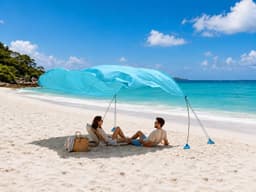
A beach shelter here has a roof. The small Glymnis is a sprung pop-up at 185 × 140 × 115 cm. Amazon Basics is a screened house on poles. CUUPO is a two-pole canopy about 2.1 m square. WOOTMIN is a 3 × 3 m canopy with a listed ceiling of 200 cm. You sit under each of those. A windbreak is poles driven into the sand and fabric panels between them. It blocks wind at sitting height. It does not cover a pushchair, a changing space, or a child lying down. Simple Days Outside splits them the same way: a pop-up for children and bags, a windbreak when wind and sand are the problem. If the problem is sun between 11am and 3pm, you are shopping for a roof. A windbreak leaves that sun on your shoulders.

Wind, shade, and space

A pop-up catches more wind because it has a roof and, on several of these listings, walls. The small Glymnis weighs 1.15 kg. That mass does not resist a gust. Sand in the bags, ropes, and pegs do, and a short peg in dry sand is still a weak plan. A windbreak can sail too if the poles are shallow. It does not present a roof to the wind the way a closed shelter does. In a proper blow, the pole wall is the more honest tool, and the light pop-up is the one you take down. Ballast for a roof you did buy is on how to anchor a beach tent. Shade is where the windbreak fails. Cancer Research UK treats a canopy as shade, not complete protection, and still wants sunscreen because UV reflects off sand. A windbreak leaves the sky open. A UPF 50+ line on a shelter applies to that cloth, and only where the listing states it. It does not transfer to a windbreak. WOOTMIN’s 3 × 3 m canopy has no UPF figure, on 4.8 from only 12 reviews. Space is the other split. A windbreak’s footprint is a strip. A shelter’s is a floor. WOOTMIN’s stated 9 m² is the largest floor here. Thanet’s code says structures need consent. Hunstanton limits them to marked areas. BCP’s visitor page bans overnight camping and open fires. Size clashes are on the beach shelter buying guide.
WOOTMIN WOOTMIN 3 m canopy

Testsieger

WOOTMIN WOOTMIN 3 m canopy
9.6/10about £69.99

Which to buy, and when both

Buy the shelter when you need shade, a changing space, or a roof over kit between 11am and 3pm. On a calm day the small Glymnis is the light pop-up with the large review sample, and Amazon Basics is the lower-priced screened alternative if you will assemble poles. Buy the windbreak when wind and blown sand are the whole problem and you are happy with open sky. That purchase sits outside this table. On a windy east-coast beach, expect to drop a 1.15 kg pop-up if a corner lifts. A driven pole wall can still do its job in that breeze. Buy both if the days are mixed: windbreak to seaward, small shelter behind it, each with its own ballast. A 3 × 3 m canopy is not a windbreak. WOOTMIN is a roof with a 200 cm ceiling, pre-attached sandbags, and no UPF line, at £69.99. The fishing shelter is a third object, on beach shelter for sea fishing.

One buy or both

If you only have room for one, sun on a still day is the miss with a windbreak, and a lifting frame on a gusty day is the miss with a light pop-up. Leave the stove outside either product. If the RNLI windsock is flying, that is a cue for inflatables and a practical reason to prefer the wall, or to sit without a frame.

Common questions

Does a windbreak block UV the way a UPF roof does?
It blocks sun from the side and leaves the sky open. A UPF 50+ line on a shelter here is a claim about that cloth, and Cancer Research UK still wants sunscreen because of reflection. A windbreak does not hand you that roof. If the listing has no UPF figure, as on Shakespeare and WOOTMIN, you do not invent one for either product.
Which is the better buy on a windy east-coast beach?
If the wind is the problem and you can live without overhead shade, the windbreak is the better buy, and it is not one of the nine shelters in this set. A light pop-up, including the 1.15 kg Glymnis, presents a roof to the gust. If you still need a changing space, take the shelter and drop it when it lifts.
Can you use both?
Yes, when the day is bright and breezy and the beach allows the footprint. Put the windbreak on the windward side and the shelter behind it, and anchor each one. The wall does not replace sand in the shelter’s pockets. Two structures also take more of the beach, which matters where Thanet wants consent.
Are large windbreaks restricted on busy beaches?
Structures can be. Thanet’s code requires consent. Hunstanton limits structures to marked areas. BCP’s visitor page bans overnight camping and open fires. A long windbreak and a 3 × 3 m canopy both occupy sand other people want. Read the page for your beach. A product listing is not the permission.
Is a 3 × 3 m canopy the same as a windbreak?
No. WOOTMIN is a 3 × 3 m roof with a 200 cm ceiling, sandbags, and wind ropes, at £69.99, with no UPF figure and 4.8 from 12 reviews. A windbreak has no roof. The canopy still needs ballast, and a pole that broke after two days is part of that thin sample.

Related pages

Sources

Public UK sources and the amazon.co.uk listings compared on this page. Listings captured 19 October 2026. Updated 22.10.2026.

  1. NHS: sunscreen and sun safety (retrieved 22.10.2026)
  2. Cancer Research UK: sun safety (retrieved 22.10.2026)
  3. Met Office: sunburn and UV (retrieved 22.10.2026)
  4. GOV.UK: General Product Safety Regulations 2005 (retrieved 22.10.2026)
  5. Thanet: code of conduct for responsible beach use (retrieved 22.10.2026)
  6. RNLI: on the beach safety advice (retrieved 22.10.2026)
  7. amazon.co.uk: Beach & Sun Shelters best sellers (retrieved 22.10.2026)
  8. ASA: substantiation (retrieved 22.10.2026)