Independent comparisons. We may earn from shop links. More info

Beach parasol UPF

Updated: 22.10.2026

You are looking at UPF 50+ on a beach parasol and wondering whether that replaces the bottle of sunscreen in the bag. It does not. A beach parasol UPF line is the seller’s claim about cloth. It is not the sun-protective clothing label, and shade on a beach still lets scattered ultraviolet reach you. This page does not rank the parasols and it does not tell you how to twist a screw. The rows sit on the [beach parasol comparison](/hub/sun-shades/beach-parasol). Products Compared read public UK sources plus amazon.co.uk captures from 19 October 2026. None of those sources certifies these ASINs. A qualifying purchase can earn a commission at no extra cost to you.

You are looking at UPF 50+ on a beach parasol and wondering whether that replaces the bottle of sunscreen in the bag. It does not. A beach parasol UPF line is the seller’s claim about cloth.

Our top picks

On this page

UPF is a clothing number

GOV.UK describes UPF as a measure for clothing fabric. UPF 20 means about one twentieth of the ultraviolet in that test reaches the skin through the cloth. Only clothing at UPF 40 or above is labelled solar UV-protective under BS EN 13758-2. That is a garment mark. It is not a sentence printed on a beach umbrella. BSI’s scope note for BS EN 13758-1 says the method is a test for apparel fabrics. It is not a test for umbrellas, and it is not a test for shade at a distance from the cloth. A canopy sold with UPF 50+ can still be a seller’s line with no laboratory named. None of the listings in this set shows a test house or a certificate number. If a shopping page says a beach umbrella blocks 99%, that percentage is not in these files.

Shade is not a full block

The British Association of Dermatologists say about half of summer UV is scattered, and a beach umbrella gives about 3 to 5 times the protection of no shade. Woodland-level shade is their picture for a much higher factor, about 20, which a single parasol on open sand is not. Sand reflects light. You can burn on your legs and under your chin while you sit in the shadow. A Texas trial that compared an umbrella with SPF 100 is not a result for these ASINs. Keep the NHS hours even when the canopy is up. From March to October, shade matters between 11am and 3pm. Use SPF 30 with at least a 4-star UVA rating. Babies under 6 months should be kept out of direct sun. Cancer Research UK says over 90% of UV can pass through cloud. The Met Office advises shade from umbrellas when the index is high, including at UV 6 to 7, as part of sun protection, not as a substitute.

What these listings print

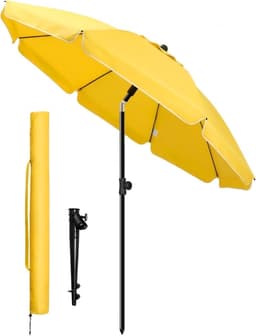
Two files print UPF 50+. The yellow VOUNOT, B0FR8RN8DV, at about £23.99, puts UPF 50+ in the title, with polyester stated at 160 g/m². No laboratory is named. The rating is 4.7 from 265 reviews, which is a satisfaction sample, not a UV test. Builrand, B0H29QFKR4, puts UPF 50+ in the title of a two-pack chair umbrella at about £23.99. The file has no reviews. A claim on a clamp is still a cloth claim.

When the file prints no number

Cheerful Bargains, B09G38P2B1, says UV-protection on a 1.8 m parasol at about £39.99 and prints no number. One reviewer wrote 50 uv protection. That sentence does not upgrade the specification. Vanilla Leisure, B0D3LPM2YS, at about £24.99, has no UPF figure at all. Four URL-only ASINs, B0G353956C, B0GGZ1TLJQ, B0CXDYW9MK and B0FR8R4VKX, have no UV line in the capture. The parasol is extra shade. It is not the whole plan.

Common questions

What does UPF 50+ on a beach parasol actually mean?
In these files it means the seller printed UPF 50+ on the cloth claim. GOV.UK uses UPF as a clothing measure, where UPF 20 means about one twentieth at the skin in that test. The parasol listings do not show a laboratory. Do not turn the printed line into a percentage the page never states.
Is that the same label as sun-protective clothing?
No. Clothing at UPF 40 or above can be labelled solar UV-protective under BS EN 13758-2. BSI says the part 1 fabric test is not for umbrellas. A beach parasol with UPF 50+ in the title has not been shown, in this capture, to carry that clothing mark.
Will I still burn under the canopy?
You can. The British Association of Dermatologists put a beach umbrella at about 3 to 5 times the protection of no shade, because scattered UV still arrives, and sand reflects light. That is not a guarantee you will not burn. Sunscreen and clothing stay in the bag.
Do I still need SPF 30, a hat and sunglasses?
Yes. The NHS asks for SPF 30 with at least 4-star UVA, shade from 11am to 3pm between March and October, and care when the UV index is 3 or higher. Cancer Research UK adds clothing. Sunglasses are a separate check against BS EN ISO 12312-1. The parasol does not retire any of those.
Which listings in this set even print a number?
The yellow VOUNOT and the Builrand clamp print UPF 50+, with no test house named. Cheerful Bargains says UV-protection and prints no number. Vanilla Leisure prints no UPF figure. The four URL-only ASINs have no UV line in the files.
Does a review that says 50 uv upgrade the specification?
No. One Cheerful Bargains reviewer wrote 50 uv protection. The title and the spec block still say UV-protection without a UPF number. A review sentence is not a laboratory result and it does not rewrite the listing.
Are babies safe under the parasol alone?
No. The NHS says babies under 6 months should be kept out of direct sun. A canopy does not cancel scattered UV or light reflected from sand. Use shade, clothing and the rest of the NHS sun advice, and do not treat the parasol as the only measure.

Related pages

Sources

Public UK sources and the amazon.co.uk listings compared on this page. Listings captured 19 October 2026. Updated 22.10.2026.

  1. NHS sun safety (retrieved 22.10.2026)
  2. Met Office UV advice (retrieved 22.10.2026)
  3. GOV.UK ultraviolet FAQ (retrieved 22.10.2026)
  4. BSI, BS EN 13758-1 scope (retrieved 22.10.2026)
  5. British Association of Dermatologists (retrieved 22.10.2026)
  6. Cancer Research UK sun safety (retrieved 22.10.2026)
  7. GOV.UK product safety 2005 (retrieved 22.10.2026)
  8. RNLI flags and signs (retrieved 22.10.2026)