Independent comparisons. We may earn from shop links. More info

How to anchor a beach parasol

Updated: 22.10.2026

You already have a beach parasol with a spike or a screw, the wind is picking up, and you want it to stay over the towel rather than travel down the beach. This is how to anchor a beach parasol in firm sand, how a screw differs from a push, and when to close the canopy. None of the listings in this set states a wind speed, so the method ends with a test you can do by hand. The [beach parasol comparison](/hub/sun-shades/beach-parasol) shows which file includes an anchor. Products Compared used amazon.co.uk captures from 19 October 2026. There was no beach trial. A qualifying purchase can earn a commission at no extra cost to you.

You already have a beach parasol with a spike or a screw, the wind is picking up, and you want it to stay over the towel rather than travel down the beach.

Our top picks

On this page

Firm sand, not the dry top of the beach

Loose, dry sand on the top of the beach lets a short spike lift as soon as the canopy fills. Firmer sand, lower down where the tide has packed it, holds a point or a spiral more honestly. If your heel sinks and the hole collapses, move until a pushed heel leaves a neat dent. Clear stones and shells so the pole sits straight. Plant so the canopy, once open, leans slightly into the breeze rather than cupping it. Seat the anchor first and only then open. A US voluntary test that talks about 30 mph is not UK law and is not printed on these listings. This set does not state how many centimetres of the VOUNOT spiral should disappear. If the anchor will not seat, the sand is wrong or the fitting is wrong. Decathlon’s note about 20 km/h belongs to Decathlon parasols, not to VOUNOT, Cheerful Bargains, Vanilla Leisure or Builrand.

Screw or spike

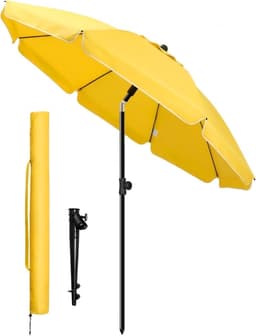
A screw is a twist, not a stamp. On the yellow VOUNOT, B0FR8RN8DV, the listing describes a spiral ground anchor with a handle for sand, grass or soil. Stand the spiral upright and turn the handle until it bites, then shake the pole before you lift the canopy. If it rocks, twist further or move the pitch. One UK reviewer said the handle works in soft sand and less well in damp sand. Another used it at Wells-next-the-Sea and said it did not move. Those are two visits, not a test house. Open only after the shake. If the canopy tugs, drop the 30° tilt back toward the wind rather than chasing the sun. A pointed spike is a push into the same firm sand, then the same shake. Cheerful Bargains, B09G38P2B1, names no spike and no screw. Vanilla Leisure reviews split: one family said it stood up on the beach, and one said the top blew off in a light breeze because it did not lock. A lock that will not seat is a reason to stop. Contact the seller if a rib or a lock fails.

A clamp is a different method

A chair clamp is a different method. Builrand, B0H29QFKR4, clips to one seat. The title calls the clamp universal and leaves security and wind questions unanswered. There are no reviews in the file. Fit it to the tube and take it off when the chair starts to sail. It does not plant in sand. The best beach parasol page says who that clamp is for.

Close it before it becomes a sail

Close the canopy when you would not trust it, because no kept listing gives you a speed at which it is safe. Practical signs are a pole that shifts in the shake test, sand scouring out around the spiral, a canopy that lifts and slams, or a clamp that twists on the chair. Take the cloth down and put it in the bag. The VOUNOT bag has been a tight fit for at least one reviewer. An orange RNLI windsock means strong or offshore wind. The printed rule is about inflatables, not parasols. Close a light parasol as well. The same spike is a poor patio tool. Reviewers who used the yellow VOUNOT over a garden table added a separate heavy base. That weight is not in the beach box.

Common questions

Where on the beach should I plant it?
Choose firmer sand, where a heel print keeps its shape, rather than the dry, loose top of the beach. Clear the spot, seat the anchor, and shake the pole before you open the canopy. If the hole collapses, move. This set does not publish a depth in centimetres for the VOUNOT spiral.
How do I use a screw anchor rather than a push?
Stand the spiral upright and turn the handle until it bites, then shake the pole. The yellow VOUNOT listing describes that anchor for sand, grass or soil. Pushing a screw in like a spike leaves it shallow. Open the canopy only after the shake, and tilt so the cloth is not a cup for the wind.
What did UK reviews say about damp sand?
One VOUNOT reviewer said the anchor handle works in soft sand and less well in damp sand. Another said the parasol did not move at Wells-next-the-Sea. Those are single visits. Damp sand can make the handle harder to turn, which is a reason to reseat it, not a wind certificate.
When do I close it?
Close it when the pole shifts, the sand scours out, the canopy slams, or you are standing under an orange windsock and would not trust a light sail. No listing here states a wind speed. Pack it into the bag rather than leaving it half open.
Does an orange windsock ban the parasol?
The RNLI orange windsock means strong or offshore wind, and the printed rule is about inflatables. It does not mention parasols. Close a light beach parasol anyway. The flag is a water-safety sign, not a product rating for these ASINs.
Can I use the same spike on a patio?
Not as the only hold. A spiral or spike needs sand, grass or soil it can bite. Patio decking needs a heavy base, which these beach files do not include. One VOUNOT reviewer kept a separate base for the garden table and still used the beach spike on sand.

Related pages

Sources

Public UK sources and the amazon.co.uk listings compared on this page. Listings captured 19 October 2026. Updated 22.10.2026.

  1. NHS sun safety (retrieved 22.10.2026)
  2. Met Office UV advice (retrieved 22.10.2026)
  3. GOV.UK ultraviolet FAQ (retrieved 22.10.2026)
  4. BSI, BS EN 13758-1 scope (retrieved 22.10.2026)
  5. British Association of Dermatologists (retrieved 22.10.2026)
  6. Cancer Research UK sun safety (retrieved 22.10.2026)
  7. GOV.UK product safety 2005 (retrieved 22.10.2026)
  8. RNLI flags and signs (retrieved 22.10.2026)