Independent comparisons. We may earn from shop links. More info

Castors for grass and decking

Updated: October 2026

Your castors arrived, the chair rolls beautifully across the kitchen tile, and the first warm weekend you discover the same 50 mm wheels sink into the lawn or drop between deck boards. Surface chooses diameter and tread patch; a high kilogram title does not float a small wheel. This page covers boards and firm turf only. Soft sand exits to [beach chair castors vs balloon wheels](/hub/sun-loungers/beach-chair-wheels/sub/beach-chair-wheels-vs-balloon-wheels), and bolting the plate is [how to fit beach chair wheels](/hub/sun-loungers/beach-chair-wheels/sub/beach-chair-wheels-how-to-fit). Compare captured rows on [beach chair wheels](/hub/sun-loungers/beach-chair-wheels).

Your castors arrived, the chair rolls beautifully across the kitchen tile, and the first warm weekend you discover the same 50 mm wheels sink into the lawn or drop between deck boards.

Our top picks

On this page

Decking

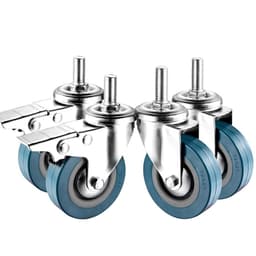
On tight, level composite or timber boards with narrow gaps, 50 mm furniture castors often behave well if you roll straight and keep the frame square. Problems start when the gap between boards is wider than the tyre width. The wheel drops, the chair catches, and you lever the plate screws on every move. Measure a gap with calipers or a drill bit shank; if the wheel is 50 mm diameter but only twenty-odd millimetres of tread width, bridging is physics, not marketing. Harder treads and twin 50 mm layouts spread load a little compared with a single narrow tyre, but they do not turn a 50 mm wheel into a 75 mm one. HOLKIE's twin 50 mm sets on amazon.co.uk name grass alongside wood and tile in the bullets; treat "grass" as a seller claim next to the millimetre lines, not a guarantee on your lawn.

Marks, point loads, and how you pull

Marking is another deck worry: soft wheels can leave lines on untreated timber; periodic moving or mats under parked chairs reduces witness marks more than a higher kg title. If your deck is new composite with manufacturer guidance on point loads, rolling a heavy hooded chair concentrates weight through four small patches anyway. Castors are still usually kinder than dragging feet, but you may want wider wheels before you host a full table of guests. Sideways shoves stress swivel bearings; pulling the chair straight along the board direction reduces the chance a brake lever catches a board edge. When you store the chair against a wall, lock brakes if you have them so gusts do not walk it along the boards.

A lawn is a contact-patch problem

Firm, dry lawn that you mow short is different from soft spring turf or worn paths where the soil compacts under a small radius. A 50 mm castor concentrates load on a tiny patch, so the wheel digs a rut when you push a heavy hooded chair. The Himimi listing pairs a 50 mm diameter with a 24 mm tread width and also mentions wet lawn in the same breath, which is exactly the tension to notice. Load ratings assume a reasonably level floor; Ross Castors' wheelchair and trolley notes say stated loads expect level support, and ridges or dirt change the result. If you must cross grass regularly, stepping up within the castor category beats fighting 50 mm every time. A 75 mm double-wheel set such as BGS 81940 appears on UK price comparison around the mid-thirty pounds band for four castors sold as beach-chair sized. That figure is a comparison-site signpost, not a captured amazon.co.uk shelf price, but it marks the kind of upgrade serious lawn users look for. Twin 50 mm is not equivalent to 75 mm overall diameter; compare the stated overall wheel size, not the word "double" alone. Picture a Sunday when the chair must sit half on paving and half on lawn for shade: the lawn-side wheels dig while the patio-side wheels roll freely, twisting the frame slightly each time someone sits. That is the contact-patch problem in miniature.

The larger double wheel, and where it still fails

Seventy-five millimetre double castors widen the footprint and roll over shorter grass and minor bumps better than 50 mm singles, yet they still fail on soft sand, deep gravel, and steep dunes. That is balloon-tyre territory. Mounting height rises with the larger fork, so check hood clearance and door thresholds before you swap. Zinc-plated forks resist rust modestly; practical advice for seafront storage is to rinse salt, store under cover in winter, and accept that zinc is not a lifetime coastal guarantee. That is experience, not a standard clause. Higher load ratings do not stop dig-in if the diameter is wrong; they only tell you the fork might survive when it finally bottoms out. Taking wheels off for winter storage reduces bearing corrosion on chairs that sit idle for months. When the lawn is really a dune path to the beach, stop upgrading castors and read the versus page instead.

Common questions

Will 50 mm castors cross a lawn?
Sometimes on firm, short turf for occasional moves; regular use on soft lawn usually needs a larger diameter or a different route.
What about a gap between deck boards?
If the gap exceeds effective tread width, the wheel will catch. Measure gaps or choose a wider wheel.
Is a twin 50 mm wheel the same as a 75 mm wheel?
No. Overall diameter and mounting height still differ; read the specification lines.
Do harder wheels sink less?
Harder treads can reduce rolling resistance on firm ground but do not fix soft soil with a small radius.
Will they mark the boards?
Soft treads can leave lines; moving the chair or using mats helps on sensitive timber.
When is the lawn actually a sand problem?
If you cross loose dry sand or dunes, castors are the wrong category regardless of diameter.
Does a higher load rating stop the wheel digging in?
No. Dig-in is contact patch and soil firmness, not title kilograms.
Should I take the wheels off in winter?
Many owners remove or cover castors for seafront winters to slow bearing and plate corrosion. Sensible practice, not a formal standard.

Related pages

Sources

Public UK sources named below. The three amazon.co.uk files in this comparison do not contain a GBP price, a star rating or a review count. Prices cited for other castor listings were read on 19 October 2026. Page updated October 2026.

  1. GOV.UK, General Product Safety Regulations 2005 (retrieved October 2026)
  2. GOV.UK, product safety advice for businesses (retrieved October 2026)
  3. Consumer Rights Act 2015, section 11 (retrieved October 2026)
  4. BS EN 12528:1999, furniture castors (retrieved October 2026)
  5. Ross Castors, WheelEEZ balloon beach wheels (retrieved October 2026)
  6. amazon.co.uk Emuca castors B01DDE7GHE (retrieved 19 October 2026)
  7. amazon.co.uk Himimi beach castors B07GSYSYZZ (retrieved 19 October 2026)
  8. Livedale, M10 shepherd castors (retrieved October 2026)