Independent comparisons. We may earn from shop links. More info

Picture hanging nails for plasterboard, brick and timber

Updated: October 2026

Picture hanging nails work only when the frame is light, the wall is understood and the head can retain the wire or fitting. In a UK home, a painted surface may hide stud plasterboard, dot and dab, soft brick or much harder masonry, and those constructions do not share one safe nail. This guide helps you decide between a nail, a picture hook, a board fixing and a plug with a screw. The [steel nails comparison](/hub/staplers-and-nail-guns/steel-nails) covers the available packs and prices. Here, the purpose is to keep a light frame on the wall without inventing a load rating that none of those products provides.

Picture hanging nails work only when the frame is light, the wall is understood and the head can retain the wire or fitting.

Our top picks

On this page

Work out what wall you actually have

Stud plasterboard is a brittle board on a timber or metal frame. A nail in the board alone may hold a very light decoration, but length does not create a universal capacity. DIY Doctor recommends fixing into a stud or using a light-duty plasterboard fixing. If the frame could injure someone, a bare nail in board is the wrong shortcut. Dot-and-dab has adhesive dabs and a cavity before the masonry. A short 20 mm nail may pass the face without reaching anything substantial. Use a fixing intended for that construction. On brick, a masonry nail may work for a light item, but the surface can reject it. EasyFrame's guidance uses a drilled plug and screw. If the first nail bends, stop and use the masonry nails or wood nails guide. A detector helps, but it may miss plastic pipe.

What a picture nail has to do

A picture nail needs to enter the substrate without folding and leave a head that retains the wire. Length only matters against the wall build-up: 20 mm may suit one light job and fail to bridge another. None of the compared packs states a safe load. Eteamcan's 20–40 mm nails receive UK praise for a large head that is easier to strike and helps keep picture wire in place. One of six UK reviews reports a bent first nail, so the head does not prove the shank suits every brick. The 4.5-star line is from 20 reviews. Headless finishing nails leave a smaller mark, but they give slipping wire less of a barrier. Unifizz sells a headless option, and the listing conflicts between 25 mm and 25–100 mm. If the frame hangs from wire, a broad-headed picture nail or a purpose-made hook is easier to reason about. Leave enough head exposed for the fitting.

Which packs here are picture nails

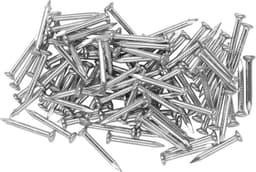
Eteamcan is the clearest picture-oriented assortment in this set. The £7.98 box contains 120 carbon-steel nails in 20, 25, 30 and 40 mm lengths. The large head is the practical advantage. The sample is 4.5 from 20 reviews, with one bending report and no rated load. The black-and-gold set also contains 120 nails in those four lengths, at £9.49, with 4.7 stars from 52 reviews. The title says stainless steel while the bullets also say hardened steel and iron. OMOTOOL's £3.98 pack is 100 galvanised 55-grade steel nails at 20 × 2.10 mm, rated 4.5 from 229 reviews. It is best value when that short size matches the wall. Amazon Basics includes picture nails among 550 mixed wood nails for £5.28, from 5,822 reviews, and explicitly excludes cement and concrete. See the best steel nails page.

When to stop using a nail

Use something else for a mirror, a heavy frame, an overhead object or anything that could hurt someone if it falls. No nail in this comparison carries a rated load. On hollow plasterboard, that may mean a board anchor or a screw into a stud. On brick, it may mean a drilled plug and screw. Compare picture hooks and fixings rather than treating a hook as another steel nail. Stop if the nail bends, plaster stars or the wall sounds loose. External insulation, possible asbestos, listed fabric and a tenancy ban need a different plan.

Common questions

Can I hang a picture on plasterboard with a nail?
Only the lightest decoration should rely on a nail in the board alone, and there is no universal weight limit. For a meaningful hold, locate a stud or use a plasterboard fixing selected for the wall and load. Dot-and-dab construction needs its own fixing approach.
What should I use on a brick wall?
A suitable hardened masonry nail may work for a light item in compatible brick, but stop if the first nail bends. A drilled plug and screw is the clearer method when the brick is hard, the frame matters or you need a fixing selected for the task.
What nail length do I need for a light frame?
Length depends on the wall build-up, not the frame alone. Packs here offer common picture lengths from 20 mm to 40 mm, but a short nail may not bridge dot-and-dab and a longer nail increases the need to check for services. No length implies a rated load.
Why does picture wire slip off the nail?
The head may be too small or headless, the wire may be slack, or the nail may have been driven too far. A broad head such as the one noted in Eteamcan reviews gives the wire a clearer shoulder. Check the frame hardware and use a purpose-made fitting if needed.
Will a galvanised nail prevent rust stains?
Galvanising improves corrosion resistance but does not guarantee that a nail will never rust. Exposure, coating quality and wall moisture all matter. Choose a product explicitly intended for the environment and avoid placing an unverified finish where staining would damage valuable work.
Can I use picture nails in a rented home?
Read your tenancy agreement and ask the landlord if it is unclear. Some landlords permit small picture holes if services are avoided and the wall is made good, while others restrict particular walls or fixings. A local handbook is an example, not permission for your property.

Related pages

Sources

Public UK sources on loose steel nails, masonry fixings and picture hanging. amazon.co.uk listings checked 16 October 2026. Prices move.

  1. BS EN 10230-1:2000, steel wire nails (retrieved 16 October 2026)
  2. NBS, BS EN 10230-1 confirmed February 2021 (retrieved 16 October 2026)
  3. BS 1202-1:2002, specification for steel nails (retrieved 16 October 2026)
  4. JCP Fixings, masonry nail hardness sheet (retrieved 16 October 2026)
  5. HSE, ladders and stepladders (retrieved 16 October 2026)
  6. Screwfix Easyfix masonry nails 3 × 40 mm (retrieved 16 October 2026)
  7. EasyFrame, hanging pictures on brick (retrieved 16 October 2026)
  8. DIY Doctor, fixing to plasterboard (retrieved 16 October 2026)