Independent comparisons. We may earn from shop links. More info

Masonry nails or wood nails: which fixing fits?

Updated: October 2026

Choose masonry nails or wood nails by the substrate, not by whichever assortment has the largest count. An ordinary wire nail is meant to grip timber fibres; a genuine masonry nail uses hardened steel to resist folding in a suitable brick or concrete surface. The complication on amazon.co.uk is that a product title can say masonry without stating hardness, and UK reviews may tell a different story. The [steel nails comparison](/hub/staplers-and-nail-guns/steel-nails) records those claims and conflicts. This page explains when each family makes sense and when a plug and screw is the more reliable answer.

Choose masonry nails or wood nails by the substrate, not by whichever assortment has the largest count.

Our top picks

On this page

What a masonry nail is supposed to be

A masonry nail is not merely a thick wood nail. Trade products use hardened carbon steel so the shank can withstand impact against a hard, brittle substrate. JCP Fixings specifies austempered high-carbon steel at 50–54 HRC for its masonry nails. That figure belongs to the JCP sheet and cannot be transferred to any pack in this comparison. Soft brick, engineering brick, block and concrete differ, as do mortar joints. Even a genuine hardened nail is not promised to enter every one of them. No compared amazon.co.uk pack gives a rated load, so masonry should not be read as a capacity statement. Zinc plating can improve corrosion resistance without proving outdoor suitability. Screwfix's Easyfix 3 × 40 mm masonry nails were £3.09 including VAT on 16 October 2026, bright zinc plated and marked indoor. The steel nails buying guide puts finish, length and listing clarity into the wider buying order.

What wood assortments are for

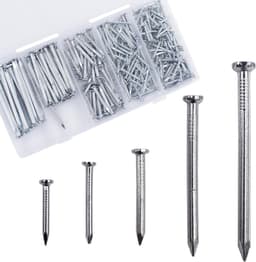
Wood nails work by entering and displacing timber fibres. None becomes a concrete nail through force. Amazon Basics is the clearest example: its 550-piece case contains finish, wire, common, brad and picture nails, and the listing says they are not for cement or concrete. For £5.28, that box is a useful household assortment, supported by 4.5 stars from 5,822 reviews. Some buyers report that larger nails bend, so keep it to modest timber rather than treating it as a structural kit. MIDHILL's £3.99 assortment is described as iron, the coating is not stated, and the size counts total 224 rather than 250. METALLIXITY's 1.2 × 16 mm pins suit cabinet backs, not brick. A rough rule is a nail two to three times the thickness of the fixed piece. That is a workshop rule of thumb, not a rated-load calculation.

Where this set's masonry claims split

QiXinGYL shows why the title cannot be the deciding factor. Its 750-piece set claims hard steel for brick and concrete, with sizes up to 38 mm. At £5.47 it looks like strong value, yet it is rated 3.1 from 130 reviews and repeated UK comments say the nails bend in ordinary brick. OMOTOOL's larger assortment claims galvanised 55-grade steel, offers lengths up to 60 mm and is rated 4.5 from 214 reviews at £7.98. UK buyers describe use on old hard walls where ordinary pins folded. One buyer could not fully drive the longest nail into an outside wall, and the listing conflicts between 300 and 280 pieces. 55-grade is not a stated 50–54 HRC measurement. The short £3.98 OMOTOOL pack gives a clear 20 × 2.10 mm size and 4.5 stars from 229 reviews. It is the best-value choice for that exact light wall-nail job, and it gives no rated load. The best steel nails page compares these conditional picks.

When a screw is the honest fix

A plug and screw is the better method when a trial nail bends, the brick flakes, the fixing must carry more than a light decorative item or failure could hurt someone. EasyFrame's brick-picture guidance uses drilling, a wall plug and a screw rather than relying on a picture pin. Stop rather than making repeated test holes. Crumbling plaster may indicate a detached finish. On plasterboard, DIY Doctor advises locating a stud or using a light-duty board fixing. Dot-and-dab can leave a cavity before the masonry. A longer masonry nail is not automatically the solution. For a mirror or a valuable heavy frame, use a fixing with suitable manufacturer data or ask a competent professional to assess the wall.

Common questions

Will a masonry nail go into any brick?
No. Brick hardness, condition, mortar and the surface finish vary, and even a hardened nail has limits. A masonry label is not a universal promise. Start only with a suitable nail for a light permitted job, and stop immediately if the shank bends or the face breaks away.
Can I use the Amazon Basics kit on concrete?
No. The amazon.co.uk listing explicitly says the assortment is not suitable for cement or concrete. It is a mixed wood and frame kit. Its large review sample and useful case do not change the intended substrate.
Why do masonry-labelled nails bend?
The nail may lack sufficient hardness, be too thin, meet unusually hard brick or strike at a poor angle. In this comparison, repeated QiXinGYL reviews dispute the masonry claim, but that is buyer feedback rather than a hardness test. A second, harder blow is not the remedy.
Are galvanised masonry nails suitable outdoors?
Not automatically. Galvanising or zinc plating improves corrosion resistance, but coating thickness and the manufacturer's use statement determine the intended exposure. A zinc-plated trade masonry nail can still be marked indoor. Do not infer an outdoor lifespan where none is stated.
Is a thicker shank the same as hardened steel?
No. Diameter describes size; hardness describes resistance to indentation and deformation. A thick mild-steel nail can still bend, while a hardened nail can be relatively slim. Look for a credible material specification and supporting use evidence rather than diameter alone.
What should I do if the first nail bends?
Stop, remove it safely and reassess the substrate. Do not straighten and reuse it or keep striking. For brick, a properly sized plug and screw is usually the clearer next method; for timber, switch to a suitable wood nail rather than another masonry-labelled pack.

Related pages

Sources

Public UK sources on loose steel nails, masonry fixings and picture hanging. amazon.co.uk listings checked 16 October 2026. Prices move.

  1. BS EN 10230-1:2000, steel wire nails (retrieved 16 October 2026)
  2. NBS, BS EN 10230-1 confirmed February 2021 (retrieved 16 October 2026)
  3. BS 1202-1:2002, specification for steel nails (retrieved 16 October 2026)
  4. JCP Fixings, masonry nail hardness sheet (retrieved 16 October 2026)
  5. HSE, ladders and stepladders (retrieved 16 October 2026)
  6. Screwfix Easyfix masonry nails 3 × 40 mm (retrieved 16 October 2026)
  7. EasyFrame, hanging pictures on brick (retrieved 16 October 2026)
  8. DIY Doctor, fixing to plasterboard (retrieved 16 October 2026)