Independent comparisons. We may earn from shop links. More info

How to use a coil nailer

Updated: 21 October 2026

The first hour with a coil nailer is where dry tools hiss, nails sit in the wrong place, and people clear a jam with the hose still on. You already have the gun and a compressor. This page is the sequence for that first coil, not a ranking of the eleven models in the [coil nailer comparison](/hub/staplers-and-nail-guns/coil-nailer). Which nail the fence needs is on the [coil nailer for fencing](/hub/staplers-and-nail-guns/coil-nailer/sub/coil-nailer-for-fencing) page. Roofing against siding is on [roofing nailer or siding nailer](/hub/staplers-and-nail-guns/coil-nailer/sub/coil-nailer-roofing-or-siding). The manuals below are Senco and Grip-Rite patterns, plus the Health and Safety Executive. They are not the sheet in your box. Follow that sheet where it differs. We did not run a firing test.

The first hour with a coil nailer is where dry tools hiss, nails sit in the wrong place, and people clear a jam with the hose still on. You already have the gun and a compressor.

Our top picks

meite meite CN55

Best overall

meite meite CN55
9.4/10about £139.90
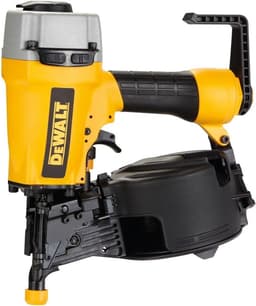
DeWalt DeWalt DPN64C

Rank 2

DeWalt DeWalt DPN64C
8.6/10about £244.27
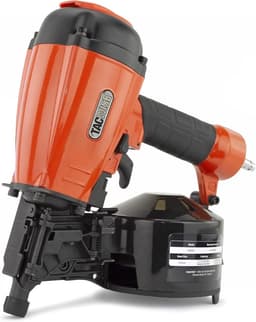
Tacwise Tacwise FCN55V

Rank 3

Tacwise Tacwise FCN55V
8.2/10about £163.91
On this page

Before the hose goes on

Put eye protection on before the airline clicks home. Where the gun is work equipment, the Control of Noise at Work Regulations 2005 put duties on the employer at 80 dB(A) and 85 dB(A). None of these listings gives a decibel figure. Tacwise prints 2.6 m/s² on the FCN55V and no decibel number. Do not borrow another brand’s sound level. Oil the inlet unless the maker marks the tool oil-free. Senco’s coil-nailer manual, which is not yours, says 5–10 drops into the inlet twice a day. Tacwise ships oil with the FCN55V, and UK reviews say a dry inlet hisses and jams. The meite CN55 does not include oil, so you supply it. Keep your finger off the trigger while you connect the hose, and stay inside the printed band, often 70–120 PSI.

Loading the coil

Disconnect the air before you open the drum. A UK workplace card lists that pause before adjustments, reloading, clearing a jam, and moving the gun. Grip-Rite’s manual says the same thing: air off, then load, because the wrong fastener jams or flies free. On the Tacwise FCN55V, reviewers who got past the first jam describe the nails sitting at the top of the guide before the latch closes. Close the latch fully. The Tacwise pack of 5,400 conical nails is 38 mm, so it loads only if 38 mm is the nail the timber needs. Do not defeat the nose contact to make a stubborn coil feed.
meite meite CN55

Testsieger

meite meite CN55
9.4/10about £139.90

One nail or bump fire

Sequential fire is one nail per trigger pull, after the nose is on the timber: nose down, then trigger, then release. Contact trip, also called bump fire, fires as you bounce the nose while the trigger is held. It is faster on short nails, and it is what reviewers describe when a gun double-fires. The Health and Safety Executive says repeat firing is not suitable for large construction nails. Leave the gun in sequential mode for a rail or a framing length. The DeWalt DPN64C is sequential only. Do not carry the gun with the trigger held. If employees use the tool, training is the employer’s duty under the Provision and Use of Work Equipment Regulations 1998.

Depth and pressure

Test depth on scrap of the same timber. East Coast Fencing’s note on featheredge is the picture: the head should hold the board, not disappear into it. Start shallow where the listing names an adjuster. The FCN55V, the CN65S, the CN45R, the JCN90V and the DPN64C name one. The CN55 does not. A UK review of that gun set depth with compressor pressure. One UK review of the CN65S says the tool is marked 70–120 PSI: at 70 PSI the nails did not clear, and at 120 PSI they embedded. The CN55’s band is 85–120 PSI. None of the eleven states litres per minute, so this page will not size a compressor. If the compressor sags, the nail stays proud.

Jam, double fire, or a gun that will not stop

Take the hose off before you open the nose, and pull the nails out of the drum. Nose on the timber before the trigger, air off before a jam, eye protection on, and do not defeat the safety. Double fire on the FCN55V shows up as once or twice a coil even after oiling. Stop and check the mode. Do not bounce the nose to clear a second nail. A gun that keeps firing is a different event. The only UK review of the meite CN65 says that after about 30 nails on fence panels the gun continued to fire, and the buyer returned it. Disconnect it and send it back. The same stop applies if it fires with the nose free of the timber.

Common questions

Do I oil the gun before the first nails?
Yes, unless the maker marks that model oil-free. Put a few drops into the air inlet with the hose off, then connect. Tacwise reviews on the FCN55V say a dry inlet hisses or jams. Senco’s manual says 5–10 drops twice a day. That drop count is Senco’s, not a meite specification. The CN55 listing does not include oil, so you buy a small bottle of air-tool oil.
How does a coil go into the drum?
Disconnect the airline first. Open the drum, seat the coil so the nail shanks lead into the guide, and close the latch. On the Tacwise, reviewers who stopped the early jams describe the nails at the top of the guide. The sheet in your box is the picture that counts. A coil of the wrong length, head or shank will jam even if the latch feels shut.
What is the difference between sequential and bump fire in the hand?
Sequential fire gives you one nail when the nose is down and you pull the trigger, then you release. Bump fire fires as the nose hits the work while the trigger stays pulled. Use sequential for larger nails. The Health and Safety Executive says repeat firing is not suitable for large construction nails. Bump fire is what reviewers associate with double fire.
How do I set depth without burying the board?
Fire into scrap of the same thickness and stop when the head is flush, not buried. Use the depth adjuster if the listing or the tool has one. On the CN55, a UK reviewer had no depth gauge and used compressor pressure instead, which is coarser. If 120 PSI on a CN65S drove the nail too deep, the answer is less pressure or a shallower adjuster, not a harder board.
What pressure should I start at?
Start at the low end of the band printed for your gun, test on scrap, and raise it until the head sits flush. One CN65S user needed more than 70 PSI inside a 70–120 PSI mark. The CN55 band begins at 85 PSI. If the listing states no pressure, as on the DeWalt DPN64C, use the manual in the box.
What do I do if it jams or double-fires?
Disconnect the hose and remove the nails before you touch the nose. Check the mode, the nail size and whether the coil is sitting in the guide. A double fire once or twice in a coil, as reported on the FCN55V, is a reason to stop and reset. If the gun keeps firing on its own, as in the CN65 fence-panel review, return it.

Related pages

Sources

Public UK sources from the research digest, listed below. amazon.co.uk prices, stars and review counts are the lines on these listings. Page updated 21 October 2026.

  1. HSE, Nail guns (retrieved 21 October 2026)
  2. Control of Noise at Work Regulations 2005, regulation 4 (retrieved 21 October 2026)
  3. HSE, noise duties for employers (retrieved 21 October 2026)
  4. HSE, PUWER overview (retrieved 21 October 2026)
  5. HSE, INDG178 (retrieved 21 October 2026)
  6. BS EN ISO 11148-13:2018 (retrieved 21 October 2026)
  7. Electrical Safety First, nail guns (retrieved 21 October 2026)
  8. BCAS fact sheet, Supply of Machinery (Safety) Regulations 2008 (retrieved 21 October 2026)