Independent comparisons. We may earn from shop links. More info

Wood burning kit UK

Updated: October 2026

You are stood in a British kitchen or shed, comparing a wood burning kit before the brand names blur together. A 70-piece title, a 100 W claim and a 750 °C figure can describe three different things, and only one of them is the tool in your hand. This page is the checklist: which tool type you are actually buying, whether the listing states a BS 1363 plug for 230 V mains, whether you can turn the heat down, and what the box is counting besides tips. The [pyrography kit comparison](/hub/soldering-and-welding/pyrography-kit) holds the eleven amazon.co.uk rows, priced from about £16.98 to £49.99 on 16 October 2026. Peter F. used those listings and their UK review text. Tip temperature was not measured in a lab. A qualifying purchase through our links can earn us a commission at no extra cost to you.

You are stood in a British kitchen or shed, comparing a wood burning kit before the brand names blur together.

Our top picks

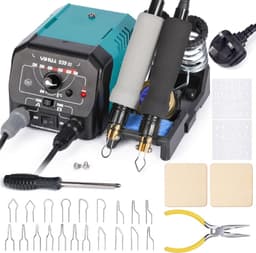
YIHUA YIHUA 939-III

Best overall

YIHUA YIHUA 939-III
8.8/10about £49.99
K KERNOWO K KERNOWO SO-Z707

Best value

K KERNOWO K KERNOWO SO-Z707
7.6/10about £19.98
Preciva Preciva 982D V

Alternative

Preciva Preciva 982D V
6.8/10about £26.99
On this page

Pen or station

A wood burning kit on amazon.co.uk is either a solid-point pen or a wire-nib station, and the title often hides which. A solid-point pen is built like a soldering iron: one heated shaft, a metal tip that screws or pushes on, and a handle that commonly gets hot. In this batch that group is the Afantti AF-WP100, the ZEROMX Z1020-1, the K KERNOWO SO-Z707, the Aucanla SW-L and the Preciva 982D V, from about £16.98 to £26.99. A wire-nib station puts a thin wire loop on a lighter handpiece, usually fed from a box on the bench. That group starts with the FIRElood LH20 at about £31.00 and runs to the YIHUA 939-III at about £49.99. The pen is the cheaper route to a name stamp or a bold line. The station is the route to a finer line and, on the better-reviewed units, a cooler grip. YIHUA’s listing says the 939-III is not suitable for soldering. Aucanla and the Preciva 982D V sit the other way: the listing or the reviews also treat them as soldering irons. Letter stamps are still a real job for a solid pen. Decide that before you compare stars. The wire nib or solid point guide sets the trade-off out on its own. The plug comes next, because the wrong connector still does not belong in a British socket.

Plug, voltage and wattage

UK mains are 230 V, and a domestic plug should be a BS 1363 plug with a BS 1362 fuse under the Plugs and Sockets etc. (Safety) Regulations 1994. YIHUA states a Type-G plug and 230 V. Both FIRElood listings claim a UK plug, and the LH55 also states 230 V AC. Those are the clearest plug lines in this batch. Gxpjycfob states 220 V AC and does not state a plug type. A 220 V figure is a reason to look at the connector, and it is not proof the tool is unsafe on British mains. ZEROMX, KERNOWO, Anesty, Preciva 935D, Aucanla and Afantti do not state a plug in the specification block. A missing line is not the same as a confirmed foreign plug. One KERNOWO review and one Aucanla review mention a fused or three-pin plug, which is not a specification. Preciva 982D V mentions a UK plug only in a highlight, and its catalogue says 20 W while the title says 100W. The Electrical Equipment (Safety) Regulations 2016 allow UKCA or CE. None of these listings states either mark, which is a capture gap. GOV.UK report 2503-0147, about a different eBay kit, is not evidence on these ASINs. Unplug if the handle smokes, if you can touch a connection, or if the tool shocks.
YIHUA YIHUA 939-III

Testsieger

YIHUA YIHUA 939-III
8.8/10about £49.99

What the number on the dial is

A degree figure on a wood burning kit is the seller’s stated range, not a measurement taken at the tip of these tools. Peter Child, a UK pyrography maker, says their own dial is uncalibrated, and that you should keep a dull red and turn a bright glow down. Burn and Grain’s pale-wood bands, about 200–290 °C, 290–400 °C and 400–510 °C, are a guide from other tools, not a test of these pens. Inside the batch the conflicts are specific. FIRElood LH20’s title says 200–750 °C and the catalogue upper rating is 700 °C. ZEROMX’s title says 200–500 °C and a bullet says 200–450 °C. Gxpjycfob states 0–800 °C and then tells you to stay between 200 and 500 °C. Afantti does not give degrees at all. It gives two steps, 15 W and 30 W. Anesty’s bullets say 0–750 °C while the catalogue’s lower figure is 10 °C, which is not a useful burning temperature. Test a scrap from the same piece of wood, at the lowest setting that leaves a mark, before you touch the project. If the line fades every few centimetres, as Gxpjycfob and Preciva 935D reviewers describe, stop and let the tool recover. Pressing harder does not put the heat back. Preciva 982D V reviews describe solid tips that seize in the thread after the first heat, so a hot tip change is a fault, not a shortcut.

What the box is counting

A 70-piece or 76-in-1 title counts pencils, stencils, carbon paper and offcuts as well as tips. KERNOWO’s box includes 22 tips, 20 boards, eight templates, 15 sheets of carbon paper, six pencils and a sharpener, at about £19.98. Preciva 982D V’s 70-piece title sits on 29 heads, 25 wood pieces, eight templates and four pencils. Those blanks are useful for a first evening at the kitchen table. They do not make the pen a finer burner than a station that includes two scraps and 20 wire nibs. YIHUA includes 20 wire nibs, two wood pieces, a dual holder and a sponge. FIRElood LH55’s title says 33 wire nibs, while the contents line splits that into 30 wire nibs, three pro wire nibs and three copper nibs. Count the tips you will actually heat. Then check whether a second pen heats at the same time. Anesty reviews say one pen at a time. Preciva 935D’s catalogue says one channel despite two handles. A stand matters more than another pencil: park the tip, and change a solid tip only when it is cold. Who each listing is for is on the best pyrography kit page. Piece count, wattage and a degree figure still do not describe the same tool.

Common questions

Do I need a UK plug on a wood burning kit?
Yes, if you are plugging it into a UK socket. The relevant hardware is a BS 1363 plug with a BS 1362 fuse, on a tool meant for about 230 V. In this batch YIHUA states Type-G and 230 V, and both FIRElood listings claim a UK plug. Several other listings leave the plug out of the specification block. That gap is not proof the plug is missing, and it is not something to ignore if you cannot see the connector before you pay.
Why does one listing say 20 W and 100 W?
Preciva 982D V prints both. The catalogue wattage line says 20 W. The bullets say a 20 W rating and a 100 W maximum. The title says 100W. Those are not three measurements of the same pen. Until the listing agrees with itself, the wattage line is the figure to plan around, and the title is advertising.
Is 750 °C the temperature at the tip?
Treat it as the seller’s stated top, not as a measured tip temperature. FIRElood LH20’s title says 750 °C and the catalogue says 700 °C. Gxpjycfob states 800 °C and also tells you to stay between 200 and 500 °C. Peter Child describes an uncalibrated dial and tells you to keep a dull red. Test on scrap, and turn a bright glow down.
Should a first wood burning kit be a pen or a station?
Buy a solid-point pen if you want letter stamps or bold marks and you accept a hotter handle, which in this batch means the kits from about £16.98 to £26.99. Buy a wire-nib station if you want finer lines, which starts at about £31.00 here. A station is the clearer first buy when the project is more than a name on a coaster, provided the plug line is one you can accept.
Is a stated 220 V a problem in Britain?
It is a buying problem until you see the plug. Gxpjycfob is the listing in this set that states 220 V AC and does not state a plug type. UK mains are 230 V, and a domestic lead should end in a BS 1363 plug. Confirm the connector on the product you receive, and do not assume a 220 V line includes a fused UK plug.

Related pages

Sources

Public UK sources and the amazon.co.uk listings in this set, last checked on 16 October 2026. Seller degree figures are quoted, not measured.

  1. Electrical Equipment (Safety) Regulations 2016 (retrieved 16 October 2026)
  2. Plugs and Sockets etc. (Safety) Regulations 1994 (retrieved 16 October 2026)
  3. GOV.UK report 2503-0147, a different 60 W kit (retrieved 16 October 2026)
  4. HSE, wood dust (retrieved 16 October 2026)
  5. Consumer Rights Act 2015, section 9 (retrieved 16 October 2026)
  6. Peter Child, pyrography technique (retrieved 16 October 2026)
  7. Craft Supplies UK, pyrography safety (retrieved 16 October 2026)
  8. Gathered, beginners’ guide to pyrography (retrieved 16 October 2026)
  9. Burn and Grain, wood-burning tip chart (retrieved 16 October 2026)