Independent comparisons. We may earn from shop links. More info

How to use a plastic welder (hot-staple focus)

Updated: 21 October 2026

You unboxed a hot-staple plastic welder with a tray of flat, wave and corner staples, skimmed a booklet that reads like a translation, and now you are staring at a cracked bumper or freezer corner wondering how long to heat the legs before you push. This guide walks through prep, heat, insert, cool, trim and finish for UK DIY kits like those in the [plastic welder comparison](/hub/soldering-and-welding/plastic-welder). It does not rank models.

You unboxed a hot-staple plastic welder with a tray of flat, wave and corner staples, skimmed a booklet that reads like a translation, and now you are staring at a cracked bumper or freezer corner wondering how long to heat the legs before you push.

Our top picks

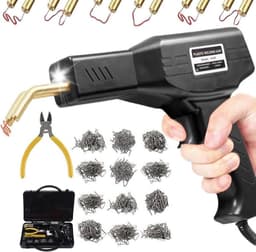
Mytovosn Mytovosn 150 W staple kit

Best overall

Mytovosn Mytovosn 150 W staple kit
9.3/10about £21.16
Not stated 170 W staple kit

Best value

Not stated 170 W staple kit
9.1/10about £19.99
On this page

Before you switch on

Work on clean, dry plastic where you can reach both sides of the crack. Wash off road grime, wax and silicone. If the part flexes in use, support it so the crack stays aligned. Movement while cooling is a common reason a straight staple fails weeks later. Many bumpers are weld-friendly thermoplastics. Some polyethylene and polypropylene stays visible even when a staple holds. Practise on scrap or a hidden spot first. Wear safety glasses and gloves, and ventilate near painted panels. Use a UK 230 V socket with a BS 1363 plug unless the listing says otherwise. Lay the staples out by shape before the gun is hot.

Choosing a staple shape

Match the geometry to the crack. Flat staples span straight runs and simple splits. Wave staples spread the load across a slightly wider gap. Inside and outside corner staples follow radii on bumper lips and housings where a flat piece would twist. Thinner legs suit small cracks. Thicker legs suit tabs and mounting ears that take stress. Trade manuals for branded staplers often suggest spacing bridges roughly one to three centimetres apart along a long crack, rather than one bridge in tension. If the kit pliers feel flimsy in the first five minutes, swap to proper side cutters. UK reviews across this category say the included pliers mash legs instead of cutting them flush.

Heat, insert, and cool

The GYS hot stapler guide describes the rhythm: heat the legs until they sink, insert them across the crack, twist slightly if the profile needs grip, then hold still while the plastic cools. A rule of thumb is about ten seconds of trigger heat. Thickness and room temperature change that, so watch the legs rather than the clock. Pull the crack closed as you insert. On a tab, bridge the ear back to its mount. On a skin crack, staple across the split. Keep the gun still for a short cooldown. Jiggling while the plastic is soft pulls the staple loose. Several small staples beat one oversized staple.

Trim and finish

Trim the legs only when the plastic has cooled and feels rigid again. Cut flush with good cutters, then sand or grind carefully so you do not gouge the surrounding texture. Fill low spots with plastic-friendly filler, feather-sand, and paint if the panel is visible. Staples are reinforcement, not invisibility. Expect a repair that looks like a tidy DIY save under paint, not a factory mould line. If legs poke through the outer face because you overheated or misaligned, grind back and re-bridge rather than forcing filler over proud metal.

If you have a 2-in-1 rod tip

Some kits switch to a small tip and coloured rods. That builds material on the surface or in a groove. It is not a 1600 W seam with a speed nozzle and a roller. Use rod sparingly, and match the colour where you can. A long floor seam or a tank still needs a hot-air tool. The split is in hot stapler or hot air.

When to stop and call a professional

Stop if the part is structural in a crash sense, surrounds an airbag, or must satisfy an insurer or an MOT tester as original structure. Stop if you cannot align the crack without pulling the panel off the car. Removal is sometimes the professional step. If you are heating painted factory panels, treat ventilation as seriously as the staple, not as an afterthought.

Common questions

How long do I heat the staple?
Until the legs soften enough to insert without forcing cold metal through brittle plastic. That is often around ten seconds on the trigger for many kits, adjusted for thickness and room temperature. Watch the legs, and do not treat ten seconds as a fixed timer.
Which staple shape for a straight crack?
Start with a flat or wave staple sized to the gap. Use corner staples only when the crack follows a radius, such as a bumper lip.
When can I cut the legs?
After the plastic has cooled and hardened. Cutting hot legs weakens the bond and burns fingers. The bridge should feel rigid before the cutter touches it.
Do I need to twist the staple?
A slight twist can increase grip on some profiles. Follow the manual if one was supplied, and practise on scrap before a visible face.
Can I use the tool on painted plastic?
You can staple through painted areas, but heating paint releases fumes. Ventilate seriously, keep your face out of the plume, and read the bumper guidance on painted panels before a long session.
What if the staple pulls out?
The usual causes are trimming too soon, too little heat, or flex during cooldown. Clean the area again, realign the crack on blocks, and bridge with a fresh staple.
Does the rod mode on a 2-in-1 work like hot air?
No. The rod tip is local build-up on the staple body. A hot-air seam uses airflow, rollers and speed nozzles on a 1600 W pistol. The 2-in-1 here, at about £25.60, is still a staple kit first.

Related pages

Sources

Sources taken from the research digest. Listings were checked on 20 October 2026.

  1. Sealey — Plastic welding kits (retrieved 20.10.2026)
  2. Optimotive — 230 V bumper repair stapler (retrieved 20.10.2026)
  3. GYS 052925P hot stapler manual (retrieved 20.10.2026)
  4. HSE — MR6 hot work on painted panels (retrieved 20.10.2026)
  5. Clarke — Plastic repair systems (retrieved 20.10.2026)