Independent comparisons. We may earn from shop links. More info

Plastic welder buying guide for UK DIY buyers

Updated: 21 October 2026

You are about to spend anything from roughly £19 to over £200 on amazon.co.uk, and the category mixes two tools under one name. A hot-staple gun melts metal staples into cracked thermoplastics. A 1600 W hot-air pistol softens welding rod along seams in flooring, liners and sheet. This guide covers method, mains, consumables and safety so you open the right row in the [plastic welder comparison](/hub/soldering-and-welding/plastic-welder) without paying for the wrong physics.

You are about to spend anything from roughly £19 to over £200 on amazon.co.uk, and the category mixes two tools under one name. A hot-staple gun melts metal staples into cracked thermoplastics.

Our top picks

Not stated 1600 W hot-air starter

Best overall

Not stated 1600 W hot-air starter
8.4/10about £106.99
Not stated 170 W staple kit

Best value

Not stated 170 W staple kit
9.1/10about £19.99
On this page

What you are actually buying

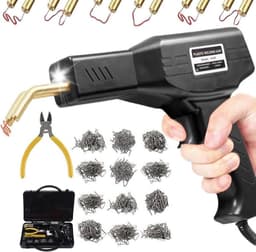
Start with the crack or seam, not the wattage in the title. A hot-staple kit leaves a stainless bridge in bumpers, mudguards, kayak hulls, freezer drawers and garden furniture. You heat the legs, push through the crack, cool, then trim. A hot-air welder feeds rod into heated air along vinyl flooring, PVC duct, tarpaulin or geomembrane. This capture holds staple-heavy listings under about £28 and hot-air rows above roughly £107. A £200 floor welder will not replace a £20 stapler on a short tab, and 800 staples will not run a long floor seam. A 2-in-1 with a small rod tip is still staple-first. It is not a nozzle-and-roller floor kit.

Mains, plugs, and 110 V listings

UK garages normally run 230 V through a BS 1363 plug. Most staple kits here mention 220 V or 230 V. Hot-air rows do the same unless the technical line says otherwise. One listing states 110 V in the product details while the title also uses dual-voltage wording. Treat that 110 V field as a stop until the live photo agrees. A pin adaptor does not change voltage. If you work on a 110 V site, add transformer cost. Otherwise favour a row that names a UK plug. Use an RCD-protected socket where you can, rest the gun on a heat-safe surface, and do not leave it while a staple or nozzle is still hot.
Not stated 1600 W hot-air starter

Testsieger

Not stated 1600 W hot-air starter
8.4/10about £106.99

Staples, rods, and what should be in the box

Staple kits here often advertise 800 or more pieces: flat for a straight crack, wave for a wider gap, and corner profiles for a bumper radius. You will waste staples while learning, and a car crack often needs two or three bridges. High-volume UK reviews praise the case, then complain about the pliers. Rods belong to hot air and to 2-in-1 kits. A hot-air kit should name the rod and include a starter pack. Floor listings add speed nozzles and rollers. Two rods are a trial build-up, not a pond liner. If the title never mentions staples, you are probably looking at hot air. If it says 800 staples and bumper repair, you are in staple territory even at 170 W.

Power claims and what reviews actually discuss

Staple guns in this capture cluster around 80–170 W. A higher number in the title is often marketing, not a bond-strength test. UK reviewers talk about heat-up, whether the ready light shows in daylight, and whether the trigger stays consistent. Hot-air listings jump to 1600 W so the air stays hot enough to melt rod on a moving seam. Many quote roughly 40–650 °C. A 5.0 from two hot-air reviews says almost nothing about a bumper. A 4.6 from thousands of staple reviews says a lot about the learning curve and the pliers.

Safety, finish, and painted panels

Both methods mean hot metal, molten plastic and sharp legs. Safety glasses and cut-resistant gloves are the baseline. Add hearing protection when you grind legs flush. On painted car panels, HSE guidance on hot work warns that some coatings can release isocyanate-rich fumes, with an occupational asthma risk if there is no extraction. An open garage door is not a filtered booth. A staple bridge still needs a trim, sand, filler and paint. A hot-air seam needs a rod colour match and often a roller pass. Neither restores insurer-approved crash performance. The staple cycle is in how to use a plastic welder.

Short checklist before you checkout

Decide staple versus hot air against the job, then open the comparison sorted by method. Confirm voltage and plug photos on the live listing, especially on hot-air rows around £180–£220. Count staples and rods against how many cracks you expect this year. Budget better side cutters if reviews mention weak pliers. Plan trim, filler and paint time for any visible panel. If the repair touches crash structure, airbag surrounds or parts an MOT tester would treat as structural, stop at DIY and use a bodyshop.

Common questions

Do I need hot staples or hot air for my job?
Hot staples suit cracks and broken tabs where a metal bridge can sit in or across the plastic. Hot air suits long seams, flooring, membranes and sheet welding with rod. If you only have a split bumper tab, staples are the rational default in this index.
What does 800 staples in the title mean?
It usually means a mixed box of flat, wave and corner staples, often around 0.6–0.8 mm, enough for learning attempts and multi-point cracks. It does not guarantee the quality of the pliers or the instructions.
Will a UK plug kit work in my garage?
If the listing shows a BS 1363 plug and 230 V operation, yes on a normal domestic supply. If the technical details state 110 V only, you need a deliberate transformer plan, not a simple extension lead.
What if the listing says 110 V?
Pause and read the plug photo and the description. Do not assume dual-voltage marketing text overrides a 110 V technical line. Many UK buyers should skip that row and choose another.
Do I need welding rods as well as staples?
Only if you buy hot air or a 2-in-1 kit with a rod tip. A pure staple kit does not need rod for a basic bumper bridge.
What PPE do I need?
At minimum, safety glasses and gloves. Add ventilation or extraction for painted panels. Add hearing protection when you grind staple legs flush.
Can this fix any plastic?
Many bumpers and housings are weld-friendly thermoplastics. Polyethylene and polypropylene can stay visible even when a staple holds. Test on scrap, match the shape to the crack, and plan filler and paint.

Related pages

Sources

Sources taken from the research digest. Listings were checked on 20 October 2026.

  1. Sealey — Plastic welding kits (retrieved 20.10.2026)
  2. Optimotive — 230 V bumper repair stapler (retrieved 20.10.2026)
  3. GYS 052925P hot stapler manual (retrieved 20.10.2026)
  4. HSE — MR6 hot work on painted panels (retrieved 20.10.2026)
  5. Clarke — Plastic repair systems (retrieved 20.10.2026)