Independent comparisons. We may earn from shop links. More info

How to connect a UPS extension lead

Updated: October 2026

The lead is already on the desk and the UPS shows a row of IEC outlets. This is how to connect a UPS extension lead that starts with a C14 plug: the pins go into the UPS, the UK plugs or the kettle leads go into the other end, and the lowest amp figure is the point where you stop adding devices. The [UPS extension lead comparison](/hub/sockets-and-extension-leads/ups-extension-lead) is where the seven listings were set out on 16 October 2026. Products Compared did not energise these products in a lab. A qualifying amazon.co.uk purchase through our links can earn a commission at no extra cost to you.

The lead is already on the desk and the UPS shows a row of IEC outlets.

Our top picks

On this page

Match the C14 to the UPS outlet

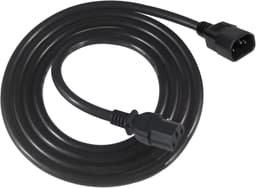
A C14 plug has pins. A C13 outlet on the UPS has holes in the kettle-connector shape. Push the C14 fully into a C13 outlet until it sits home. Do not put it into a wall socket. If your lead is a 4-gang, UK plugs go into the BS 1363 sockets. If your lead is the KC CABLE type, the other end is a C13 socket for a device that already has a kettle inlet. A UK 3-pin plug fits neither Flomiara output. Turn the UPS output off, or follow the UPS manual, before you seat the C14. Then plug in the first device, then restore the output. Do not run the block as a wall extension. The C14 is not a UK wall plug.

Add devices only up to the lower amp figure

Once the C14 is home, add the devices you actually need on the UPS output: typically a router, a switch, or a mini PC. Each new plug still shares one feed. The feed is 10 A on every listing in this set, unless a lower figure is printed. PEL01206 also carries an input-current line of 5 A, so use the lower number on the label. A 13 A mark does not add headroom. Do not use the KC CABLE 3,750 W line as the budget. Stop when the next device would be a heater, a kettle, or a second extension. The C14 to UK socket extension page explains why those four sockets still share one 10 A C14.

Fix the block down, and what you do not modify

A loose 4-gang walks out of the UPS outlet once plug-tops hang off it. The PRO ELEC leads have rear hanging holes. The Computer Spares and Mercury leads have rear screw holes, and screws are not in the box. Use your own fixings so the C14 is not taking the weight. Do not cut the C14 off to fit a UK plug. If you have both a C13 extension and a 4-gang, they go into two different UPS outlets. They do not chain. The C14 to C13 or UK sockets page is the fork if you are holding both.

When to unplug and get help

Unplug the block if you smell hot plastic, if the housing is too hot to rest a hand on, or if a socket does nothing. A PEL01204 review says two sockets were dead on two units. Call a registered electrician if you need more wall sockets, if a lead has smelled of burning, or if you were about to cut a moulded plug off.

Common questions

Which end goes into the UPS?
The C14 plug, the end with pins, goes into a C13 outlet on the UPS or PDU. The 4-gang, if your lead has one, faces the devices. On a C14-to-C13 extension the female C13 faces the device's own kettle lead. On the Flomiara splitter both female ends face devices, and the single C14 still faces the UPS.
Can I plug the 4-gang into the wall with a kettle lead the other way?
Do not. The C14 is the UPS connector, not a part you reverse through another lead so the block becomes a wall extension. A review mentioned that kind of workaround after a UPS failed. It is a misuse, and it is how people end up cutting moulded plugs. If you need sockets from the wall, buy a normal BS 1363 extension lead made for a wall socket.
Where do the screws come from?
From you, if you choose to screw the block down. The Computer Spares listing and the Mercury listing both say screws are not supplied. The PRO ELEC leads show rear hanging holes rather than promising a screw pack. Use fixings that suit the surface, and do not drill the plug or the socket face.
How do I know I have overloaded it?
You know from the arithmetic before it gets hot. Add the labelled watts of the devices and keep the total inside the lower amp figure, usually 10 A, which is about 2,300 W at 230 V as a rule of thumb. Heat, a burning smell, or a UPS that drops the load at once are late signs, not the design method. A 13 A stamp on the plastic is not extra budget.
Can I plug a second extension into the block?
No. Electrical Safety First's advice is not to daisy-chain extension leads. Schneider's APC FAQ also argues against extension cords on Back-UPS and Smart-UPS outputs. If the cable is too short, use the 2 m lead in the comparison rather than a 1 m lead plus another strip. If 2 m is still too short, the layout needs a rethink, not a chain.
What if a socket does nothing?
Stop using that block. One review of PRO ELEC PEL01204 reported two dead sockets on each of two units. Move the devices to a lead you trust, and do not keep a half-dead 4-gang on a UPS. A socket that works only when the plug is tilted is the same kind of fault.
When do I stop and call an electrician?
Stop and call a registered electrician if you need new wall sockets, if a lead has been hot or has smelled of burning, or if the next step in your head is to cut a moulded C14 off. Also stop if you are about to open the block. UPS-outlet faults on an unmodified unit belong with the UPS maker. This page does not cover rewiring.

Related pages

Sources

Public UK sources used for this comparison. Listing prices, stars, and review counts are the amazon.co.uk lines from 16 October 2026.

  1. Electrical Equipment (Safety) Regulations 2016, regulation 35 (retrieved 16 October 2026)
  2. Plugs and Sockets etc. (Safety) Regulations 1994 (retrieved 16 October 2026)
  3. Electrical Safety First — extension leads (retrieved 16 October 2026)
  4. Electrical Safety First — overloading sockets (retrieved 16 October 2026)
  5. HSE INDG236 (retrieved 16 October 2026)
  6. Schneider Electric UK FA158852 (retrieved 16 October 2026)
  7. Bulgin IEC connector ratings (retrieved 16 October 2026)
  8. Kenable 2 m C14 to 4-gang (retrieved 16 October 2026)