Independent comparisons. We may earn from shop links. More info

Cube extension lead vs strip

Updated: 23 October 2026

You have one socket and three shapes in the results: a cube, a flat strip, and a tower. This cube extension lead vs strip page is about the shape, not a brand winner. The load rule does not change with the plastic. What changes is whether bulky plugs fit, how far the lead reaches, and whether joules are printed. The kept products sit on the [power cube comparison](/hub/sockets-and-extension-leads/power-cube). Fuse and USB checks are on the [cube extension lead buying guide](/hub/sockets-and-extension-leads/power-cube/sub/power-cube-buying-guide). Peter F. is the DIY & tools editor. We did not lab-test a cube against a strip. A qualifying purchase can earn a commission at no extra cost to you.

You have one socket and three shapes in the results: a cube, a flat strip, and a tower. This cube extension lead vs strip page is about the shape, not a brand winner. The load rule does not change with the plastic.

Our top picks

BEVA BEVA 4-way cube with 3 USB

Best overall

BEVA BEVA 4-way cube with 3 USB
8.9/10about £13.59
JSVER JSVER 3-outlet cube, 2 m

Best value

JSVER JSVER 3-outlet cube, 2 m
8.7/10about £13.99
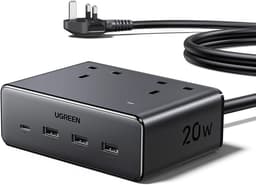
UGREEN UGREEN 2-way compact lead

Alternative

UGREEN UGREEN 2-way compact lead
8.0/10about £15.99
On this page

The load does not change

A cube, a four-gang strip and a tower are each one device on one BS 1363 socket, with one fuse, usually 13 A. Electrical Safety First says to add what may run at once and not to daisy-chain. Four faces do not become 52 A. Six sockets do not become 78 A. A lamp, a charger and a laptop brick can share a cube. A kettle plus a toaster cannot, on a cube or a strip. A 3,250 W cell is that 13 A sum written as watts, not joules and not proof a cube outruns a strip. The plug-in warning is on wall cube adaptor vs extension lead.

When a cube is the better shape

Choose a cabled cube for two to four bulky plugs on a small desk. On a strip, a laptop brick often covers the next socket. On a cube the sockets sit on different faces. BEVA is about 8.5 cm across with four outlets. Fellowes is about 8 × 8 × 7.4 cm. Leads here are short: 1.4 m on Status, 1.5 m on BEVA, 2 m claimed on JSVER, and one JSVER review says about a metre. The cube loses when you need reach, joules, or a heavy supply on one face. UGREEN is a caution: the bullets say cube, the shape field says Flat, 12.5 × 7.8 × 3.3 cm, two AC outlets. If it is flat, judge it as a compact strip.
BEVA BEVA 4-way cube with 3 USB

Testsieger

BEVA BEVA 4-way cube with 3 USB
8.9/10about £13.59

When a strip or a tower is better

Choose a strip for reach, a screw fixing, or a joule figure. Strips run much longer than the 1.4–2 m cubes here. If the socket is behind a sofa, a cube flex is the wrong tool. Scottish Fire and Rescue points toward a surge-protected bar. None of the kept cubes prints joules. Choose a tower for more than about four outlets, if the base is stable. It still shares one 13 A plug. An eight-way tower was removed because it is a different category. A strip also wins for a switch per socket. The cost is sockets in a single line.

One recommendation

Use a cabled cube for two to four bulky plugs on a desk or bedside, with the load well under the shared 13 A mark. The top pick for that job is the BEVA, on review depth and four faces. Use a strip for length, a fixing, or joules. Use a tower for more outlets if the base will not tip. Do not buy any of them as a kettle hub. Placement is on how to use a cube extension lead.

Common questions

Is a cube safer than a strip?
Neither shape is safer by default. Both are one fused plug if they are proper UK leads. London Fire Brigade prefers a fused inline lead to a plug-in cube, which is a point against wall cubes, not a win for every strip. A strip with a printed joule rating answers a surge question these cubes leave blank. Safety is the fuse, the load you add up, and whether the unit stays cool.
When does a strip win?
A strip wins when the socket is far from the devices, when you want to screw the bar down, or when you need a surge figure in joules. A 1.5 m cube lead will not cross a room. It does not win on amps. A 13 A strip and a 13 A cube have the same ceiling. Bulky plugs in a single line can still block the next socket.
Will a cube tip?
It can, if heavy supplies hang off one face or the lead is tugged. These cubes are small, around 6.5–9 cm, and the Fellowes unit is 630 g before plugs. A long strip is harder to overturn and easier to trap under a rug. Put the cube on a hard surface, keep the lead slack, and take plugs off if it rocks. A wall cube walks out of the socket instead of tipping on a desk.
What if I need eight AC outlets?
Leave this cube set. The kept cubes offer two, three or four mains outlets. An eight-way tower was removed because it is not a cube. You would still be on one 13 A plug, so eight holes only help if most of them are chargers and lamps. Read a tower or a long strip comparison for that count, and add the load before you fill every socket.
What if the socket is behind a sofa?
A cube lead of 1.4–2 m rarely reaches a lamp on the far side, and the block is awkward to fish out later. A longer strip, routed where you can see it and not under the cushion, matches that room. Do not daisy-chain a cube onto a strip to make up the distance. If the socket is scorched or loose, ask an electrician.

Related pages

Sources

Sources taken from the research digest. Shelf prices, stars and review counts are the amazon.co.uk figures in the stored listings, dated 21 October 2026. This page did not run a lab test.

  1. Electrical Safety First — extension leads, cable reels and block adaptors (retrieved 22.10.2026)
  2. Electrical Safety First — overloading sockets (retrieved 22.10.2026)
  3. Electrical Safety First — ratings of electrical appliances (retrieved 22.10.2026)
  4. London Fire Brigade — cables, fuses and leads (retrieved 22.10.2026)
  5. Which? — how to avoid overloading plug sockets (retrieved 22.10.2026)
  6. Scottish Fire and Rescue Service — electrical safety (retrieved 22.10.2026)
  7. Electrical Equipment (Safety) Regulations 2016, regulation 35 (retrieved 22.10.2026)
  8. BSI — BS 1363-3:2023 adaptors (retrieved 22.10.2026)