Independent comparisons. We may earn from shop links. More info

Extension lead USB C charging and Power Delivery watts

Updated: 23 October 2026

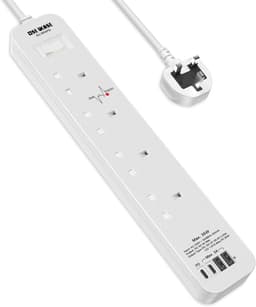
A USB-C socket on an extension lead looks like the small charger you already trust for a laptop, and the original brick goes in a drawer. Extension lead USB C charging only works that way when the listing states Power Delivery and a wattage your laptop maker already asks for. In this amazon.co.uk set, most USB-C ports are 5 V banks shared with USB-A. The [extension lead with USB comparison](/hub/sockets-and-extension-leads/extension-lead-with-usb) holds every row. This page is only about port power. Peter F. matched those listing lines on 20 October 2026 and did not measure a single port. A qualifying purchase can earn a commission at no extra cost to you.

A USB-C socket on an extension lead looks like the small charger you already trust for a laptop, and the original brick goes in a drawer.

Our top picks

SE UKASE SE UKASE 65 W USB-C tower

Best overall

SE UKASE SE UKASE 65 W USB-C tower
7.1/10about £26.99
POWSAF POWSAF 4-socket USB block

Best value

POWSAF POWSAF 4-socket USB block
6.8/10about £9.99
SE UKASE SE UKASE 20 W USB-C strip

Alternative

SE UKASE SE UKASE 20 W USB-C strip
5.5/10about £12.62
On this page

Shared 5 V USB banks

The ordinary pattern here is one pool of current at 5 V. POWSAF shares 5 V / 3.4 A, and a review says that USB-C port is not Power Delivery. Addtam shares 4.5 A, the switched HANYCONY bar shares 3.1 A, HAFINO shares 5 A, and the four-socket SE UKASE tower shares 5 V / 4.2 A. AUNNO lists up to 5 V / 2.4 A and does not print a Power Delivery wattage. Five volts times about 3 A is about 15 W. The JSVER bars are USB-A only. The buying guide puts that bank next to the 10 A and 13 A lines, because USB never increases the fuse.

Stated Power Delivery watts

Two listings print watts you can compare with a laptop charger. SE UKASE B0CZRSR1ZL states USB-C at 5 V, 3 A, 20 W, and calls it PD. The lead is £12.62. Tech Advisor’s charger guidance, a rule of thumb and not a test of this lead, puts a small laptop around 30–45 W and a mid-size laptop around 65 W. A 20 W port sits under the small-laptop band. The file is 4.1 from 209 reviews, with USB-C ports that failed physically. SE UKASE B0FVX4KV85 states up to 65 W from one USB-C port and 20 W from three others, on a six-socket tower at £26.99. That 65 W figure is the only one in this set that meets the mid-size rule of thumb, and it is one port. The star line is 4.7 from 30 reviews. This page does not treat that as a measured 65 W. If the laptop’s charger is above 65 W, keep the original brick in a mains socket.

When USB-C is not laptop-grade

Addtam prints the limit in the bullets: the USB-C ports do not support a MacBook or other laptops that need 14–22 V. A USB-C logo without that voltage is a 5 V charger that happens to use the oval plug. POWSAF’s feature line mentions a laptop, and a review still says the USB-C port is not PD. Believe the 5 V / 3.4 A line. KLINTOS, HAFINO and the four-socket SE UKASE tower do not state Power Delivery watts. HAFINO’s recommended uses mention laptops because a laptop brick can go in a mains socket, which is not the same as charging from the USB face. When the port is not laptop-grade, plug the original charger into a mains socket. The best extension lead with USB page says when the 65 W tower is the one to pay for.

Switches and USB that stays on

A master switch is only useful if it kills the ports you think it kills. On the JSVER bars and, in reviews, on the 65 W tower, one switch cuts mains and USB together. HANYCONY’s pair-switched bar leaves USB-A and USB-C on. HAFINO reviews say the USB ports and the power light stay on. An off socket does not create a 65 W port. On AUNNO, one buyer says the fourth socket switch has to be on before USB works. If a dark bedroom matters, read that switch note before you compare wattage. A port left on under a cushion is the case the safe use page tells you to unplug.

Common questions

What is the difference between 5 V / 3.4 A and 20 W PD?
Five volts at 3.4 A is a shared low-voltage pool, about 17 W if the whole bank were on one port, and POWSAF splits it across four ports with a review that says USB-C is not Power Delivery. Twenty watts PD, on B0CZRSR1ZL, is a stated negotiation at 5 V and 3 A on the USB-C claim. It is still below the 30–45 W small-laptop rule of thumb from Tech Advisor. This page did not measure either figure.
Which ASIN in this set states 65 W USB-C?
B0FVX4KV85, the SE UKASE six-socket tower at £26.99. The bullets put 65 W on one USB-C port and 20 W on three USB-C ports, plus one USB-A port. No other row prints 65 W. The file has 30 reviews. Treat 65 W as the seller’s figure, and check it against the wattage printed on your laptop’s original charger.
Can I charge a MacBook from any USB-C port here?
No. Addtam says its USB-C ports do not support MacBooks or other laptops that need 14–22 V. POWSAF, HAFINO, KLINTOS, AUNNO and the four-socket SE tower do not state a PD wattage. The 20 W SE UKASE lead is under a typical laptop charger. Only the 65 W claim on B0FVX4KV85 reaches the mid-size band in the Tech Advisor rule of thumb, and only on one port, unverified by this comparison.
Why does Addtam say its USB-C does not support MacBooks?
Because those laptops expect a higher voltage than a 5 V phone port, and Addtam’s bullet names 14–22 V as unsupported. The block still offers two USB-C and two USB-A ports on a 4.5 A share, which is coherent for phones and tablets. The sentence stops you treating the oval port as a laptop supply. Other brands in this set leave that sentence out and list laptop among compatible devices anyway.
Is USB-C on POWSAF the same as on the SE UKASE PD strip?
No. POWSAF is a shared 5 V / 3.4 A bank, and a review says it is not Power Delivery. B0CZRSR1ZL states 20 W PD. They both use a USB-C shape. The same cable can fit and still charge slowly, or not charge a laptop, on the POWSAF port. Price does not close that gap: POWSAF is £9.99 and the 20 W lead is £12.62, and the review records are not equal either.

Related pages

Sources

Sources taken from the research digest. Listings were scored on 20 October 2026. This page did not run a lab test.

  1. Electrical Safety First — Extension leads (retrieved 20.10.2026)
  2. Electrical Safety First — Plugs and fuses (retrieved 20.10.2026)
  3. Plugs and Sockets etc. (Safety) Regulations 1994 (retrieved 20.10.2026)
  4. Electrical Equipment (Safety) Regulations 2016 (retrieved 20.10.2026)
  5. BEAMA — Extension lead safety checklist (retrieved 20.10.2026)
  6. BSI — BS 1363-2:2023 (retrieved 20.10.2026)
  7. London Fire Brigade — Cables, fuses and leads (retrieved 20.10.2026)
  8. Tech Advisor — USB-C chargers (retrieved 20.10.2026)