Floor is lava game at home: rules that keep the room safe

Set a floor is lava game at home: use floor markers for under-fives, step-sized gaps, furniture kept off limits, and when stones beat cushions on wood.
On this page
The cushion shoots sideways, a foot clips the floor, and the coffee table is still in the landing zone. That is the usual failure of a floor is lava game at home: the story is simple, and the furniture is not. You can play it with cushions you already own. The rules have to be tighter than the shout.
This page is from the Products Compared editorial team. It follows a Southfolk activity card, a Norske Barneleker games page, the NHS page on keeping toddlers active, and a Cambridgeshire children's physiotherapy note on balance. Prices and review counts for bought stones come from amazon.co.uk listings in our stepping-stones comparison, recorded for this guide. We have not laboratory-tested a cushion, a stone or a living room. If you buy through our links, a qualifying purchase can earn us a commission at no extra cost to you.
In short
Under-fives use flat floor markers they can step between, with you holding a hand for the first crossings. Older children may add a sofa seat or a low stool only after you have named it, and they still stay off bookcases, windowsills and anything on wheels. A bought set helps when cushions slide. It does not turn the game into unsupervised play.
What counts as an island
An island is a surface you have named, and that stays put when a foot lands. Southfolk uses cushions, pillows, towels or markers, clears corners and toys first, and keeps movement to walking or careful stepping. The card covers ages three to ten, with about five minutes of preparation and close adult supervision. Norske Barneleker asks you to say out loud what may be stood on. A child hunting for anything off the floor will find the windowsill.
Under-fives stay on the floor. That games page lays cushions straight down, holds hands for the first rounds, and skips the countdown. A sea-of-sharks telling uses the same floor cushions, so nobody jumps down from furniture. Southfolk's easier version is a line of markers and an adult hand. Both pages come from outside the UK. This game has no British Standard and no NHS lava rule.
From about five, the Norwegian page adds the sofa, a low stool, or a chair without wheels pushed against something solid, and it holds jumps at the sofa seat. The back of the sofa stays out. Under-fives in a mixed group still stay on floor markers. Cambridgeshire children's physiotherapy uses cushions or marks as a stepping task and tells you to support any higher surface. Agree whether a hand on the floor counts, and send a touch back to the start rather than sitting a child out.
How far apart the islands sit
Set the gap to one stride of the smallest child, with the whole foot on the next island. Norske Barneleker describes that stride as about 30 to 50 cm at three, with islands that almost touch, and a good metre only around age ten. Those figures are that page's description. The NHS page gives no lava gap, so measure the step on your own rug, in the socks or bare feet you will actually use.
If children leap or slip, Southfolk says to shrink the gaps and switch to flatter markers. Ordinary socks on wood slip, so the games page prefers bare feet or socks with a rubber grip. Four cushions should shorten the route. Six to ten islands are the living-room count on that page. Leave at least half a metre of clear floor around each one, its stated clearance, so a miss meets rug rather than a table leg.
Move a marker only while everyone has stopped. Southfolk shifts one or two islands after a crossing, and only then. Skip the five-second surprise countdown with three-year-olds and let them walk to the nearest island. Edge-to-edge pieces make a path for a child who does not jump, and a wider gap can sit on an older child's stretch. A wheelchair user can roll between agreed stations. Strong colours help a child who does not see the cushions, and a raised arm replaces a shout for a child who does not hear it.
What stays off limits
Walk the room first. Norske Barneleker treats those minutes as what lets the game last about twenty. Move the coffee table, pick up toys, and point at anything that is not an island.
Off that list: bookcases, windowsills, glass tables, the television bench, and anything on wheels. A wheeled chair rolls on landing. A bookcase or a chest of drawers can topple. Fix tall furniture to the wall if it is still freestanding, and wait if you have not. These are play rules for one afternoon. A full home safety check remains yours.
Southfolk starts by clearing corners and trip hazards. Cushions go on a rug. On bare wood or tile, use a foam mat or a yoga mat, because that games page traces most falls to a slide. The sofa seat is for about age five and older, with you beside the child, and nobody goes above the seat. Windowsills stay off the list. A sill is narrow and often beside glass, and a jump from one is the landing this game should never stage. End by calling the lava cool, then walk the floor and collect the cushions. Carrying a soft toy is Southfolk's harder round, with the gaps left the same size.
When bought stones beat cushions
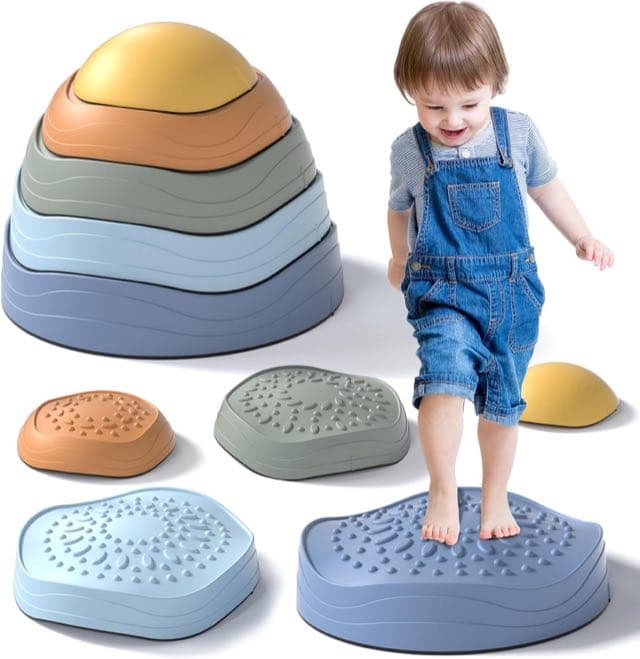
Cushions work while they stay put. They fail on wood, on tile, and on a rug that lets a pillow creep. A plastic stone with a rubber base is meant to sit still. The trade-off is texture. Grip dots can hurt bare feet, and a stone smaller than the shoe wobbles under a small foot.
The blue Lehoo Castle six-piece, ASIN B0D78X9VQ2, was £32.99 on amazon.co.uk when we recorded it, with 4.6 from 525 reviews. Open it on amazon.co.uk. The listing says 18 months and over, a 220 lb line, a 100 kg bullet, an anti-slip ring, and stones that nest. UK reviews call it sturdy and mention hard dots, a missing bag, and adults who stood on the stones. The pink colourway shares that review text, so 525 is one pool. The price can change, and we did not laboratory-test the set.
Eighteen months on the listing is a product line. Use the stones as floor markers, with a hand for under-fives, and stop a leap. If the dots are too hard, go back to a flat mat and compare surfaces in the foam or plastic guide. Six pieces suit a short route. Layout sits on the set-up page. Choose from the stepping-stones comparison and the buying guide. Indoor and outdoor wording still leaves a toy short of a garden path, which the indoor and outdoor guide separates. The 220 lb line is a shop claim about an adult standing to spot a child.
When you stop the round
Stop at the first leap, the first slide, or the first hand on a bookcase. The tag version, where one child may walk on the floor, needs more room than a lounge usually has, so leave it out.
Once a child is walking, the NHS asks for at least 180 minutes of activity across the day, with you joining in. A lava crossing can be one burst inside that total, and it needs you in the room. Families worried about balance can call Cambridgeshire children's physiotherapy on 0300 029 50 50 on weekdays.
Run the round, then judge the room.
- Name the islands out loud, and clear glass, toys and sharp corners.
- Lay six to ten markers on a rug, inside the smallest child's step.
- Cross one at a time, walking, with a hand ready for anyone under five.
- Move a marker only after everyone has stopped, and keep the new gap inside that step.
- Call the lava cool, walk the floor, and put the cushions away from the window.
If someone is hurt, frightened or climbing, the round is over. A floor touch goes back to the start when you have already agreed that feet, hands and knees count. A creeping rubber ring means you pick the stones up. Finish with a walk or a song with actions.
Common questions
What may a three-year-old stand on in a floor is lava game at home?
How far apart should lava islands be?
Are bookcases and wheeled chairs allowed?
Do I need to buy stepping stones?
When should I stop the game?
Is 30 to 50 cm a UK rule for lava gaps?
Can a toddler use the sofa as an island?
Does the NHS publish floor-is-lava rules?

Products Compared publishes British-English buying guides based on amazon.co.uk listings and public UK sources. We do not run a lab and we do not invent test scores.
Related articles

What stepping-stone sets cost in the UK
Kids' stepping-stone sets on amazon.co.uk in this file cost £19.99 to £35.99. See why other UK pages quote a different figure.

When stepping stones are smaller than they look
A 4.6-star set can still be stepping stones too small. Check the shoe, the piece count and the printed size.

Bare feet on foam and plastic play stones
Foam play stones stay firm, and plastic grip dots can hurt bare feet. Read the UK reviews, then decide whether a sock or a return is next.