Foam or plastic play stones bare feet: firm underfoot

Foam play stones stay firm, and plastic grip dots can hurt bare feet. Read the UK reviews, then decide whether a sock, a return, or a different set is next.
On this page
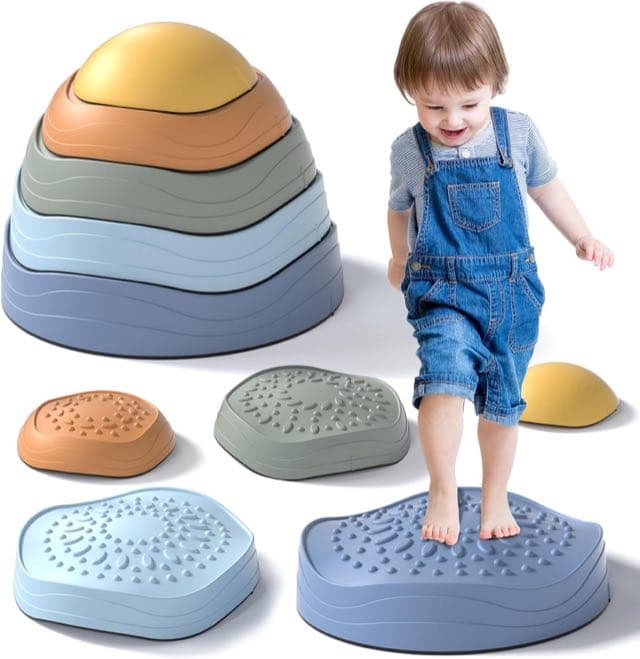
The box is open, your child has already lifted a foot off the first stone, and the listing still says non-slip. Foam or plastic play stones bare feet is the decision that moment forces, because soft, sensory, and grippy are selling words, not a description of the sole. In this comparison the foam sets are light and firm, closer to dense packing foam than to a crash mat, and the plastic sets can put raised grip dots under a bare foot. One UK reviewer sent a dotted plastic set back for that reason.
This page is from the Products Compared editorial team. Prices, star lines, and review counts are the amazon.co.uk listings stored for the stepping-stones comparison, read on 16 October 2026. We did not stand on the stones in a lab, and we did not treat another website's softness claim as a measurement of these sets. A qualifying purchase through our links can earn a commission at no extra cost to you.
In short
Foam in this file is light and firm, not a cushion. Plastic grip dots on the blue Lehoo Castle set were too hard for one tactile-sensitive toddler. Socks change the feel and do not delete a texture a child already refuses. None of these sets is a therapy tool, and a 4.6 star line does not tell you which sole will stay on the stone.
What bare feet met in the reviews
On the blue Lehoo Castle six-piece, hard plastic at £32.99, UK reviewers call the stones sturdy and non-slip, and some adults stood on them. The same 4.6 from 525 reviews includes a return: the raised grip dots were too hard for a tactile-sensitive toddler. The smallest stone is called tricky. The listing itself says a textured surface may feel firm. A high score and a texture return sit in one file, and the score does not cancel the return.
ChildWood Play is six pieces at £30.99, 4.6 from 26 reviews, age line 2+. UK reviewers describe light stones in a net bag, non-slip edges on laminate, and foam closer to polystyrene than to a padded mat. Twenty-six reviews is a thin file next to 525. One reviewer measured about a 25 cm base and a 13 cm top. That is a reviewer's tape, not a printed specification, and the standing surface is the smaller top. Anginne, five pink pieces at £19.99 with 4.4 from five reviews, is the other set sold as foam. Reviewers like the colour and the listed weight of 400 g, and they say the stones are small. A foot that overhangs is a size problem as well as a feel problem.
When EPP foam is firm, not squishy
EPP means expanded polypropylene. ChildWood's material line is printed as EPP foam, and shop pages sometimes treat that word as a promise of squash. A US-leaning round-up on Thirsty Bear calls polypropylene rigid and EPP slightly squishy, and it says raised rims can bother bare feet. Use that only as a material contrast from another site. In this folder, ChildWood reviewers reach for polystyrene. Those UK comments are the ones attached to the £30.99 listing you would actually order.
ChildWood's pack is listed at 1.2 kg, with no weight-limit line. Do not copy an adult stand-on comment from the plastic set across to the foam. The blue Lehoo pack is 1.8 kg, listed at 33 × 33 × 14 cm, with a seller's 220 lb line and a 100 kg bullet. Those figures are seller text, not a British Standard result. Anginne's bullets say EPP foam and the specification says polypropylene, and its 100 kg line is seller text as well. Premier Pons suggests foam for younger toddlers and plastic for older children or outdoor use. Soft Play Toys 4 Kids argues that stitched foam removes hard edges. Those pages are not these amazon.co.uk listings, and paying £30.99 instead of £19.99 does not turn firm foam into a crash mat. If you are choosing a material for the route rather than judging the sole, that split is on foam or plastic stepping stones.
When sensory dots are too hard
The blue Lehoo Castle set is the comparison's top pick when you want varied sizes and a stone some adults stood on during a supervised game. It is a poor first buy when bare feet are the reason you are shopping. Raised grip dots were the return reason. A stone can take a grown-up's step and still be unpleasant under a toddler's sole. The pink Lehoo listing shares that review text, so 525 is one pool, not a second test of the dots. The light-up Lehoo set, at £35.99, has UK reviews that mention a rubber rim on laminate and carpet. A rim is not a field of raised dots. National Geographic's six-piece at £24.99 has a spinner, no batteries, 4.6 from 118 reviews, and a non-slip rubber base in the bullets. Those stored review bodies are not labelled as UK shoppers, so this page does not treat them as a UK report on texture. The ten-piece at £29.99, 4.6 from 3,171 reviews, draws a complaint about size rather than dots. Who each set is for is on best stepping stones.
When a toddler will not stand on the stone
Skip a textured top when the child already refuses bumpy surfaces in ordinary play. Put one stone on the floor you will actually use and ask the child to step on with the foot they lead with. If they stand and stay for a few breaths, add a second stone a short step away. If they step off at once, or they will only stand in shoes, stop. Shoes hide the dot and change the balance. This is a household check, not a clinical screen. Skip ChildWood if a photo looked like a play mat, skip Anginne if the smaller pieces look too narrow, and skip the blue Lehoo set if raised dots are already a problem, even though the comparison ranks that set highly for other reasons. The stepping stones comparison holds listings with too little review text to judge feel. An empty file is not a gentle stone.
Socks, a return, and slip
Socks change the feel. They do not remove a dot a child already dislikes, and this file has no slip test carried out in socks. If the stone slides when they turn, take the sock out of the experiment. On ChildWood, the non-slip comment is about edges on laminate, not a certificate. A 1.2 kg pack of six pieces is easier to kick out of line than a heavy patio tile. A mention of wet grass is not a wet-slip test. That limit sits on indoor and outdoor stepping stones. A return for texture is fair when the listing already says the surface may feel firm. The returns window is the one on your order. This page cannot extend it. If the child will stand and the trouble is the gap, the furniture, or a stone that rocks, that is layout, on how to set up stepping stones.
What this is not: a therapy tool
Sensory on a toy listing is a selling word. Nothing in these amazon.co.uk files is a clinical trial, an NHS pathway, or a report written by an occupational therapist. A tactile-sensitive toddler in one Lehoo review is one family's reason for returning the dots, not evidence that ChildWood foam would have been accepted. If a therapist is already involved, the texture is their call. Blue Lehoo says 18 months and up, ChildWood says 2+, and Anginne says from 18 months. Those fields do not mean every child of that age will tolerate the surface. We will not call any set here the softest, the safest, or suitable for every bare foot. Foam in this file is the lighter, firmer piece UK comments compare to polystyrene. Plastic is the blue Lehoo set some adults stood on, with a bare-foot complaint about grip dots, at a price only £2 above the foam. Age lines and thin review files sit beside that choice on the stepping stones buying guide.
Common questions
The questions below use the same stored amazon.co.uk listings as the sections above. A live price can move after 16 October 2026. If the child will not stand on the first stone, the next step is the returns window on your order, not a second set bought to average the texture out.
Common questions
Will my child stand on raised dots?
Is EPP foam squishy under a bare foot?
Are socks safer on play stones?
Should I return a set because of the texture?
Does firm foam still slip?
Is a stepping-stone set a sensory therapy tool?
Which material is kinder on bare feet in this file?

Products Compared publishes British-English buying guides based on amazon.co.uk listings and public UK sources. We do not run a lab and we do not invent test scores.
Related articles

What stepping-stone sets cost in the UK
Kids' stepping-stone sets on amazon.co.uk in this file cost £19.99 to £35.99. See why other UK pages quote a different figure.

When stepping stones are smaller than they look
A 4.6-star set can still be stepping stones too small. Check the shoe, piece count and the printed size before you keep a route a foot will not cover.

Floor-is-lava rules that keep the room safe
Set a floor is lava game at home: floor markers for under-fives, step-sized gaps, furniture kept off limits, and when stones beat cushions on wood.