Independent comparisons. We may earn from shop links. More info

How to use a screw extractor: centre, then reverse

Updated: 22 October 2026

You have a double-ended bit or a spiral stud extractor, a drill, and a screw a driver has already ruined. How to use a screw extractor comes down to a centred start, the correct direction, and a low speed, then stopping before the bit twists off. This page is the sequence. It does not rank sets. The listings are on the [screw extractor comparison](/hub/screws-and-accessories/screw-extractor). Peter F. based the steps on the RS Components UK screw extractors guide and on UK amazon.co.uk review themes, updated 22 October 2026. There is no lab test. A purchase through our links may earn a commission at no extra cost to you.

You have a double-ended bit or a spiral stud extractor, a drill, and a screw a driver has already ruined.

Our top picks

Kuyotine Kuyotine 9-piece HSS 6542

Best overall

Kuyotine Kuyotine 9-piece HSS 6542
8.3/10about £10.99
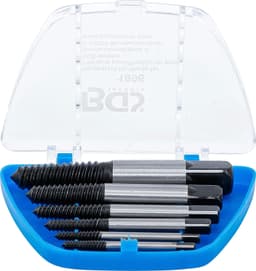
BGS BGS 1896 spiral set

Best value

BGS BGS 1896 spiral set
8.4/10about £5.60
Bryze Bryze 10-piece left-hand set

Alternative

Bryze Bryze 10-piece left-hand set
8.0/10about £13.99
On this page

Tools and eye protection before you start

Lay out a centre punch, a hammer, the drill, the size chart on your set, and eye protection. The Health and Safety Executive lists chips from power tools as an eye hazard, so wear glasses before the first chip. Clamp the workpiece. A door that swings walks the drill off centre. At work, PUWER 1998 covers the drill and the extractor, including parts that can be ejected. At home the chips are the same. Do not heat a suspension bolt in the driveway. The Engineer DBZ-20 is a side path: its listing says you do not have to drill the fastener out. Which family to buy is the screw extractor buying guide.

Double-ended bit sequence

Use this path when the head is still on the surface and the drive is stripped or rounded. Pick the size your chart prints, usually #0 to #4. Do not treat that number as a BGS millimetre band. Punch the middle of the head, fit the drill end, and run it clockwise only deep enough for a seat. UK reviews on Ryster, YURINWOO and SKmoon repeat two failures: the leaflet never says to reverse, and the drill end is too soft to cut. If it polishes, stop. Flip the bit, set the drill to reverse, and keep the speed low. If it binds hard, stop. Forcing a thin extractor until it twists off turns a stripped screw into a broken bolt.

Spiral stud sequence

Use this path when the head has snapped and you have a spiral such as the BGS 1896 or the S&R set. Punch the centre and drill a pilot on the axis of the shank, no wider than the band your chart allows. This comparison does not invent a pilot diameter. BGS prints 3–6 mm up to 19–25 mm. S&R prints M3 to M18. Choose the band that matches the hole, not the largest piece. Seat the spiral and turn it anti-clockwise, with a spanner or a drill in reverse, as the RS Components UK guide describes. Bryze’s left-hand drills turn anti-clockwise and sometimes spin the bolt out first. If they do not, stay in reverse on the extractor. Clockwise torque on a spiral can snap it.

When it spins or snaps

If the extractor spins, the seat is off-centre, too shallow, or you are still running clockwise. Confirm reverse before you blame the steel. Soft drill ends show up in UK reviews of SKmoon and both YURINWOO listings. If the extractor snaps, leave it. Do not chase the piece with a larger bit in the same oval hole. UK reviews on BGS, S&R and Bryze include snaps on studs. A leaflet that skips reverse is a risk the General Product Safety Regulations 2005 treat as not obvious. Follow the direction even when the paper does not.

Work, home, and the point you hand it over

If the drill belongs to your employer, PUWER applies, including ejected parts. At home a binding bit can throw a chip, and a snapped spiral stays in the hole. Hand the job over when you suspect a textured coating may contain asbestos (HSE sheet a27), when the fastener is a loaded engine, hub or suspension stud and the tool has snapped, or when the hole is already oval. A snapped extractor in a door hinge is a smaller problem than the same snap in a hub. Consumer Rights Act 2015, section 9, will not extract a stud that is now full of broken tool steel.

Common questions

Do you drill clockwise or anti-clockwise first?
On a double-ended bit, the drill end cuts clockwise to make a shallow seat. You then flip to the extractor and run the drill anti-clockwise at low speed. On a spiral, the pilot is a normal drill and the extractor turns anti-clockwise. A left-hand drill is the exception: it cuts while turning anti-clockwise. Clockwise on the extractor end is why the tip never bites.
What speed should the drill run at?
Low speed. The UK review theme on these kits is that the reverse tip bites slowly and polishes or snaps if you rush it. This page does not quote a revolutions figure, because the listings do not share one measured speed. If the bit smokes, squeals or walks, you are too fast or off centre. Stop, let it cool, and start again from the punch mark.
Do I need a centre punch?
Yes for any drill-in extractor in this method. Without a punch the bit walks into the side of a stripped recess or off the face of a flush stud. That is the start of an oval hole, and an oval hole will not hold the next size up. A proud head you are only gripping with pliers does not need a punch, because you are not drilling it.
What drill bit size for a spiral extractor?
Use the size chart on the set you bought. BGS 1896 prints millimetre bands from 3–6 mm up to 19–25 mm. S&R prints M3 to M18. Double-ended kits often print #0 to #4 plus a few metric drills such as 2.0 mm, 3.0 mm and 3.5 mm. This comparison does not convert those scales. If your measured shank is not on the card, do not invent a pilot a bit smaller than the stud.
Can I use an impact driver?
The method in the RS guide and in the UK reviews for these listings is a drill in reverse at low speed, or a spanner on a spiral. An impact driver’s hammering blows are a different load, and these listings do not describe that as the way to run the bit. If your only driver is an impact tool, use the lowest setting with great care or switch to a drill. Stop at the first bind rather than rattling a thin extractor until it shears.

Related pages

Sources

UK public sources and the maker page named in the digest for this comparison. Shelf prices, stars and review counts are the amazon.co.uk figures in the stored listings.

  1. GOV.UK, General Product Safety Regulations 2005: Great Britain (retrieved 22 October 2026)
  2. The General Product Safety Regulations 2005 (retrieved 22 October 2026)
  3. Consumer Rights Act 2015, section 9 (retrieved 22 October 2026)
  4. HSE, PUWER overview (retrieved 22 October 2026)
  5. HSE, eye protection (retrieved 22 October 2026)
  6. RS Components UK, screw extractors guide (retrieved 22 October 2026)
  7. ENGINEER PZ-58 specification (retrieved 22 October 2026)
  8. GOV.UK, spiral-flute stud removers tool sheet (retrieved 22 October 2026)