Independent comparisons. We may earn from shop links. More info

Dot and dab wall fixings: reach the block, spare the board

Updated: 22 October 2026

On a dot and dab wall the adhesive dabs leave a gap, and a plug that only bites the board is holding the wrong layer. This page stays with that gap. Stud toggles stay on the [cavity wall plug comparison](/hub/screws-and-accessories/cavity-wall-plug). Peter F. is the DIY & tools editor. Prices were checked on 20 October 2026. These packs were not load-tested. A qualifying purchase through our links can earn a commission at no extra cost to you.

On a dot and dab wall the adhesive dabs leave a gap, and a plug that only bites the board is holding the wrong layer. This page stays with that gap.

Our top picks

On this page

What the gap behind the board is doing

Dot and dab sticks plasterboard to block, brick or stone. The gap is not a stud void. On dab, a heavy flush load wants the masonry. Corefix’s own guide, which is not an independent test, says a standard plug fails because it grips only the board, and a frame fixing can bow the board. Dabs are not a grid you can aim at. Dust and then a void is a stud bay. Dust and then block is dab. A forum range of about 20–40 mm is a rule of thumb. The maker’s maximum is 45 mm from the board face to the block, a product limit, not a survey of your house. Face plugs are the other wrong family, on cavity wall plug vs plasterboard plug.

The two Corefix packs in this set

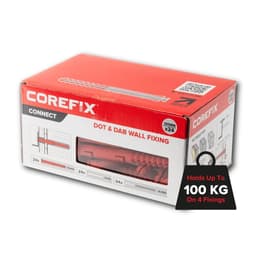
The Corefix six-pack, B082WF23TY, is about £9.49, 4.6 from 1,035 reviews: six cores, six 100 mm screws and a 10 mm bit. Drill to 100 mm, clear the dust, tap the plug, tap the core, then drive the screw. Reviews mention a wandering bit and a hole left short by debris. Screen sizes in those reviews are buyer reports, not a rated list. The 24-box, B072JYXJL6, is about £21.00, 4.7 from 1,437 reviews, with no bit listed. The size field says 5.0 x 100 mm and the thread field says M8. The listing says independently strength tested and names no laboratory. Which pack to open first is on best cavity wall plugs. There is no fischer DDF in this set, so there is no GBP for it here.

Which load line you are allowed to repeat

Quote one load sentence, and leave the others visible so they are not added. The maker page states 55 kg safe working load per fixing, factor of safety 2, and 40 kg per fixing in aerated concrete. Use 40 kg on thermal or aerated block. Brackets of about 1–10 mm are the fixture range on that page. The six-pack says up to 150 kg and also 55 kg per fixing. The 24-box says up to 100 kg on four fixings. Adding 55 to 150 does not produce a capacity. Multiplying 55 by six, or by twenty-four, does not either. A radiator on dense block and a radiator on thermal block are two quotations.

Arms, boilers and insulated board

Both listings say cantilever brackets are not recommended. A full-motion arm is that exclusion. A flush bracket close to the wall is the use reviews describe. Kingspan’s UK note on insulated plasterboard is the other limit. Do not mount the set to the insulated board. Fix through the insulation into the structure, and avoid a mortar joint. Foam is not a substrate. A bullet that names boilers does not make fitting a gas appliance DIY. A Gas Safe registered engineer does that work. Before any of these 100 mm holes, the cable scan on how to fit cavity wall plugs still applies. Clear the dust first.

Common questions

How do you tell dot and dab from a stud wall?
A stud wall gives you a void between timbers. Dot and dab gives you board, a gap, then block or brick. The bit meets masonry a short distance in, often within the 45 mm maximum this Corefix fixing is made for. That 45 mm is the product limit, not a survey of your house. If the bit never finds block, this bridge is the wrong hole.
Why does a strong plasterboard plug still fail?
It fails when it grips only the board, or when the screw pulls the board back across the gap and crushes it. The masonry never takes the load. Corefix’s maker guide describes that bow with ordinary frame fixings. The steel core keeps the board from collapsing while the screw reaches the masonry. Without that span, a strong board plug is still a board plug.
What is the steel core doing?
The steel core is the spacer across the adhesive gap. You tap the plug, tap the core, then drive the 100 mm screw into the block. The core limits how far the board can crush. If dust has shortened the hole, the core never reaches sound material. Clear the hole before you tap.
Which of the two Corefix packs includes the drill bit?
The six-pack at about £9.49 includes a 10 mm bit, six cores and six 100 mm screws. The 24-box at about £21.00 does not list a bit, and its bullets omit a hole diameter. Use the 24-box when you already own a 10 mm masonry bit, and check the screw: the size field says 5.0 x 100 mm and the thread field says M8. Both packs exclude cantilever brackets.
Which kilogram do you quote?
Quote 55 kg as the maker’s safe working load per fixing, factor of safety 2, and 40 kg per fixing in aerated concrete. Quote up to 150 kg only as the six-pack’s group line, and up to 100 kg only as the 24-box’s four-fixture line. Do not add those sentences or multiply 55 kg by the pack size. Independently strength tested names no laboratory.
Can you use a full-motion television arm?
Both Corefix listings say cantilever brackets are not recommended, and the maker page says the same. A flush set close to the board is the use buyers describe. A full-motion arm asks the fixing to resist rotation. If the board is insulated plasterboard, Kingspan’s note is to fix into the structure behind the insulation, not into the foam.

Related pages

Sources

Maker pages and UK public sources used for this comparison, checked on 20 October 2026. Shelf prices, stars and review counts are the amazon.co.uk listings checked that day.

  1. fischer DuoTec nylon toggle (retrieved 20 October 2026)
  2. fischer DuoTec recommended loads (retrieved 20 October 2026)
  3. fischer DuoHM cavity fixing (retrieved 20 October 2026)
  4. Corefix Connect 100 mm, 24 box (retrieved 20 October 2026)
  5. Corefix, why standard plugs fail on dot and dab (retrieved 20 October 2026)
  6. HSE, electricity safety (retrieved 20 October 2026)
  7. Gas Safety (Installation and Use) Regulations 1998, regulation 3 (retrieved 20 October 2026)
  8. BSI, BS EN 14566 mechanical fasteners for gypsum plasterboard (retrieved 20 October 2026)