Independent comparisons. We may earn from shop links. More info

Circular saw blade for a laminate worktop

Updated: October 2026

You are about to cut a kitchen worktop, a gloss door, or a melamine-faced sheet, and a chip along the post-formed edge means the board is scrap. A fine tooth count helps, and it does not save a cut when the decorative face is on the exit side or the offcut twists. This page is about a circular saw blade for a laminate worktop on a handheld 165 mm saw: face down, a fine blade UK reviewers actually used, and both sides supported. The full table is the [main comparison](/hub/saw-accessories/saw-blade-165x20). We used amazon.co.uk reviews and UK notes from Neasden Hardware and EGGER. We did not cut your worktop.

You are about to cut a kitchen worktop, a gloss door, or a melamine-faced sheet, and a chip along the post-formed edge means the board is scrap.

Our top picks

DeWalt DeWalt 24T framing blade

Best overall

DeWalt DeWalt 24T framing blade
6.7/10about £11.55
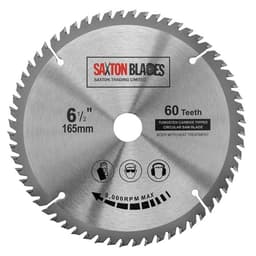
Saxton Saxton 60T wood blade

Best value

Saxton Saxton 60T wood blade
9.0/10about £11.99
On this page

Why the show face goes down

A handheld circular saw cuts on the upstroke. The teeth at the front of the shoe rise through the board, so they break out on the top surface and press the bottom surface down onto the shoe. Neasden Hardware’s worktop note says to put the decorative side down, to support both pieces, and to run masking tape on the line. EGGER’s installation sheet says the same thing for a manual circular saw: decor side underneath, front edge toward you, and stop the offcut from falling. If you leave the gloss upward, you are asking the tips to exit through the face you will see every day. Tape reduces the chip. It does not reverse the rotation. On a plunge saw, read that saw’s manual before you copy the face-down rule from a handheld shoe.

Tooth count that reviewers actually used

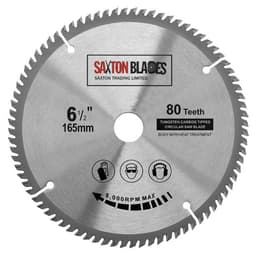
A 24-tooth framing blade is the wrong default here, even if you go slowly. Neasden’s floor is at least 40 teeth. The Saxton 80-tooth turns up on an IKEA Ekbacken worktop and on laminate flooring. The Saxton 60-tooth turns up on a gloss worktop. The Trend 60-tooth turns up on a laminate worktop and a gloss plinth. One Saxton 60-tooth buyer on a DeWalt DCS520 said the blade burned laminate and the riving guard stuck, because the kerf was thinner than that plunge saw expected. One Saxton 80-tooth worktop chipped when the offcut twisted, and the reviewer blamed the support. For this material, start at 60 or 80. Where 40, 48, and 80 sit beside that choice is the 24-tooth versus 60-tooth page.
DeWalt DeWalt 24T framing blade

Testsieger

DeWalt DeWalt 24T framing blade
6.7/10about £11.55

ATB in this set, TCG in the guides

Almost every blade in this comparison states an alternate-top-bevel grind, ATB. Specialist laminate advice often prefers a triple-chip grind, TCG. We did not find a TCG blade in this 165 x 20 mm set, and we are not going to invent one. An ATB blade at 60 or 80 teeth is what these UK reviewers used, and it can leave a tidy edge when the face is down and the board is supported. It is a worse match, compared with a true TCG, when the laminate is thick and brittle. If you are buying from this table, buy the fine ATB and treat the grind as a limit, not as a hidden TCG.

Support, tape, and the wrong diameter

Set the board on a sacrificial sheet or on battens so both the keeper and the offcut stay level until the cut is finished. A twist at the end is the failure the Saxton 80-tooth reviewer described. Neasden and EGGER both say to stop the offcut falling. Masking tape, a sharp blade, and a steady feed without dwelling are the rest of the technique. ITS, writing about Festool, says a saw built for 160 mm does not take a 165 mm blade just because the numbers are close. The Trend three-pack makes this worse as a shopping trap: the title says 165 mm and the components line says 160 mm. A full post-formed run you have to scribe to a wall is a fitter’s job if a mistake is expensive. One straight rip, decor down, is the DIY cut this page is for.

Common questions

Face up or face down?
Decorative face down on a handheld circular saw. The teeth cut upward at the front, so they chip the top. Neasden Hardware and EGGER both say the decor goes underneath. Do not let the offcut drop. Tape is extra insurance, not a reason to leave the gloss upward.
Is 24 teeth enough if I go slowly?
No. A slow feed on a 24-tooth blade still takes a large chip. Neasden’s floor is at least 40 teeth, with more described as better. The framing blades in our set are for solid timber. For a worktop, start at 60 or 80 teeth and keep the feed moving.
60 or 80 teeth for a worktop?
Both appear in UK reviews of this set. The Saxton 60-tooth is cited on gloss worktops. The Saxton 80-tooth is cited on Ekbacken and laminate. Eighty teeth take a smaller chip. They are not guaranteed cleaner if the offcut twists. Pick 60 if that is the blade you already have in the same kerf family.
Will ATB do, or do I need TCG?
This set states ATB, not TCG. Laminate specialists often prefer a triple-chip grind for a hard plastic face. An ATB blade at 60 or 80 teeth is what the stored UK reviews used. We are not listing a TCG model we did not see.
Why did a fine blade still chip?
Because the board moved, the face was on the exit side, or the tips were dull. One Saxton 80-tooth review chipped a worktop when the offcut twisted, and the reviewer blamed the support. A fine blade reduces the size of the chip. It does not clamp the work.
Can I put a 165 mm blade on a 160 mm plunge saw?
No. ITS states that a Festool saw built for 160 mm does not accept a 165 mm blade, because the guard and the riving knife are not clearanced for it. The Trend pack whose components line says 160 mm while the title says 165 mm is a listing conflict. Buy the diameter printed on your saw.

Related pages

Sources

Sources from the research digest. amazon.co.uk prices, stars, and review counts are the listing lines captured on 15 October 2026.

  1. amazon.co.uk listings for these 165 x 20 mm blades, 15 October 2026 (retrieved 15 October 2026)
  2. HSE WIS16, circular saw benches (retrieved 15 October 2026)
  3. HSE, circular rip saws (retrieved 15 October 2026)
  4. Provision and Use of Work Equipment Regulations 1998 (retrieved 15 October 2026)
  5. BS EN 847-1:2017, marking of circular saw blades (retrieved 15 October 2026)
  6. Compel, circular saw blade size chart (retrieved 15 October 2026)
  7. Saxton, TCT reduction rings (retrieved 15 October 2026)
  8. Selco, DART reducing ring 20 mm to 16 mm (retrieved 15 October 2026)