Independent comparisons. We may earn from shop links. More info

Jigsaw blades for clean cuts in plywood and laminate

Updated: 22 October 2026

An 18 mm birch ply shelf or a laminate-facing cabinet panel shows every chip on the face you will see. A coarse wood blade will get through the sheet. A clean cut needs a fine or reverse tooth, orbital action turned down, and the sheet supported so the underside does not break out. Prices and review counts come from the amazon.co.uk listings in our [jigsaw blades for wood comparison](/hub/saw-accessories/jigsaw-blades-wood). We did not run a lab cut. We may earn a commission.

An 18 mm birch ply shelf or a laminate-facing cabinet panel shows every chip on the face you will see. A coarse wood blade will get through the sheet.

Our top picks

On this page

Why a coarse blade chips a ply face

T144D and T111C lean the teeth so the kerf clears thick softwood. That width chips a thin veneer: the tooth lifts fibres as it exits. An 18 mm ply sheet sits inside the T144D band of about 5–50 mm, so the blade will cut and the edge will still be coarse. Tape on a T144D reduces some lifting. It does not make a cabinet blade. Saxton’s 15-piece at £5.99, 4.6 from 599 reviews, draws splinter comments on finer work, which matches the tooth. Use the coarse blade only if the edge will be hidden or trimmed later. The opposite job is thick timber blades.

T101B for a straight edge, T101BR when the top face matters

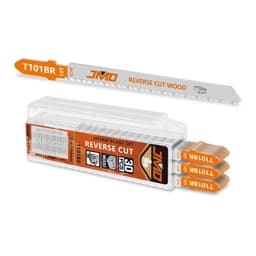
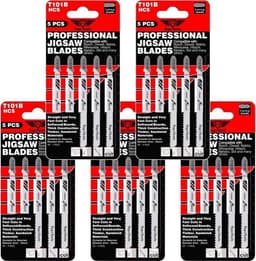
T101B is the tapered clean-cut code, about 2.7 mm spacing, for ply, chipboard and fibreboard around 3–30 mm. TopsTools’ 25-piece pack is £8.99, about 36p a blade, 4.6 from 2,930 reviews. It is the best value stock when the face is plain board and the job repeats. T101BR reverses the tooth so the top stays tidier. JMD’s 30-piece tube, £16.99, quotes about 5–32 mm and 4.8 from 22 reviews, which is not the same evidence as 2,930 reviews. Reverse tooth does not stop underside breakout.

Orbital off, and a moderate speed

Orbital action bites harder on the upstroke. That clears thick softwood and lifts ply and laminate. For a show edge, set it off, or to the lowest stage the manual allows. Electrical Safety First is the UK reminder to match the blade and secure the work: electric jigsaws. Start on scrap at a middle speed. A high stroke rate can melt laminate and blunt a fine tooth. Slow down if the edge browns. Forcing a T101B through a 40 mm stud is a thickness problem, not a reason to turn orbital back up on a veneered door.

Tape, a backing board, and the starter hole

Tape the line on the face you care about. It holds fibres for the first millimetre and is not enough on a T144D. Clamp a sacrificial sheet under the cut so the teeth exit into wood, and support a worktop offcut so the last centimetres do not snap. For a sink opening, drill a starter hole the blade can enter, often about 10–12 mm as a rule of thumb. Fit the blade with the saw unplugged and start from the hole. Keep the shoe flat. Call a fitter if the opening must match a template or if services may sit under the board.

Packs in this comparison that carry a clean-cut code

TopsTools’ 25× T101B at £8.99 is the deep clean-straight stock, 4.6 from 2,930 reviews. JMD’s 30× T101BR at £16.99 is the deep reverse-tooth stock, with a thin review file. BGTEC’s £19.79 case includes ten each of T101B and T101BR, plus coarse and thin-metal blades, 4.6 from 442 reviews. EXFEIN’s £19.99 wood-only set also names both clean codes, 4.5 from 120 reviews. SabreCut’s £6.99 mix names T101B and T101BF and does not state the shank, so check the photos. Buy 25 of T101B if that is the cut you repeat. Buy a mixed case only if you will use the other codes. The tooth, the orbital setting and the backing board are one job.

Common questions

Should I use T101B or T101BR for a laminate worktop cut-out?
Use T101BR when the top face is the one that must stay clean, which is the usual worktop case. T101B is the better general straight blade for plain ply and chipboard where both faces are similar. JMD’s T101BR listing quotes about 5–32 mm. Support the underside either way, and keep orbital action off. A coarse T144D is the wrong tooth for that face.
Does a reverse tooth stop all splintering?
It reduces tear-out on the top face. The underside can still break out as the teeth exit. A backing board, tape, and a shoe that stays flat close that gap. Orbital action left on a high stage will chip the face even with T101BR. Nothing in this comparison is a guaranteed splinter-free cut.
Is masking tape enough if I keep a coarse blade?
Tape helps a little and does not replace the tooth. Saxton T144D reviews already flag splintering on finer work at the same £5.99 as a specialist coarse pack. If the edge is visible, fit T101B or T101BR. Keep the T144D for OSB, studs and edges that will be covered.
How big should the starter hole be for a sink cut-out?
Drill a hole the blade body can enter without force. A rule of thumb is about 10–12 mm, then fit the blade with the saw unplugged and start from that hole. Do not plunge a wood blade through the laminate if you can drill. Call a fitter if the opening has to match a supplied template or if services may run under the board.
Which compared pack includes T101BR?
JMD’s 30-piece tube is only T101BR, at £16.99 with 22 reviews. BGTEC’s 50-piece set includes ten T101BR blades, and EXFEIN’s wood-only 50-piece title also names T101BR. TopsTools’ 25-piece pack is T101B, not the reverse tooth. Check the tang is T-shank before you order.

Related pages

Sources

Public UK sources and the amazon.co.uk listings compared on this page. Listings captured 20.10.2026.

  1. Bosch Professional GB T111C jigsaw blade (retrieved 20.10.2026)
  2. Abracs wood jigsaw blade chart (retrieved 20.10.2026)
  3. Axminster jigsaw blades guide (retrieved 20.10.2026)
  4. Electrical Safety First: electric jigsaws (retrieved 20.10.2026)
  5. HSE woodworking WIS index (retrieved 20.10.2026)
  6. HSE COSHH woodworking (retrieved 20.10.2026)
  7. Bosch Professional GB 10-piece wood jigsaw blade set (retrieved 20.10.2026)