Saw blade bore size UK: match the hole and the diameter

Saw blade bore size UK: 22.23 mm, 20 mm and 30 mm are not interchangeable. Match the hole and diameter to your grinder, compact saw or mitre saw.
On this page
You have a blade in your basket that looks right: right price, decent reviews, the word "wood" in the title. Then you read the small print and it says 125 mm, 22.23 mm bore, with a 20 mm ring and a 16 mm ring "for other tools". Which one is yours?
This guide sorts out the saw blade bore size UK tools actually use, in the order that matters: diameter from the guard, bore from the arbor or flange, then the speed rating. A reducing ring is a narrow fix, not a universal adaptor.
In short
UK saw tools mostly use three centre holes: 22.23 mm for 115 mm and 125 mm angle grinders, 20 mm for many 165 mm compact and cordless circular saws, and 30 mm for most mitre and table saws. A reducing ring only steps a larger bore down to a smaller arbor when it fits both snugly and the saw maker allows it. Start with the tool label, not the listing title.
The three bores UK saws actually use
On amazon.co.uk, saw accessories mostly fall into three bore sizes, each lined up with a family of tools. The bore is the centre hole. It has to sit on the saw arbor, or on the grinder flange collar, with no rattle. A blade that wobbles there will run off true.
- Angle grinder: 115 mm or 125 mm blade, 22.23 mm bore. See the 125 mm wood cutting disc comparison.
- Compact or cordless circular saw: often 165 mm, 20 mm bore. See 165 × 20 mm saw blades.
- Mitre saw or table saw: 216 mm to 254 mm, usually 30 mm bore. See 250 × 30 mm circular saw blades.
Treat that list as a rule of thumb. The Compel circular saw blade size chart shows the same pattern, plus 16 mm and 25.4 mm. Some 190 mm saws take 30 mm, and some older saws take 16 mm. The plate on the tool settles it. 22.23 mm is 7/8 inch, also written 22.2 mm or 22 mm.
Diameter, bore and speed: read them together
A listing gives you three numbers, and they answer three different questions. Diameter: does the blade fit under the guard? Bore: does it centre on the tool? Maximum rpm: is it safe at the speed your tool spins? You need all three. Two out of three is still the wrong blade.
Diameter comes first. A 115 mm disc and a 125 mm disc both have a 22.23 mm bore, so the larger disc will slide onto a 115 mm grinder. It should not: the smaller guard does not cover the rim, and at the same rpm the larger disc is faster at the edge. Charts that use 80 m/s put 115 mm near 13,300 rpm and 125 mm near 12,200 rpm.
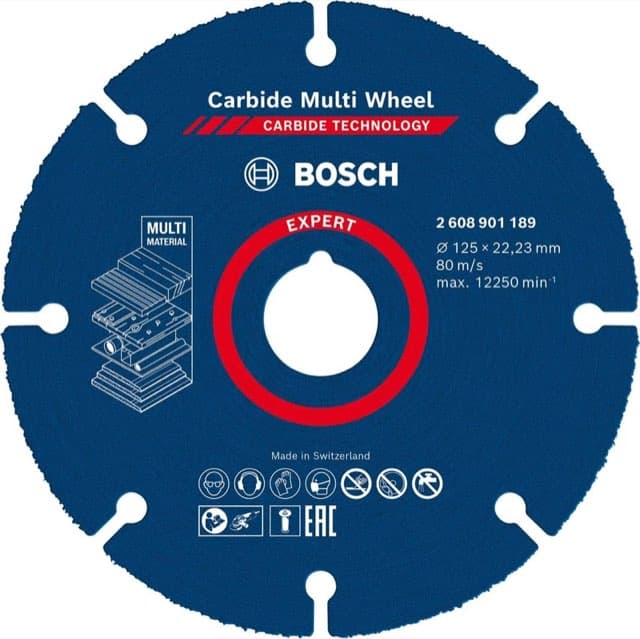
The disc must be rated at or above the no-load speed on your tool. The Bosch Expert Carbide Multi Wheel 125 mm, our top pick, states a 22.23 mm bore and 1 mm thickness on amazon.co.uk and no maximum rpm. If rpm is missing, read the disc or the pack before you fit it.
125 mm angle grinders and the rings in the box
A 125 mm angle grinder takes a 22.23 mm bore. The spindle is usually M14, but the disc sits on the inner flange collar, not on the thread, and the outer nut clamps it.
Some 125 mm wood discs in that set still ship with extra rings. On amazon.co.uk, HAWCUT includes 20 mm rings, Chersun includes a 16 mm ring, and Fresilkora includes rings without saying which bore they reduce to. Bosch and Oiieco include none. A grinder does not need them. Extra rings mean the seller is aiming at more than one tool.
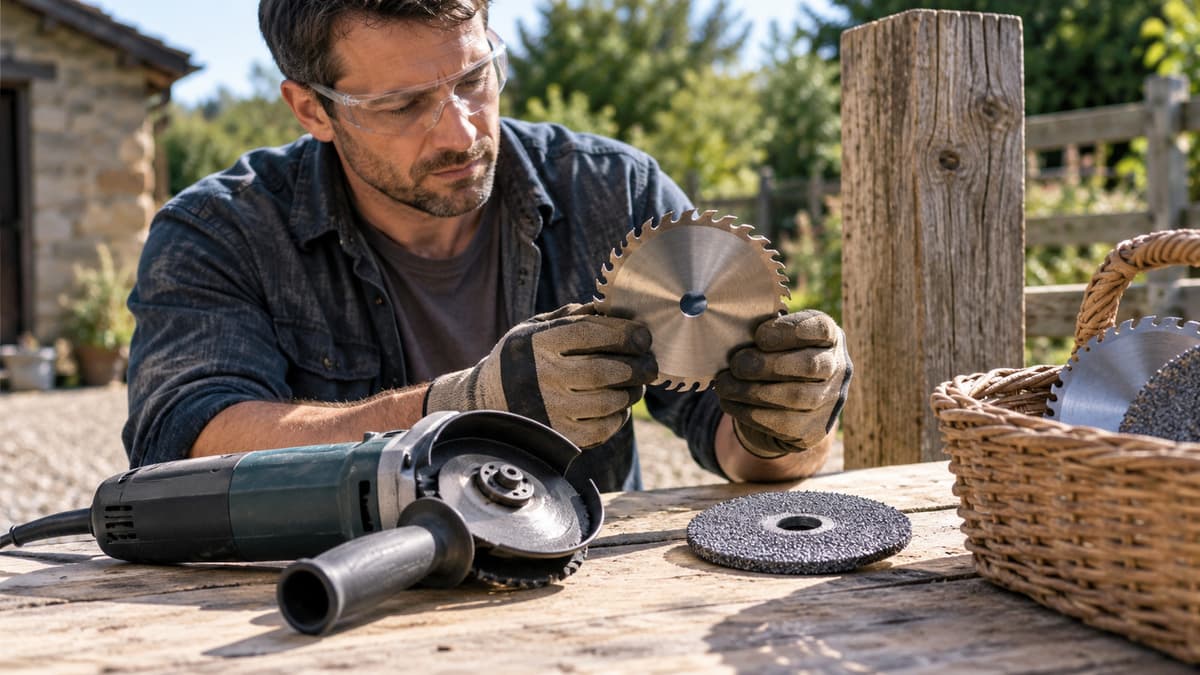
Many of those multi-tool discs are toothed. The Office for Product Safety and Standards has warned that toothed wood blades on angle grinders can kick back hard; we cover that in toothed blades on an angle grinder. A toothless carbide grit wheel such as the Bosch is a different design, and it still needs the grinder maker's approval and the guard fitted.
One more snag: the Chersun bullets say 22.2 mm, and one UK review says the hole measured 23 mm. On a grinder collar, that gap is the difference between a disc that centres and one that can shift as you tighten the nut.
165 mm and 250 mm blades in this hub
On circular saws a wrong bore costs more, because the blades are dearer and the arbors vary. Many 165 mm cordless and compact saws in the UK take 20 mm. A 30 mm bore will not centre on that arbor without a ring, and a 20 mm blade will not go onto a 30 mm arbor.
Mitre saws and table saws are mostly 30 mm. The 250 × 30 mm comparison covers the common UK mitre-saw size, and 254 mm blades are often sold for the same machines. Some 254 mm blades include 25.4 mm or 16 mm rings for older saws or other markets. On a 30 mm arbor, fit the blade straight on.
On a table saw the diameter also has to suit the riving knife. HSE's WIS16 information sheet on circular saw benches sets the knife for a range of blade sizes. A much smaller blade leaves a gap above the knife, and a thicker plate can bind on it.
When a reducing ring is not the answer
A reducing ring, sometimes called a bush, fills the gap between a larger blade bore and a smaller arbor. A 30 mm blade with a 20 mm ring can go onto a 20 mm arbor only if the saw maker allows rings and the ring is a precise fit. It cannot work the other way, and it cannot fix diameter or speed. A ring is the wrong fix in four cases.
- Play. A ring that rattles in the bore or slides on the arbor leaves the blade off centre. The nut will not true it.
- Unknown size. If the listing does not say which bore the rings reduce to, as with Fresilkora, measure them.
- A forbidden ring. If the manual says use the stated bore only, that guidance wins.
- A bore that is already too small. A ring cannot open a hole.
Do not drill or file a blade bore. Opening the hole by hand puts it off centre, removes the machined fit, and can weaken the plate. Buy the right blade. It is cheaper than a repair, and far cheaper than an injury.
Read the tool label, not the listing title
Listing titles on amazon.co.uk are written to catch searches, so they stack every size the seller can think of. The tool in your hand is the only reliable source. This check takes two or three minutes and saves a return.
- Read the plate or the manual. Note the maximum blade diameter, the arbor or bore, and the no-load speed in rpm.
- On a grinder, remove the outer nut and check the inner flange collar. A 115 mm or 125 mm grinder should take 22.23 mm discs; if the manual gives another figure, use the manual.
- On a circular saw, mitre saw or table saw, check for a 16 mm, 20 mm, 25.4 mm or 30 mm arbor, including any tolerance the manual states.
- Take diameter, bore and maximum rpm from the specification table, not the title. If rpm is missing, check the disc or the pack before you fit it.
- Fit the blade with the guard on, pull the plug or take the battery out, turn the blade by hand, and look for wobble at the rim.
If anything does not match, the blade goes back. Under the Consumer Rights Act 2015, a product has to match its description, so a stated bore that turns out to be 23 mm when the listing said 22.2 mm is a fair reason to return it.
How we put this together
Peter F., editor for DIY & tools at productscompared.co.uk, updated this guide in October 2026 from amazon.co.uk listings in the 125 mm, 165 × 20 mm and 250 × 30 mm comparisons, UK reviews, the Compel chart and HSE WIS16. We did not run a lab test. Links may earn a commission at no extra cost to you.
Common questions
Is 22.23 mm the same as 7/8 inch?
What bore does a 125 mm angle grinder need?
Is a 165 mm circular saw blade 20 mm or 30 mm bore?
Why do mitre saw blades say 30 mm?
Can a reducing ring fix any bore mismatch?
Does the diameter follow from the bore?
Can I fit a 125 mm disc to a 115 mm grinder?

Peter F. is the editor for DIY & tools at productscompared.co.uk. Comparisons in this category are checked against amazon.co.uk listings, review evidence and public UK sources.
Related articles
Toothed blades on an angle grinder
Why the Office for Product Safety and Standards warns about toothed wood blades on grinders, and what to fit instead.

What a 125 mm wood cutting disc costs
Pack price against price per disc, and why the cheapest 125 mm blade can be the wrong tool for your grinder.

115 mm or 125 mm angle grinder disc
Both sizes share a 22.23 mm bore. The guard, the rim speed and the cutting depth are where they part ways.