Independent comparisons. We may earn from shop links. More info

Stainless steel railing tube polishing

Updated: 21 October 2026

Visible stainless handrail punishes shortcuts. A weld can be structurally fine and still look wrong because the grain runs sideways or heat tint sits beside a satin face. A stainless handrail tube polisher on amazon.co.uk might be a 760 mm belt machine, a grinder attachment, or a narrow finger sander for posts. This page is the finishing sequence for installed or shop-built balustrade. Live prices for the seven kept tools sit in our [pipe belt sander comparison](/hub/sanders/pipe-belt-sander). We did not run a lab test, and we do not guarantee a mirror finish from a consumer tool. A qualifying purchase through our links can earn a commission at no extra cost to you.

Visible stainless handrail punishes shortcuts. A weld can be structurally fine and still look wrong because the grain runs sideways or heat tint sits beside a satin face.

Our top picks

On this page

What good looks like on handrail

On site, good usually means a consistent satin grain along the tube, weld toes blended flush without a hollow, and no cross-scratches when daylight crosses the face. Mirror polish is a different job: more grit steps, compounds, and often a professional. A multi-speed listing on its own does not deliver that. Compare a sample with an untouched factory face on the same profile. If direction and sheen do not match, change grit or tool before the longest visible run. Heat tint is cosmetic until you remove more metal than the rail allows. Blend it in the same direction as the rest of the rail, working outward rather than burning one patch darker.

Tool choice for rail diameter and access

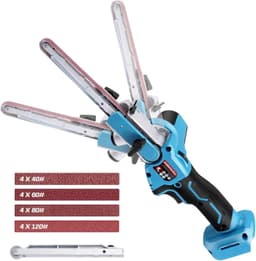
On long straights of typical 42 mm round rail, a 40×760 mm belt on a dedicated polisher or a grinder attachment wraps the tube. The best-value attachment claims tube up to about 180 mm in the listing. Check that against your profile and the stand-off from the wall. Which listing fits which job is on best pipe belt sanders. Tight bends, post bases, and welds beside brackets favour a finger belt. Pair the top-pick finger tool with a long belt if you are finishing a landing, not one weld. If the rail is fixed, you may only reach the room side without nicking plaster, and leave the wall face as factory satin. When a £49.99 head is enough, and when dedicated handles pay back, is on pipe sander vs angle grinder attachment.

Grit sequence after TIG or MIG welds

Rule of thumb only: dress the weld with a coarse zirconia belt until the toe matches the parent metal, then step through medium grits, finishing around 80–120 for a satin many UK handrails use. A heavy MIG cap needs more coarse time. A neat TIG weld may skip the coarsest step after a scrap test. Prove the sequence on an offcut of the same wall thickness. Thin tube overheats, and a heavy grind can ovalise it. Change a glazed belt. Heat colour and stubborn scratches are the sign. Pass order is on how to use a pipe belt sander.

Installed rail versus shop fabrication

In the shop you can rotate and clamp the rail. On a staircase, mask walls and floors and plan a cleanup that does not sweep fine dust through the house. A garage still produces respirable metal particles. HSE’s grinding guidance applies to DIY, and a paid fabricator may owe extraction under COSHH. Work short sections between posts so the belt does not catch a bracket. File a protruding screw or weld flush before the belt crosses it. Keep the grain parallel to the rail on every face the room can see.

When to stop DIY

Stop when access needs ladders or an over-reach on open stairs, when building control or a client spec needs documented fabrication, or when the welds are load-bearing and you can only dress them. Stop when a test piece will not match the grain. A mismatch on the top flight is cheaper than ruining the longest rail. Call a fabricator for structural sign-off, a marine-grade spec, or a rail that may not be stainless. The wrong abrasive makes a later repair expensive.

Common questions

Can I polish rail in situ on the wall?
Often only in part. You can usually finish the room-facing side and the accessible edges. The wall side may be unreachable with a 760 mm loop. Plan masking and dust control before you start, and accept factory satin where the belt cannot seat.
How do I hide weld heat tint?
Blend it with progressive grits along the grain. Avoid a heavy spot grind that digs a dish beside the weld. Severe tint on thin tube may need a fabricator so you do not thin the wall past what the rail was designed for.
Should I use an attachment or a dedicated polisher on 42 mm rail?
Both can work if belt tracking is stable. An attachment saves money when your grinder is suitable. A dedicated body helps on long runs and on repeated commercial jobs, because the handles and the speed range are built for tube rather than inherited from the grinder.
Will a finger sander scratch visible faces?
It can, if the grit is too coarse or the belt tracks at an angle to the rail. Use finer grits for the final passes and keep the direction aligned with the rail grain. A finger tool is for posts, brackets, and tight bends, not a substitute for a long straight pass.
Do I need extraction on a domestic garage job?
Ventilation and a mask are the minimum for many DIY sessions. Fine stainless dust is still a lung irritant in a garage. Stricter workplace rules can apply if you are paid to fit the rail, including extraction under COSHH.
When must a fabricator sign off structural welds?
Whenever load-bearing capacity or the regulations require qualified welding and inspection. Cosmetic polishing does not replace that certification. Stop DIY dressing if you are unsure whether the weld is structural.

Related pages

Sources

Sources taken from the research digest. Prices, stars and review counts are the amazon.co.uk listing figures as of 20 October 2026.

  1. HSE — scabbling or grinding (retrieved 20.10.2026)
  2. Electrical Safety First — sanders (retrieved 20.10.2026)
  3. EN 62841-2-4:2014 — hand-held belt sanders (retrieved 20.10.2026)
  4. FEIN UK — pipe sander (retrieved 20.10.2026)
  5. EC Hopkins — finishing stainless steel tube (retrieved 20.10.2026)
  6. Machine Mart — Holzmann RSG760 (retrieved 20.10.2026)
  7. Bosch Professional — PRO Y580 sanding belt 40 × 760 mm (retrieved 20.10.2026)
  8. VEVOR UK — 800W tube belt sander (retrieved 20.10.2026)