Independent comparisons. We may earn from shop links. More info

How to use a Bosch orbital sander

Updated: 21 October 2026

You have a door on trestles, or a dresser pulled into the middle of the room, and the risk is a field of circles and a rounded arris you then have to paint over. How to use a Bosch orbital sander comes down to the sheet, the pressure and the grit steps, whichever PEX, Orbit or GEX body is in your hand. The GSS changes the pad shape, not those habits. This is technique, written by Peter F. from UK sanding guides and the Bosch notes stored with these listings. It is not a lab test. A qualifying purchase can earn a commission at no extra cost to you. Model choice stays on the [Bosch orbital sander](/hub/sanders/bosch-orbital-sander) comparison.

You have a door on trestles, or a dresser pulled into the middle of the room, and the risk is a field of circles and a rounded arris you then have to paint over.

Our top picks

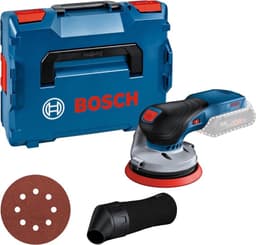
Bosch Bosch GEX 18V-125 (L-BOXX)

Best overall

Bosch Bosch GEX 18V-125 (L-BOXX)
9.6/10about £145
Bosch Bosch PEX 220 A

Best value

Bosch Bosch PEX 220 A
9.0/10about £48.49
Bosch Bosch PEX 400 AE

Rank 3

Bosch Bosch PEX 400 AE
8.8/10about £105
On this page

Fit the sheet and fix the work

Clamp the work, or weigh the far end, and route the cable behind you before you switch on. A door that rocks will catch the pad on the edge. Fit a hook-and-loop sheet with the holes lined up. The EasyOrbit and the UniversalOrbit include paper assistant 2 609 004 646. On a GEX the scope is one C430 sheet at grit 120. On the GSS, punch the sheet before you stick it. If a disc will not hold, stop. The hose and the mask are on Bosch sander dust extraction.

How to make the pass

Put the pad flat on the wood, then start. Lift only after you have moved off the surface, or after you have stopped. A running pad that tips onto an arris rounds the edge. Use light pressure. The orbit does the cutting. Overlap each pass by about a third of the pad, and keep moving. If you have spent a long time at low speed on a GEX 18V-125, the manual asks for about three minutes at maximum speed with no load, so the motor can cool. Stop when the sheet is clogged.

Grit, as a rule of thumb

Grit bands are a rule of thumb from UK guides, including Homebuilding and Norton, not a Bosch specification. Old paint often starts around 80, sometimes 60 if the film is thick. Bare, flat wood often starts nearer 120. Jumping from 80 straight to 220 leaves the coarse trenches. Close the steps, often 80, then 120, then 180, and only when the previous scratch has gone. Before a clear finish, about 180 to 220 is a common stopping point. Model choice is on the best Bosch orbital sander page.

When to stop

Stop power sanding when the veneer is thin. A factory veneer can be sanded through at the corner in one coarse pass. The last millimetre of a door edge is safer by hand than with a 125 mm pad. A palm sander is the wrong machine for a floor. Hire a floor sander rather than spending a weekend on your knees with a PEX. If the circles are still obvious, you have skipped a grit or lifted the pad while it was running.

Common questions

Do I start the sander on the wood or above it?
On the wood. Seat the pad flat, switch on, and move. Switching on in the air and dropping the disc onto the door is a reliable way to cut a crescent. Switch off only once you have moved off the surface or the pad has stopped.
How hard should I press?
Lightly. The weight of a PEX 220 A, listed at 1.29 kg, or a GEX body around 1.09 kg without a battery, is enough for ordinary prep. Extra pressure loads the sheet, heats the timber and, on the GEX 34-150 reviews, can stall the pad. If the tool will not cut, change to a fresher or coarser sheet.
Which grit for a painted door?
As a rule of thumb, about 80 to remove a failed film, and about 120 to 180 to key paint that is still sound. Do not jump from 80 to 220. Those bands come from UK sanding guides, not from a Bosch grit chart, and a thick lacquer may need longer at the coarse step before you move on.
Which grit for bare wood before varnish?
Bare, flat timber often starts nearer 120 and finishes around 180 to 220 before a clear coat. Then a light hand pass with the grain. Between varnish coats, a finer grit and less pressure knocks down nibs. One K80 sheet in a cordless carton is not that finishing sequence.
Why do circles stay in the surface?
The pad was tipped, paused, or lifted while it was still spinning, or a grit step was skipped so the coarse scratch is still underneath. Keep the pad flat, keep moving, and sand until the previous scratch has gone before you fit a finer disc. Clean dust from under the sheet, because a trapped grain cuts its own circle.
How do I line the holes up on a Bosch pad?
Use the paper assistant where the listing includes one. That is the EasyOrbit and the UniversalOrbit in this set. On the GSS, use the hole punch so the sheet matches the plate. On a GEX or a PEX, turn the disc until you can see the pad holes through the sheet. Blocked holes leave the dust in the room even when the box is fitted.
Can I sand old paint that might contain lead?
Do not dry-sand it. Suspected lead paint is a stop, not a grit choice. Get advice before you create dust you then have to clean. A microfilter box does not make that job safe.
When should I stop and hand-sand?
At a thin veneer, on the last millimetre of an arris, and for the final with-grain pass before a clear finish. Stop using the machine entirely on a floor, on suspected lead paint, and when someone is sanding as work for most of the day. Those jobs belong with a different machine or a professional.

Related pages

Sources

Sources taken from the research digest. Prices, stars and review counts are the stored amazon.co.uk listing figures.

  1. Bosch DIY — PEX 220 A (retrieved 19.10.2026)
  2. Bosch DIY — PEX 400 AE (retrieved 19.10.2026)
  3. Bosch DIY — EasyOrbit 18V-10 (retrieved 19.10.2026)
  4. Bosch DIY — UniversalOrbit 18V-20 (retrieved 19.10.2026)
  5. Bosch Professional — GEX 18V-125 (retrieved 19.10.2026)
  6. Bosch Professional — GSS 18V-13 (retrieved 19.10.2026)
  7. HSE — cutting and sanding wood (retrieved 19.10.2026)
  8. POWER FOR ALL — battery FAQ (retrieved 19.10.2026)