Independent comparisons. We may earn from shop links. More info

How to use a belt and disc sander on a UK bench

Updated: 21 October 2026

You have unboxed a bench belt and disc sander, and the first instinct is to dress an edge. How to use a belt and disc sander starts earlier than that. The belt has to track, the disc table has to be square, the guards have to be on, and the hose has to be sealed before you make dust. This page is setup and the first passes, not a ranking. Specs stay on the [belt and disc sanders comparison](/hub/sanders/belt-and-disc-sanders). Levers differ, so follow this order and check your manual. Products Compared used public UK guidance and listing notes on 19 October 2026, not a lab session. A qualifying purchase can earn a commission at no extra cost to you.

You have unboxed a bench belt and disc sander, and the first instinct is to dress an edge. How to use a belt and disc sander starts earlier than that.

Our top picks

On this page

Before the first switch-on

UK mains tools in this class should arrive with a BS 1363 plug. If you find a moulded European two-pin plug, which one reviewer reported on an Einhell TC-US 350, stop. Wear eye protection and hearing protection for every run. For wood dust, use a mask or respirator meant for fine dust, and run extraction as well. The mask does not replace a hose. If the timber might have been painted before 1992, do not sand it here. Unplug whenever you change a belt, dress a disc, or move a guard. If the disc hub arrived broken, as in some Einhell TC-US 380 reviews, return the machine. The hose test is in the belt sander dust extraction guide.

Bolt it down and square the table

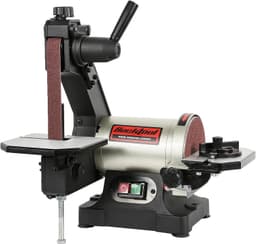
A light combo will walk. The Sealey SM750 weighs 7 kg and the Bucktool MM493C about 9 kg. Bolt the base through the holes the manual shows, into a bench that does not rock. Rubber feet reduce buzz. They do not replace bolts if you lean on the belt. Square the table to the disc with a small square before that first pass. Most tables here tilt from 0 to about 45 degrees, and the Sealey’s single bolt works loose, so check it again after a few minutes.

Track the belt and set the tension

Unplug first. Fit the belt with any arrow pointing the way the machine runs. A joint put on backwards will slap. Tension until the belt is firm and you can still turn the drum by hand. Over-tension is how bearings get noisy. Stop when the belt does not slip under a light pinch. Plug in only for the tracking test. Stand to the side, switch on for a second or two, and if the belt walks off, stop, unplug, and move the tracking knob a fraction. Do not sand a job while you are still chasing the belt. The size check is in the buying guide.

Using the disc and the belt

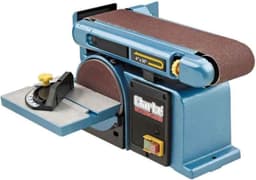
Start the extractor, then the sander, and let it reach speed before the timber touches. On the disc, use the half that moves down onto the table, so the rotation presses the piece into the support. If the face burns or the disc hops, stop. On the belt, use the flat platen for flat edges. The open stretch of belt will round the work. A 25 mm belt, as on the Sealey, is for narrow edges. A 100 mm belt, as on the Clarke, covers a typical board edge in one pass. The Clarke, the Draper 98420 and the Einhell TC-US 380 state a vertical lock. The Sealey row does not. Stop if you smell burning, see sparks, or hear a new knock.

When the belt wanders or the disc wobbles

Wandering after a good setup usually means dust on the drums, a glazed belt, or a tracking knob that has drifted. Unplug, brush the drums, and track again with short jogs. If the belt edge is frayed, replace it. Disc wobble means the abrasive is proud, the hub is loose, or the disc is out of round. If a guard, a switch or the hub is damaged, stop. A switch that dies after light use, which one Clarke reviewer reported, is a return. Also stop for a floor, a session with no extraction, or paint that might contain lead.

Common questions

How do I stop the belt tracking off?
Unplug, clean the drums, and set the tension so the belt is firm without being bar-tight. Jog the motor for a second, standing to the side. Turn the tracking knob a little, then jog again, until the belt stays centred. If it only stays on when you over-tighten it, change the belt before you sand a job.
How tight should the belt be?
Tight enough that it does not slip under a light pinch, and loose enough that you are not loading the bearings. The manual’s diagram beats a universal measurement. Over-tension shows up as noise and heat. Under-tension shows up as a belt that walks or slaps at the joint. After the first ten minutes of real work, unplug and look again. New belts settle.
How do I square the disc table?
Unplug. Hold a small square between the table and the disc, slacken the tilt lock, and nip it when the blade sits clean. Tilt away and back, then square again, because some locks shift as you tighten. Clarke reviewers find this fiddly. On the Sealey, the single table bolt loosens with vibration, so check it after a short run. Then match the mitre gauge to the same square.
Can I use the belt vertically?
Only if the model states a lock from horizontal to vertical. The Clarke CS4-6E, the Draper 98420 and the Einhell TC-US 380 state that movement. The Sealey row does not. Move the arm with the plug out, lock it at the stop the manual shows, and only then plug in. Do not sand on a half-raised arm. Vertical use is for edges the platen can support, not for freehand pressure on the open belt.
Should I bolt the sander down?
Yes, if the base has holes and the bench is solid. Machines around 7–9 kg walk more readily than an 18 kg Clarke, even when reviewers call them quiet. Rubber feet help. They are not a substitute once you press on the belt.

Related pages

Sources

Sources taken from the research digest. Prices, stars and review counts are the stored amazon.co.uk listing figures.

  1. HSE WD12 — fixed narrow belt sanders (retrieved 21.10.2026)
  2. HSE WD13 — fixed disc sanders (retrieved 21.10.2026)
  3. Electrical Safety First — sanders (retrieved 21.10.2026)
  4. Axminster Perform PD150BDS specification (retrieved 21.10.2026)
  5. Charnwood BD46 product page (retrieved 21.10.2026)
  6. UK Workshop — bench belt sanders (retrieved 21.10.2026)
  7. amazon.co.uk listings for this comparison (retrieved 21.10.2026)