Independent comparisons. We may earn from shop links. More info

Diamond blade for paving slabs, block, and Indian stone

Updated: 21 October 2026

You are cutting a patio, block paving, or Indian stone with a 9 inch grinder, and you want a diamond blade for paving slabs that will not blow the corner or fill the garden with dust. The disc is 230 mm, the hole is 22.23 mm, and the rim in this set is almost always segmented. The table is on the [230mm diamond cutting disc comparison](/hub/sanders/230mm-diamond-cutting-disc). The Products Compared editorial team read the saved listings on 19 October 2026. We did not cut a slab. A qualifying purchase can earn a commission at no extra cost to you.

You are cutting a patio, block paving, or Indian stone with a 9 inch grinder, and you want a diamond blade for paving slabs that will not blow the corner or fill the garden with dust.

Our top picks

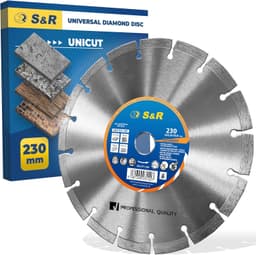
S&R S&R 252.471.230

Best overall

S&R S&R 252.471.230
9.2/10about £15.49
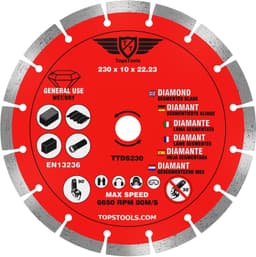
TopsTools TopsTools TTDS230

Best value

TopsTools TopsTools TTDS230
9.2/10about £8.99
On this page

What the disc is being asked to cut

The usual job is a concrete or stone slab, a concrete block paver, or Indian sandstone, sometimes with a kerb. Segmented rims are the general masonry choice. Norton’s UK note puts a continuous rim on a cleaner tile edge, and none of these twelve discs is a thin porcelain blade. Blue Spot names kerb stones, slabs, and bricks. PRODIAMANT names paving stones. S&R names brick, concrete, masonry, and stone. A reinforced-concrete bullet means you may meet a bar in concrete. It does not make this the tool for a structural slab or porcelain. Tech Traders has praise for Indian sandstone and a review of teeth leaving the rim within seconds on a block-paving block. If that is the first cut, look at S&R or Blue Spot, which have larger samples of paviors.

Setting the slab up so the corner survives

Mark the line on the face you will see, and support the slab so both sides of the cut stay put. A full bed of sand, with the cut clear of the ground, lets the waste sit instead of dropping onto the rim. A slab on a single timber will pinch the disc as the cut breaks through. Start with a short relief cut at the corner before the long line. HSE’s CN6 sheet covers where you stand when cutting blocks, paving, and kerbs. A kerb you cannot support is the moment to stop. The fitting sequence is on how to use a 230mm diamond blade.
S&R S&R 252.471.230

Testsieger

S&R S&R 252.471.230
9.2/10about £15.49

Which disc in this set suits the patio

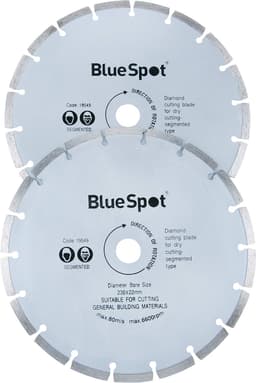
For a handful of slabs, the TopsTools TTDS230 at £8.99 is the lowest price, segmented, 4.6 from 263 reviews. It is a poor match for tile pavers. Named picks for other jobs are on the best 230mm diamond cutting disc page. Blue Spot’s twin at £15.10 is about £7.55 a disc, with 6,600 rpm, an EN 13236 mention, and 4.5 from 877 reviews. Slabs and block paving dominate the praise. One review says the discs buckled after two cuts in lightweight blocks. S&R at £15.49 states a 10 mm height and is 4.6 from 6,401, with 60 mm block paving in the sample. PRODIAMANT at £16.70 states a 7 mm segment and EN 13236, with 4.5 from 7,076, including a 50 square metre patio. The OX XLC15-230/22 at £15.24 states a 15 mm turbo segment and has no review line. For a visible sandstone edge, the segmented discs with large samples are the calmer default.

Dust in the garden, and when a grinder is the wrong saw

Cutting slabs outdoors still releases respirable crystalline silica. HSE’s limit is 0.1 mg/m³ over 8 hours. The controls are water, or an M-class or H-class extractor, plus respiratory protection at APF 20. Keep slurry wet, and do not dry-sweep it into a border. A block splitter suits dozens of straight breaks in concrete block. A wet saw bench suits many straight cuts in stone if you can contain the slurry. The 230 mm grinder remains the tool for a notch and a one-off slab. Rim shape is on segmented vs turbo diamond blade.

Common questions

Segmented or turbo for Indian sandstone?
Start with a segmented rim if the arris will show. The Bosch universal sample includes Indian stone without a reported chip, on a small file. A turbo rim is the more aggressive edge, and the OX 15 mm turbo has no UK reviews here, so the finish is unreported. Choose turbo when speed matters more than a clean corner, and keep the cut light either way.
How do I avoid blowing out the corner?
Support both sides of the cut on sand, and put a short relief cut in at the corner before the long run. Let the disc work at its own pace. Twisting out of a tight kerf tears the face of a slab. If the waste can fall, it will pinch the rim and the corner goes with it. A second person on the offcut is often the whole fix.
Should a patio cut be wet or dry?
Wet is the better dust control on a garden job. HSE still treats slab and block cutting as silica work: water or extraction, plus respiratory protection at APF 20. Many discs are labelled wet or dry, including DeWalt’s. Dry is a product permission, and it still puts a plume toward next door. Keep the slurry wet rather than brushing it up.
Is a cheap disc enough for six slabs?
Six slabs is a short job, which is the use named for the TopsTools at £8.99. That file also includes a chunk leaving the rim after three thin pavers, so check the rim after each slab. Tech Traders at £9.99 has Indian sandstone in the praise and a review of teeth leaving a block-paving block. For six block pavers, Blue Spot’s twin pack gives you a spare and a much larger review sample.
When is a splitter or a saw bench the better tool?
Use a block splitter for lots of straight breaks in concrete block. Use a wet saw bench when you have many straight cuts in stone and you can manage the slurry. Keep the 230 mm grinder for notches and a small number of slabs. Hand the job on when the concrete is structural, the disc has already shed a segment, or you cannot keep people out of the dust.

Related pages

Sources

Sources taken from the research digest. Listings were checked on 19.10.2026.

  1. HSE — Scabbling or grinding (retrieved 19.10.2026)
  2. HSE — CIS54 Respirable crystalline silica (retrieved 19.10.2026)
  3. HSE — CN6 Cutting paving and kerbs (retrieved 19.10.2026)
  4. HSE — CN2 Chasing with hand-held tools (retrieved 19.10.2026)
  5. HSE — HSG17 Safety in the use of abrasive wheels (retrieved 19.10.2026)
  6. FEPA — Diamond saws on angle grinders (retrieved 19.10.2026)
  7. Norton UK — Segmented versus continuous diamond blades (retrieved 19.10.2026)
  8. Bosch Professional UK — 2608602397 turbo disc (retrieved 19.10.2026)